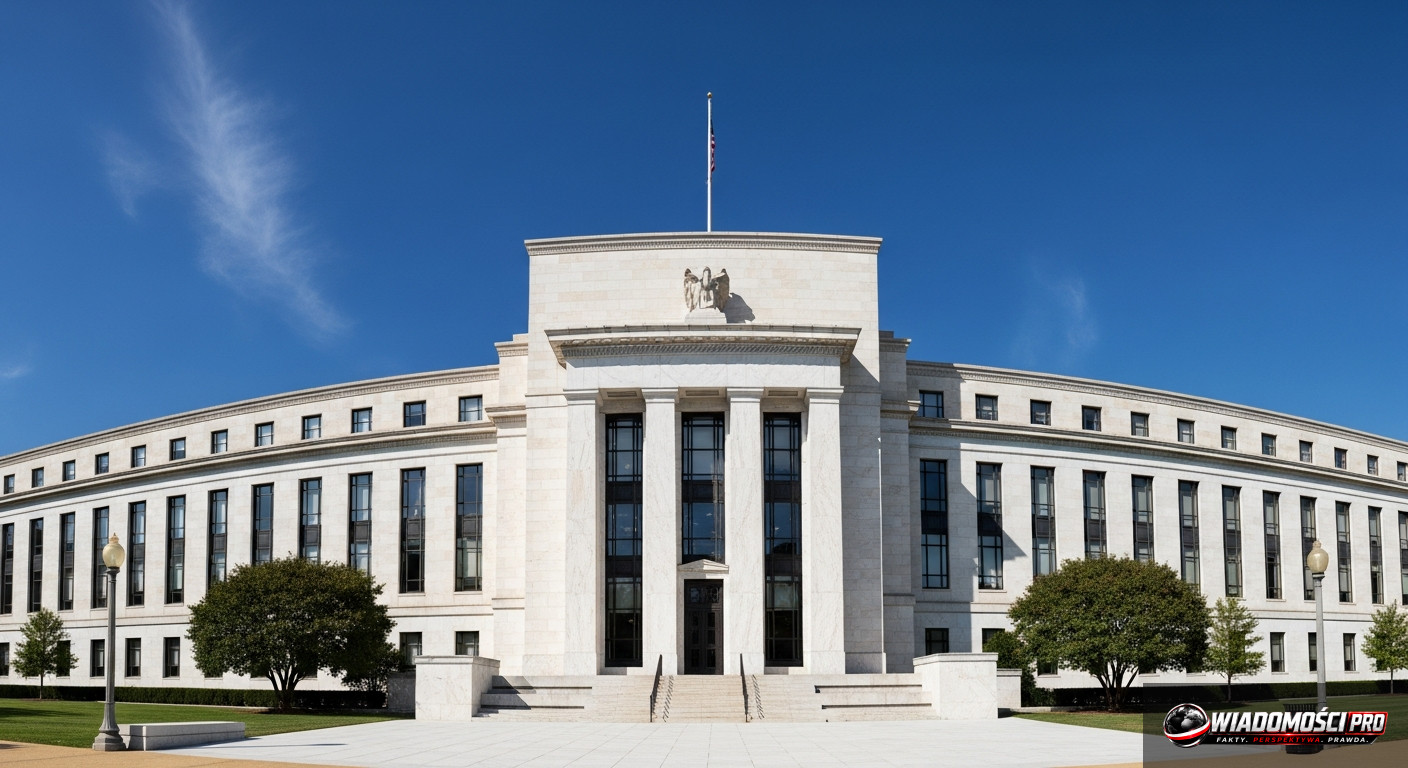
The rate cut to the 4.75-5.00% range does not signal the end of the fight against inflation, but rather a strategic shift toward supporting a slowing economy despite still-worrying price data. This is a precautionary decision, stemming from concerns about the health of the labor market and GDP dynamics, rather than a conviction that price pressure has been permanently extinguished. The FOMC committee has opted to protect growth, consciously risking the entrenchment of higher inflation in the long term.
Decision mechanics: Why 50 basis points?
The Federal Reserve decided on a move that electrified financial markets in September 2025. The 50-basis-point rate cut was not merely a technical adjustment, but a clear signal of shifting priorities. Policymakers in Washington, after months of maintaining restrictive policy, concluded that continuing with a high cost of money was beginning to genuinely threaten economic stability. Analyses published by Business Insider Polska and Strefa Inwestorów indicate that the American central bank faced a difficult choice. On one hand, data on inflation, which refused to return to the target permanently, continued to arrive. On the other, the labor market began sending warning signals, suggesting that the economy was losing momentum faster than originally assumed.
Jerome Powell and the members of the FOMC have changed their weaponry. Instead of continuing an aggressive fight against prices, they have opted to try and avoid a recession. This approach forces investors to change their perspective. The mechanics of this decision were not based on optimism regarding falling prices, but on fear of the negative effects of high rates on business. Companies that have struggled with drastically higher debt service costs over the last few years have received a signal that the Fed recognizes their problems. However, this breathing room for businesses comes at a price. Every move downward in such an unstable inflationary environment increases the risk of an error that could turn against the policymakers themselves in future quarters.
Analyzing reports from September 2025, it is clear that the bond market did not react with the enthusiasm one might expect from such a significant move. Investors, instead of buying debt en masse, began calculating the risk. They understood that the central bank had not declared victory in the fight against inflation. It merely changed the time horizon of its actions, shifting the weight of responsibility from fighting high prices to maintaining economic activity. This is a maneuver calculated for time, not for a permanent change in the price trend.
Inflation vs. Economy: The dilemma of American policymakers
The situation the Federal Reserve finds itself in is a textbook example of a monetary dilemma. On one hand, we have inflation readings that still cause concern, especially in the services sector. On the other, data from the real economy points to a cooling. The decision to cut rates to the 4.75-5.00% level is an attempt at a "soft landing." The Fed is counting on the economy avoiding a hard stop, and on inflation slowly fading under the influence of external factors, even if rates are slightly lower.
The problem is that such a strategy is fraught with a huge risk of error. If inflation "detaches" from expectations, the Fed will have to raise rates again, which would be an image and economic catastrophe. Investors who, after September 2025, were counting on a series of quick cuts were quickly brought back to earth. Communications coming from FOMC meetings in subsequent months became more enigmatic. Instead of the announced path of easing, warnings appeared about the need to remain vigilant regarding data coming from the labor market and the consumer sector.
It is worth noting that the fight against inflation has ceased to be linear. It has become a process in which every basis point is a subject of dispute within the committee. Jerome Powell has repeatedly emphasized that decisions will be made "meeting by meeting." This means a lack of a long-term strategy, which is an environment difficult to price for financial markets. Capital does not like uncertainty, and Fed policy in recent months is based on exactly that. Policymakers are trying to satisfy two sides: markets that expect cheap money, and consumers who expect price stability in stores. Reconciling these two interests is, in practice, impossible without incurring costs.

Reaction of financial and bond markets
The bond market is the harshest judge of monetary policy. According to data from March 2026, the yield on US Treasuries exceeded 4.3%. This is a level that, for many analysts, is a signal that the market is not buying the narrative of an easy victory over inflation. Bond investors are pricing in the risk that rates in the US will remain at an elevated level much longer than the original September scenario assumed.
Bond yields are a mirror of inflation expectations. If they exceed 4.3%, it means that capital is demanding a higher risk premium for holding debt in an environment where inflation may prove more persistent than the Fed predicted. This, in turn, translates into real financing costs for the economy. Even if Fed rates have fallen to 4.75-5.00%, the debt market itself is correcting financial conditions, keeping them at a level that does not favor cheap loans for consumers or businesses.
For individual and institutional investors, this situation means that traditional strategies based on Treasury bonds as a safe haven have lost their effectiveness. The rise in yields above 4.3% in March 2026 is proof that the market is pricing in the "stickiness" of inflation. Investors are forced to look for alternatives, which increases volatility on stock exchanges. This phenomenon shows that it is not enough to look at official Fed communications. One must observe what the big players in the bond market are doing. If they do not believe in quick cuts, then an investment portfolio should be built on the assumption that money will remain expensive for the foreseeable future.
Global context: Europe vs. USA
In September 2025, when the Fed announced the rate cut, the European Central Bank (ECB) adopted a completely different strategy. Analizy.pl indicated that the ECB kept rates unchanged, ignoring pressure to ease policy. This divergence between Washington and Frankfurt is key to understanding global capital flows. The US opted to save growth at any cost, while Europe remained faithful to its conservative line, prioritizing price stability over economic stimulation.
Such a gap in monetary policy does not remain without influence on currency exchange rates. The dollar, despite the rate cut, remains strong relative to the euro, which results from the difference in asset yields. Global investors began moving funds where rates remain high, which further complicates the situation in the eurozone, which is struggling with stagnation. Europe, by keeping rates at a high level, risks a deeper recession, while the US, by lowering them, risks the return of inflation.
The lack of synchronization between the two most important central banks in the world is an unprecedented situation in recent years. Previously, monetary policy in the West was largely correlated. Now we see two different models for dealing with the cost-of-living crisis. For an investor, this means that a portfolio must be geographically diversified to minimize the risk resulting from differing monetary decisions. If the US begins to struggle with a renewed rise in prices, and Europe plunges into recession, capital will look for a third way, which could lead to violent movements in commodity or precious metal markets.

Forecasts for the second half of 2026
Expectations regarding Fed policy for the second half of 2026 have evolved. Instead of belief in a quick return to a "cheap dollar" policy, the market is currently pricing in a stabilization scenario. After March 2026, when bond yields exceeded 4.3%, it became clear that the Fed would have to act extremely cautiously. Every subsequent move downward will be analyzed through the prism of inflation data, which – as recent months show – does not intend to disappear without a fight.
Forecasts indicate that interest rates in the US will remain in the current range for a longer period. Fed policymakers have understood that easing too early could be a mistake that cannot be fixed. On the other hand, the American economy is showing some signs of resilience, which gives the central bank room to maneuver. Investors should prepare for a period of increased volatility, in which every speech by Jerome Powell will trigger reactions in stock and bond markets.
In the coming months, data from the labor market will be key. If unemployment begins to rise sharply, the Fed will be forced to make further cuts, even with higher inflation. However, if the labor market remains strong, the central bank will likely maintain the current level of rates so as not to add fuel to the inflationary fire. This uncertainty regarding the Fed's path makes forecasting the results of publicly traded companies a task with a high degree of difficulty.
What does this decision mean for an investor's portfolio?
For an individual investor, the rate cut to the 4.75-5.00% level is a signal that the days of easy profits from bonds are over. The portfolio must now be more selective. Companies with weak balance sheets that based their growth on cheap credit will have a huge problem with financing. In turn, companies with a strong cash position and low debt may become beneficiaries of the current environment, as higher interest rates (compared to the zero era) still reward those who possess capital.
Stock investors should focus on companies that have the ability to pass costs on to consumers. In an environment where inflation still causes concern, the ability to protect margins is the most important asset. Shares of companies in the consumer staples or utilities sectors may prove to be a safer choice than speculative gains in the technology sector, which is exceptionally sensitive to changes in bond yields.
One cannot ignore the impact of the dollar on investment results. A strong US currency, resulting from differences in monetary policy relative to the ECB, acts negatively on exporting companies. For a portfolio, this means the need to hedge currency positions or invest in entities that generate revenue mainly in the American market. False hopes for a quick return to a cheap money policy may be the most expensive trap for an investor in 2026.
What this means for you
The Fed's decision is a signal to the market that the era of free capital has definitively ended, even though the cost of money has fallen slightly. For you, it primarily means the need to re-evaluate your saving and investment strategy. Dollar deposits no longer bring the same profits as a year earlier, and bonds require more careful risk analysis due to still-high market yields. The catch remains inflation, which, despite the central bank's actions, still exerts pressure on the purchasing power of your savings. The security of your portfolio in the coming months will depend on your resistance to volatility and your ability to select assets in an environment where the Fed no longer guarantees continuous support for the markets.
Questions and answers
Will rates in the US fall again this year?
Signals coming from FOMC meetings suggest stabilization instead. Policymakers prefer to hold off on further moves to assess how the economy absorbs the cut to the 4.75-5.00% level. The market currently is not pricing in an aggressive pace of further cuts.
How does the Fed's decision affect the dollar exchange rate?
A rate cut usually weakens a currency, however, the strong divergence of monetary policy between the Fed and the ECB makes the dollar remain relatively strong. Investors take into account the fact that rates in the US still remain significantly higher than in Europe, which maintains interest in the American currency.
Is inflation in the US already under control?
Despite the rate cut, financial institutions indicate that inflation still causes concern. Price data does not show a downward trend that would allow the central bank to declare victory. This remains a key challenge for the FOMC in the coming quarters.
Why did the bond market react this way?
Bond yields exceeding 4.3% in March 2026 are proof that the market does not believe in a permanent drop in inflation. Investors fear that the Fed will be forced to maintain restrictive financial conditions longer than the optimistic forecasts from the fall of 2025 assumed.
Is this the end of the fight against inflation?
No. This is merely a change in tactics. The Fed has shifted the center of gravity from fighting inflation to protecting economic growth, which is an admission that the US economy is in a phase of slowdown that required a reaction in the form of cheaper money. The fight against prices is still ongoing, but it is now being conducted in a more limited scope.
Sources
- Trump got his way. The Fed has resumed its interest rate cut cycle - Bankier.pl
- The Fed holds its breath. The market expects interest rate stabilization in the US - Money.pl
- Why the Fed cut interest rates even though inflation in the US still causes concern - Business Insider Polska
- The FED will decide on interest rates today. What decision will the FOMC make? - Strefa Inwestorów
- Rates in the eurozone unchanged for the second time in a row - Analizy.pl
- The Fed cuts rates for the first time this year. What will the effects be? - Subiektywnie o finansach
- Half the world was waiting for this decision. The Fed indicated interest rates in the US - Money.pl
- The Fed signals a halt to interest rate cuts, and US bond yields exceed 4.3%. - Vietnam.vn
Article prepared by the Wiadomości PRO editorial team with the support of artificial intelligence. Facts come from the sources listed above.


Komentarze (0)
Ładowanie komentarzy...