
In the second quarter of 2026, the Orlen Group generated a net profit of PLN 14.2 billion, which is double the result achieved in the same period last year. The government, at a Council of Ministers meeting scheduled for September 15, 2026, is processing a draft law on a tax on extraordinary profits (windfall tax), which, if it comes into force, will reduce the company's budget by PLN 6 billion. This result is a direct effect of maintaining the refining margin at USD 18.5 per barrel while fully utilizing the refining capacities in Płock and Gdańsk.
Orlen's financial success in Q2 2026 is not a matter of chance, but the result of brutal cost optimization and the exploitation of a supply gap in the finished fuel market. While European refineries struggled with raw material shortages, the Płock-based concern kept its installations at 102 percent of nominal processing capacity. This approach allowed for the processing of crude oil contracted under long-term agreements, the prices of which were significantly lower than current quotations on the London or New York stock exchanges. The difference between the cost of the input and the selling price of finished products, such as diesel or 95-octane gasoline, generated a margin that had no precedent in the company's history.
Investors observing Orlen's results point to a comparison with giants such as Shell or BP. In the same period, Shell recorded a 174 percent increase in margins in the refining segment, which confirms that we are dealing with a global trend, not a local phenomenon. The difference, however, lies in the cost structure. Thanks to the merger with Lotos and PGNiG, Orlen gained a unique ability to mix different types of crude oil, which in Q2 2026 became a bargaining chip in the face of Brent crude price fluctuations caused by the Iranian crisis.
The Ministry of Finance, while preparing the draft windfall tax law for September, is based on a simple fiscal assumption: profits exceeding the average from 2021–2025 are a location rent, not the result of innovation. The Ministry assumes that collecting PLN 6 billion will not stifle investment, but will allow for the transfer of funds to the budget in the face of rising defense and energy expenditures. For stock market analysts, such as those at XTB, this is a signal to revise recommendations. If the tax is introduced in the proposed form, Orlen will have to limit spending on hydrogen projects and the development of an electric vehicle charging station network.

Operating refineries at 102 percent of processing capacity is balancing on the edge of technical safety. Every hour of a longer installation operating cycle without maintenance downtime increases the risk of failure, which, in conditions of high fuel prices, could cost the company billions of zlotys in lost benefits. In its periodic reports, Orlen's management emphasizes that maintaining such high efficiency was possible thanks to the implementation of digital raw material flow management systems. However, this is a short-term solution. The market is asking the question: what will happen when the installations, after such intensive operation, undergo mandatory technical inspections in Q3 and Q4 2026?
The fuel market in Q2 2026 became a hostage to the situation in the Persian Gulf. Restrictions on oil supplies from Iran affected the global price index, forcing refineries to look for alternative suppliers. Thanks to contracts with suppliers from Norway and Saudi Arabia, Orlen avoided the supply paralysis that affected smaller players in the Central and Eastern European region. This logistical advantage translated directly into the financial result, but at the same time became fuel for proponents of taxing the company. Politicians argue that the record profits of a state-owned company should support consumers, while the company maintains that this capital is necessary to maintain Poland's energy security.
Orlen's dividend policy is currently the biggest unknown for individual shareholders. In the face of the windfall tax announcement, the management must show exceptional caution. Paying a dividend at the level expected by the market, i.e., above PLN 4 per share, while simultaneously bearing a PLN 6 billion tax burden, could lead to a drain of cash from the company's coffers. Institutional investors, analyzing cash flow from Q2, note that Orlen has the funds, but their allocation will become a subject of dispute between the supervisory board and the Ministry of State Assets.
Technical analysis of stock quotes after the publication of Q2 2026 results indicates high volatility. The price opened higher, reacting to record profits, but quickly stabilized in anticipation of the details of the government's draft law. The market no longer values Orlen solely through the prism of operational efficiency, but increasingly through the prism of "regulatory risk." Every announcement from the Ministry of Finance after September 15 will cause sudden spikes in trading volume. Investors who remember earlier attempts to interfere in the energy market are showing increased distrust of the company's long-term forecasts.
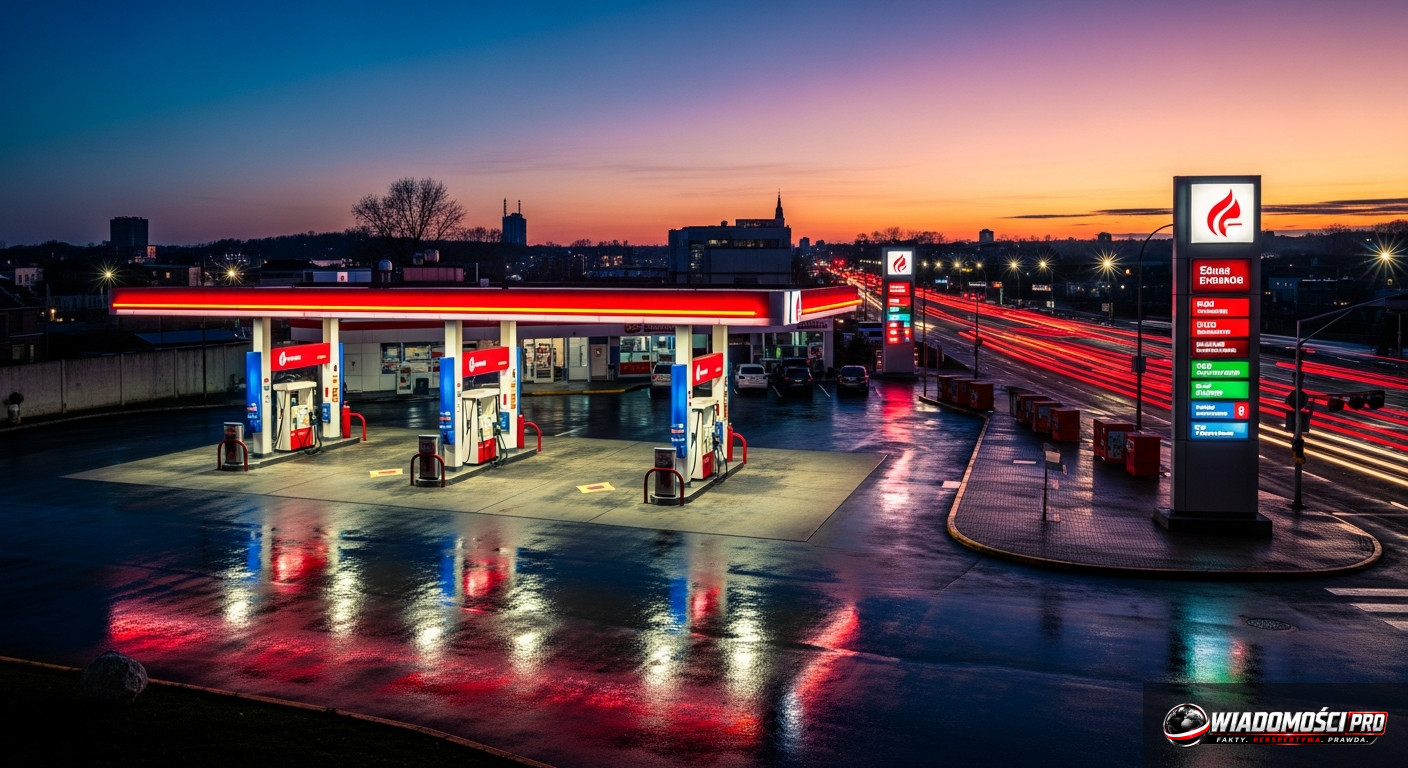
Prices at gas stations in the second quarter of 2026 remained at historically high levels, which for drivers is direct proof that refining margins are being "passed on" to the end user. Orlen argues that retail margins are separated from refining margins, but in economic practice, both of these values are connected vessels. Since the refinery is operating at full capacity and selling the product with a high margin, there is no economic justification for lowering prices at stations as long as demand in Europe exceeds the supply of finished fuels. This is a brutal economics lesson for consumers who were counting on rapid price drops.
It is worth noting how the merger and acquisition strategy, initiated in previous years, influenced the group's current resilience. Without the integration with Lotos and PGNiG, Orlen would not have been able to generate such high margins with such large fluctuations in the raw materials market. The scale of operations allows for arbitrage that smaller players cannot perform. This builds Orlen's position as a regional champion, but at the same time makes it a primary target for regulators. If the tax on extraordinary profits is introduced, Orlen will have to prove that it can manage such a scale of business even in conditions of limited profitability.
The outlook for the second half of 2026 depends on two factors: the sustainability of the refining margin above USD 15 per barrel and the final shape of the windfall tax law. If margins fall below USD 12, the government's arguments for taxation will lose strength, which may lead to a withdrawal from the project or its significant easing. However, with the current tensions in the Middle East, a downward scenario seems unlikely. The company must therefore prepare for a variant in which PLN 6 billion is permanently removed from the balance sheet for the state budget.
Competition in the form of BP, TotalEnergies, or Shell is also facing similar dilemmas in their home countries. In the UK or Italy, windfall taxes have been structured in such a way that they allow for the deduction of green energy investment expenditures from the tax base. Will the Polish government follow this path? The draft, which is to reach the Sejm in mid-September, does not yet contain clear provisions regarding investment tax credits. The lack of such mechanisms would be a serious blow to Orlen, limiting the concern's competitiveness against European rivals.

For analysts tracking Orlen's results, Q2 2026 is proof that the company has become a cash-generating machine, but the price of this success is high. Political risk has become part of operating costs. Investors must take into account that even with the best results, a "success tax" can wipe out shareholder profits. Orlen's management faces a challenge: how to maintain the pace of investment while simultaneously satisfying shareholders and government fiscal expectations? We will know the answer to this question after the publication of the third-quarter results, which will show whether high margins were maintained during the holiday season.
In summary, Orlen's situation is a mirror of the entire European energy sector. On one hand, we have record operational efficiency, and on the other, growing fiscal pressure caused by the geopolitical crisis. PLN 14.2 billion in net profit is a result that, under normal conditions, would be a reason for celebration. Today, it is the cause of a debate about the limits of state interference in the profits of publicly traded companies. Regardless of whether the PLN 6 billion tax is passed, Orlen's share price will remain under pressure until the situation in the Persian Gulf stabilizes and refining margins return to historical averages.
Questions and answers
How much exactly can the windfall tax take from Orlen's profits?
Estimates indicate that this tax could reduce the Orlen Group's finances by an amount reaching PLN 6 billion. This figure results from government estimates based on an analysis of excess refining margins generated under geopolitical crisis conditions.
Why were Orlen's profits in Q2 2026 so high?
The results were driven by record refining margins of USD 18.5 per barrel, resulting from a global imbalance between fuel supply and demand, exacerbated by the Iranian crisis. Refineries operating at over 100% of processing capacity used this spread to maximize net profit, reaching PLN 14.2 billion.
Are stock market investors afraid of the introduction of a new tax?
The market is reacting positively to the financial results, but regulatory uncertainty related to the specter of the windfall tax remains the main risk factor that dampens full optimism and affects the valuation of the company's shares by investment funds.
What is the government's main argument for introducing a tax on extraordinary profits?
Government argumentation focuses on the thesis that such high margins are not the result of innovation or better management, but the effect of external geopolitical conditions, and therefore these profits should in part serve to stabilize public finances.
Is Orlen the only company in this situation?
No, this is a global trend. Other giants, such as Shell or BP, are also recording record refining margins, which makes the issue of the windfall tax a subject of debate in many European countries, although legislative solutions in each of them may differ significantly in terms of investment protection.
What can drivers expect in the coming months?
Experts point to the stabilization of fuel prices at high levels. Even the introduction of a tax does not guarantee price cuts at stations, as retail margins are a derivative of global oil prices and processing costs, on which local taxes have a limited impact.
Sources
- Record results for Orlen. Will the government make a second attempt at the windfall tax? - Strefa Inwestorów
- Orlen shares at peaks after Q2 2026 results. What's next? - XTB.com
- Orlen shows profits and answers questions. How much did the Iranian crisis help it? - pb.pl
- Orlen, BP, Shell and other fuel market giants. This is how much they earned on expensive oil - Business Insider Polska
- Orlen results: What are investors waiting for? - XTB.com
- Not just Orlen. Analysts point to companies that may gain from fuel price hikes - Strefa Biznesu
- Before Orlen's results: Shell's margin increased by 174 percent. Refineries operated at over 100 percent capacity - Bankier.pl
- Orlen doubled net profit. Windfall tax will take up to PLN 6 billion - edgp.gazetaprawna.pl
Article prepared by the Wiadomości PRO editorial team with the support of artificial intelligence. Facts come from the sources provided above.



Komentarze (0)
Ładowanie komentarzy...