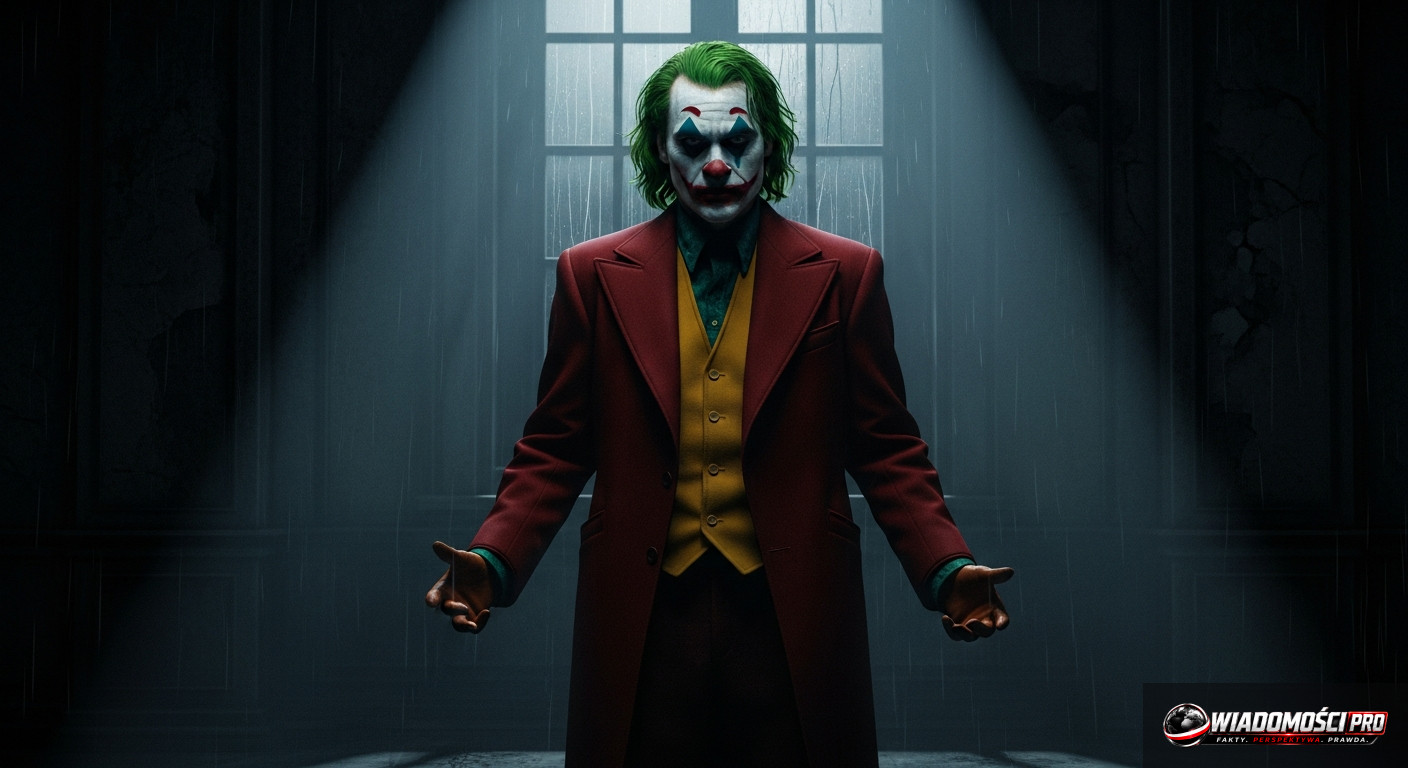
The film "Joker: Folie à Deux" earned only $40 million in the US during its opening weekend, and according to financial forecasts, Warner Bros. will lose over $150 million on this production. This result represents a drastic departure from the spectacular success of the first installment in 2019, which grossed over a billion dollars worldwide. For the Burbank-based studio, this is a signal that a strategy based on sequels to well-known brands has ceased to be a guarantee of profit in the face of changing cinema audience expectations.
Opening weekend: Disappointing numbers from American cinemas
Box office analysts tracking ticket sales noted that $40 million in the opening weekend places "Joker: Folie à Deux" well below any rational financial expectations of the studio. Early forecasts, though cautious, assumed a result at least twice as high. However, the reality proved brutal. The decline in interest in the production was visible as early as the first days of screening, which suggests that the marketing campaign did not translate into real conversion in cinemas.
For Warner Bros., this situation poses a challenge on a scale the studio has not faced regarding its main franchises in years. In the film industry, the opening weekend is the most important indicator of a project's health. A result of $40 million for a production with a budget of around $200 million (excluding marketing and distribution costs) means that the film will not recoup its financial outlays even under optimistic scenarios of long-term theatrical exploitation.
Industry media, such as Variety and Deadline, point to a drastic change in sentiment among the audience. The first "Joker" was a cultural phenomenon that combined the niche character of a psychological drama with comic book iconography. The sequel, despite the presence of Lady Gaga and the return of Joaquin Phoenix, failed to generate similar tension. Viewers, instead of waiting for the premiere, largely ignored the title, which is visible in the opening weekend ticket sales statistics.
The studio faced a fact that cannot be ignored. The American market, being the main source of revenue, sent a clear message. The lack of interest in the new vision of Gotham proposed by Todd Phillips reflects audience fatigue with a format that was fresh in the first installment but became derivative or simply incomprehensible to the mass audience in the sequel. Decision-makers at Warner Bros. had to quickly correct their financial models, which led to painful conclusions regarding the profitability of the entire brand.

Financial disaster: Why is the studio losing $150 million?
Financial forecasts indicate a loss exceeding $150 million. This amount results from a simple calculation: a production budget of approximately $200 million, to which marketing costs, global promotion, and profit participation (so-called backend deals) must be added. In the world of Hollywood, for a film to be considered profitable, it usually needs to earn about 2.5 times its production budget in theaters. In the case of "Joker: Folie à Deux," this threshold is unattainable.
Cost analysis shows that Warner Bros. invested significant funds in an advertising campaign, hoping that the status of the previous film would facilitate distribution. However, the opposite happened. Each subsequent day of theatrical screening only deepened the deficit, as the costs of keeping the film in the cinema repertoire exceeded the revenue generated by ticket sales. We are talking here about a real hole in the budget of the theatrical division, which will affect the quarterly results of the entire corporation.
The financial collapse of this production is particularly severe, as the studio had placed great hopes in it as a pillar of the autumn season. Instead of profits, Warner Bros. must now manage crisis communication around a project that has become synonymous with loss. The lack of box office success is not just an accounting issue; it is also a weakening of the negotiating position for future projects. Investors observe such situations with great attention because they show how quickly a budget of $200 million can turn into a liability rather than an asset.
The causes of this situation are multifaceted. Production costs in Hollywood have risen in recent years, which forces studios to plan more precisely. In the case of "Joker 2," the risk proved too great, and the lack of security in the form of strong viewer interest led to a situation where every dollar spent on promotion was a loss. The film industry calls this the "financial black hole" effect, where marketing outlays do not generate an appropriate return on investment but only increase the final deficit amount.
Joker 2 vs. The Market: Comparison with other productions
Comparing "Joker: Folie à Deux" with other projects that also failed to meet expectations puts the film in a very unfavorable light. Industry media often cite the example of "Morbius" as a reference point for productions that, despite the presence of well-known characters, failed to break through to wider awareness. The fact that "Joker 2" lost in a direct comparison with titles considered artistic mistakes is a slap in the face for Warner Bros.
The cinema market is ruthless. Viewers have less and less time and money, so film selection is based on reviews, social media opinions, and trailers. "Joker 2" did not pass this test. In comparison with productions that were successful in 2024, a clear disproportion is visible. While other hits attracted crowds to cinemas, the sequel to Arthur Fleck's adventures recorded attendance drops as early as the second week of screening. This phenomenon, which analysts call "short theatrical life," is deadly for financial results.
Moreover, the 2019 "Joker" was a unique product. The sequel, although it tried to refer to the aesthetics of its predecessor, did not offer viewers enough added value to justify another visit to the cinema. Compared to other franchises that still remain at the top, "Joker 2" looks like an experiment that did not meet with market interest. For box office analysts, these numbers are proof that even a brand with an established position is unable to survive without a strong, viewer-attracting concept.
The comparison with the results of "Morbius" is particularly painful. Sony's film, although mocked by critics, at one point in its distribution achieved better revenue indicators in relation to its costs than "Joker 2." This shows that even weaker productions can defend themselves at the box office if they hit the tastes of a specific group of recipients. "Joker 2," on the other hand, being a film with a different tone and pace, did not reach either comic book fans or musical drama fans, remaining in a vacuum between these two groups.

Warner Bros.' position on the results
Inside Warner Bros., the situation after the premiere was analyzed with great attention. The studio, initially avoiding explicit declarations, eventually had to admit that the film's financial result is a failure. In corporate jargon, this means that the project did not meet business assumptions and will not be the basis for further investments in this particular branch of the franchise. The lack of optimistic signals after the first weekend was a clear signal to the board that it was time to end the promotion and move to the phase of minimizing losses.
For Warner Bros. investors, this is a clear signal that the studio's strategy requires revision. In Hollywood, financial success is the fuel for subsequent productions. When it is missing, the whole machine begins to slow down. The studio is no longer trying to sugarcoat this reality. Instead of a narrative about artistic courage, we currently have a cold calculation of losses and drawing conclusions for the future. It is a lesson in humility that teaches that recognizable names are unable to save a project that raised doubts among decision-makers from the very beginning.
It is worth noting that in Hollywood, such a failure carries personal and structural consequences. Decisions about the budgets of subsequent projects will now be made with even greater caution. Every dollar allocated to a film with comic book roots will now be subjected to rigorous analysis. Warner Bros. cannot afford a repeat of such a scenario, which is why a more cautious approach to sequels that do not have guaranteed commercial potential can be expected.
This failure casts a shadow over the studio's future plans regarding the DC universe. Will anyone on the board draw conclusions from this before approving subsequent budgets? Certainly. Time will tell whether the studio decides to completely move away from risky experimentation with brands or perhaps change the profile of its productions to be more predictable. The balance sheet, however, is dramatic and constitutes one of the loudest lessons for the American film industry in recent years.
Analyst expectations vs. box office reality
Box office analysts who prepared their reports before the premiere did not foresee the scale of disappointment that "Joker: Folie à Deux" met with. Forecasts suggested a result that could approach the level of the first part, which in the context of the current state of the market was a very optimistic assumption. Reality, however, brutally verified these models, showing that even the most advanced algorithms are unable to predict the audience's reaction to such a controversial production.
The actual revenue of $40 million in the opening weekend was a shock to many observers. Following the history of the project since the announcement of work on it, it is clear that expectations were set very high. The production was supposed to be one of the financial pillars of the studio, but it became a symbol of financial disaster. According to available financial forecasts, Warner Bros. will lose over $150 million on this project. This is an amount that shifts the center of gravity in the studio's budget and forces a change in strategy for the coming months.
This is not just a matter of a failed marketing strategy. The problem turned out to be the very nature of the film, which missed what viewers expected from the "Joker" brand. Production and promotion costs, compared with such low receipts, create a financial black hole that cannot be filled with results from international markets. The market reacted quickly, and investors, who do not like uncertainty, began to withdraw from optimistic assumptions regarding future Warner Bros. projects.
The situation became so serious that industry media began to describe the film as one of the biggest disasters of the year. Comparisons to the poor results of other productions, such as those from the Sony or Marvel universes, further deepened the image crisis. Warner Bros. officially recognized the film as a failure, which in the case of such an expensive brand is a rare admission of error. For fans, this is the end of illusions; for the studio – a costly lesson in humility that will shape their decisions for years to come.
Impact on the future of the franchise
The financial failure of the film "Joker: Folie à Deux" calls into question any further development of this brand in its current form. The production, which earned only $40 million in the US on its opening weekend, proved to be a burden for Warner Bros. that will affect subsequent investment decisions. Financial forecasts are ruthless: the studio will lose over $150 million on this title. This is not a statistical error, but a powerful blow to the corporate strategy that assumed that it was enough to combine the name of a popular actor with a recognized brand to ensure profit.
The negative financial reception affects the studio's future investment decisions. The board in Burbank is already verifying its approach to sequels, which were previously treated almost as guaranteed sources of revenue. After results that turned out to be worse even than the "Morbius" criticized by fans, an atmosphere of waiting for safer projects has prevailed in the offices of Warner Bros. Investors do not like risk, and "Joker 2" has become a symbol of unnecessary waste of capital.
The contrast between this flop and the successes of other productions is stark. While large Disney animations or other franchises attract crowds and guarantee a stable stream of revenue, "Joker: Folie à Deux" remains in the memory of analysts as one of the biggest disasters of the year. For the brand, this means a long break. If Warner Bros. ever returns to this universe, it will have to show much greater caution. Every subsequent dollar spent on this world will now be examined from every side before it leaves the studio's safe.
Questions and answers
How much exactly did Joker 2 earn in the US at the start?
The film earned $40 million in its opening weekend, which is a result well below the expectations of analysts and the studio.
What are the estimated losses for Warner Bros.?
It is predicted that the film will bring the studio over $150 million in losses, taking into account production and marketing costs.
Was the result worse than other superhero films?
Yes, the film achieved worse financial results even than productions such as "Morbius," which is a significant image and financial problem for the studio.
Sources
- Joker 2 is a humorless joke at the box office. Results are even worse than assumed - Eurogamer.pl
- Box Office USA: Shocking debut of the film "Joker: Folie à Deux" - Filmweb
- "Joker 2" will lose over 150 million dollars. "One of the biggest disasters of the year" - naTemat.pl
- How much will Joker 2 earn in the opening weekend? Predicted result much worse than part 1 - naEKRANIE.pl
- Joker 2 lost even to Morbius. The worst Marvel and Sony films earned more - Gram.pl
- This is how much "Joker: Folie à deux" earned in its opening weekend! A big flop for the creators and cast? - Radio ESKA
- Box Office USA: Massacre of new releases. "Toy Story 5" is heading for a series record - Filmweb
- Opinions on Joker 2 are divided, but one thing we know for sure: Warner Bros. considers the film a failure - Eurogamer.pl
Article prepared by the Wiadomości PRO editorial team with the support of artificial intelligence. Facts come from the sources provided above.

Komentarze (0)
Ładowanie komentarzy...