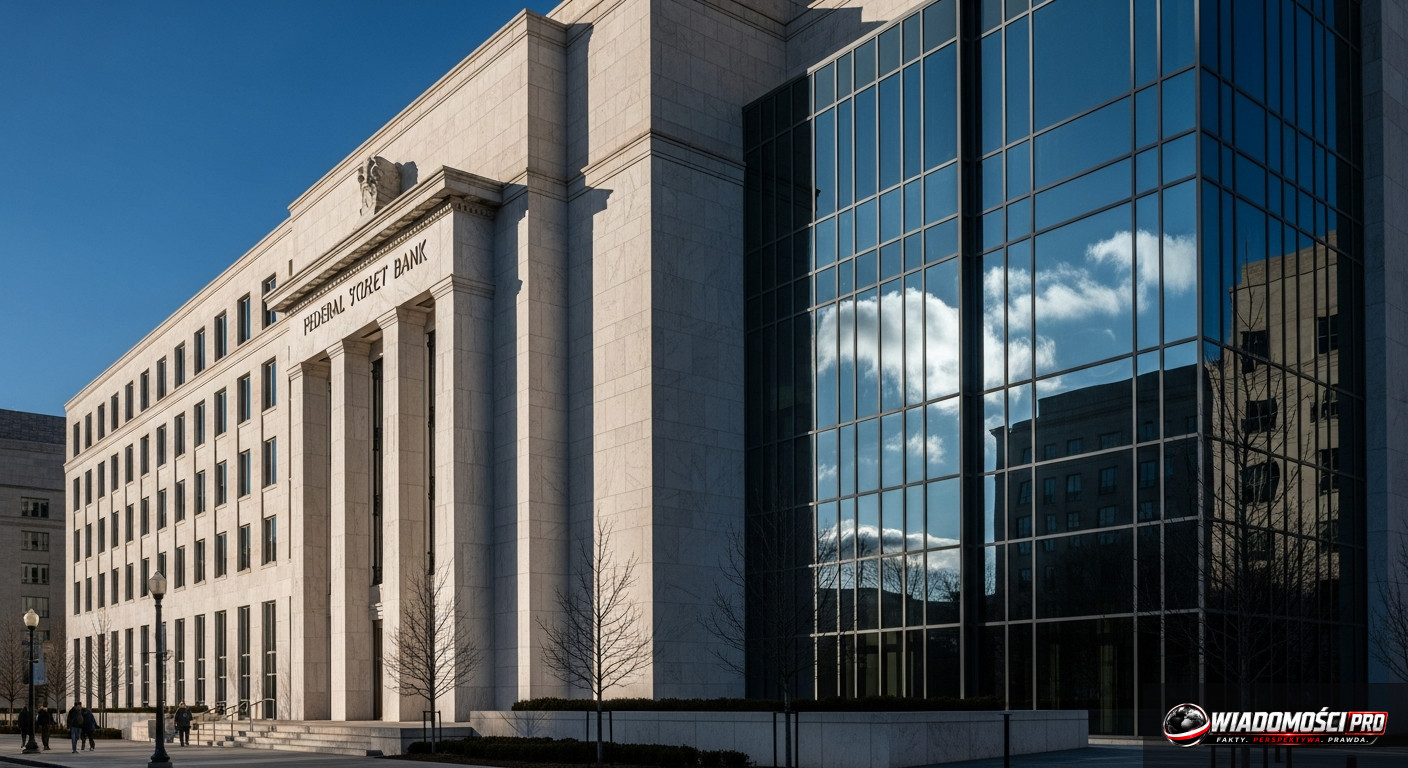
The Fed has kept interest rates unchanged, ignoring market signals that priced in an 80 percent probability of a hike in the face of inflation at its highest level since 1981. The decision was made on July 29, 2026, calling into question the effectiveness of the central bank's current strategy. Investors who were counting on a decisive tightening of monetary policy had to immediately re-evaluate their portfolios in the face of the greatest uncertainty in 32 years.
The decision by the Federal Open Market Committee (FOMC) from the last Wednesday of July marks a turning point for the American economy. For many weeks, the derivatives market suggested that Jerome Powell had no choice but to raise the cost of money. Inflation, the dynamics of which have not been seen since the crises of the 1980s, forced a tough stance from central bankers. Nevertheless, July 29 brought a pause, which for many analysts is a signal of weakness or deep concern about the condition of US GDP.
From the perspective of the average American borrower's portfolio, the lack of a rate hike is a double-edged sword. On one hand, variable-rate mortgage installments did not rise overnight, providing temporary relief to households. On the other hand, keeping rates at their current level with such high inflation means that real interest rates remain negative. Savings held in banks are losing value at a rate exceeding the gains from deposits. Commercial banks in the US, seeing the Fed's indecision, are under no pressure to raise interest rates on deposits, which further worsens the situation for those holding cash.
In the long term, the lack of a hike in such a heated economy could lead to the entrenchment of inflation expectations. If consumers and businesses conclude that the Fed is afraid to stifle inflation at the expense of growth, prices may rise even faster. In that case, the cost of credit – both mortgage and consumer – could rise in a way uncontrolled by the bond market, which will begin to demand higher yields for the risk of holding debt in an environment of unbridled price increases.

The US dollar exchange rate reacted to this decision in an unusual way. Instead of the expected sell-off that often follows "dovish" decisions, the dollar showed resilience. Against the euro, the EUR/USD rate is oscillating within ranges that suggest investors treat the dollar not only as a currency dependent on interest rates, but primarily as a safe haven in times of uncertainty. Since the world's most important central bank is unable to set a clear direction, international capital prefers to remain in the dollar, waiting for more concrete macroeconomic data.
For the currency market, this means that the predictability of Fed policy has become secondary to global chaos. However, if inflation in August and September shows that the price peak has not yet been reached, the dollar could come under strong pressure. Investors will begin to price in not only the lack of hikes, but indeed the Fed's inability to protect the value of the American currency from the erosion of purchasing power. Such a situation could lead to an outflow of capital from US Treasury bonds toward commodities or other hard assets.
Analyzing the reaction of investors, a clear division between speculative and institutional capital is visible. The former, focused on quick profit from interest rate differentials, was surprised by the lack of a hike. The losses of those positioning themselves for an increase in the cost of money are tangible. Hedge funds that built strategies based on the assumption that the Fed must react to 1981-level inflation had to close positions in an emergency. This generates additional volatility on stock exchanges, which hinders the rational valuation of stocks. Technology companies, extremely sensitive to the cost of debt financing, reacted to the Fed's decision with a short-term rebound, but remain on the defensive in the long term.
The uncertainty we have been struggling with for 32 years is not just a matter of numbers. It is a lack of belief that policymakers have full control over the economic mechanism. In 1981, the then-head of the Fed, Paul Volcker, did not hesitate to radically raise rates, which led to a painful but effective recession. Today's Fed, under the leadership of Jerome Powell, seems more interested in avoiding a hard landing. This difference in approach is crucial. The financial market sensed this hesitation and reacted with a lack of trust in future central bank communications.
From the perspective of global supply chains and investments, the lack of changes in interest rates means maintaining the status quo in operating costs. Companies do not know whether they should expect more expensive money in the next quarter, or perhaps the Fed will maintain the current course for a longer period. Such uncertainty freezes decisions on new capital investments. Corporate boards prefer to hold cash rather than risk expansion under unclear monetary policy. This, in turn, translates into slower productivity growth and an even greater risk of stagflation.
It is worth paying attention to forecasts for mortgages in the USA. The interest rate on 30-year loans, which is a benchmark for the American real estate market, has been in an upward trend in recent months, following the yields of ten-year bonds. The Fed's decision to keep rates unchanged does not mean that mortgage interest rates will fall. On the contrary, if the market decides that inflation will remain high despite the lack of hikes, bond yields may rise, dragging mortgage costs along with them. For the average American, this means that even with unchanged main rates, the cost of buying a home may continue to rise.
Expectations for September and October are already becoming the main topic of discussion in brokerage houses. If the Fed does not show decisiveness in the near future, the market will begin to price in a scenario in which the central bank has lost its room for maneuver. This would be the worst possible signal for the dollar. The US currency could then lose its status as the main reserve asset, which in the long term would be devastating for American imports, making them significantly more expensive for consumers.
The Fed's dilemma is visible in every word of the July 29 statement. On one hand, the necessity of fighting inflation, which is draining citizens' real income. On the other, the fear of a recession, which in conditions of high national debt could trigger a fiscal crisis. This is not a zero-sum game. It is an attempt to survive in a system that has been stimulated by cheap money for years and now must face the reality of high energy and commodity prices.
For the individual investor, the most important conclusion is the necessity of diversification. If the central bank does not guarantee price stability, the only way to protect capital is to own assets that have historically performed well in an inflationary environment. Gold, selected commodities, and shares of companies with strong pricing power are becoming safer havens than Treasury bonds, which in the current situation do not offer real protection against inflation.
It should be emphasized that the current situation differs from the crises of the last decade. Back then, central banks had a margin for error. Currently, with inflation at 1981 levels, every decision-making error costs significantly more. The Fed cannot afford to wait too long. If macroeconomic data for August show that the momentum of price growth is not weakening, the pressure for a hike in the following months will be even greater. In that case, the market may react much more sharply than during the last meeting.

The impact of the Fed's decision on emerging markets cannot be ignored. Many of these economies are heavily dependent on the dollar. Maintaining high rates in the USA while lacking clear communication causes capital to flee emerging markets toward American assets, which weakens local currencies and increases the debt of these countries. For global investors, this is a signal that systemic risk in developing countries is growing, and liquidity in these markets may be limited in the coming months.
In summary, the Fed's decision on July 29 is a signal that central bankers are on the defensive. Instead of shaping economic reality, they are trying to keep up with it, which in conditions of such high inflation is an extremely risky strategy. Will Jerome Powell manage to regain control over inflation expectations? We will only know the answer to this question after the publication of subsequent labor market reports and consumer price data. Until then, the market will remain in a state of suspension, and every communication from Washington will be analyzed for signs of panic or confusion.
For the financial market observer, it is crucial to monitor not only the rates themselves but primarily the yields of long-term bonds. These are the true thermometer of sentiment and inflation expectations. If the yield curve continues to flatten, it may mean that the market fears a recession more than inflation. In such an environment, traditional investment models stop working, and investors must demonstrate great flexibility.
It cannot be denied that the American consumer is currently the biggest victim of this state of affairs. Their purchasing power is shrinking, and hopes for cheap credit have been deferred. The Fed, trying to balance between inflation and growth, has risked the institution's credibility. Was it the right decision? Time will tell. For now, however, we remain in a world where interest rates in the USA are no longer an anchor of stability, but a source of uncertainty that we must learn to live with.
Questions and answers:
Did the Fed raise interest rates in July 2026?
No, despite market expectations, the US central bank decided to keep rates at an unchanged level.
Why is inflation in the USA from 1981 a point of reference?
It is a period in which inflation in the USA reached extremely high levels, which forces current monetary authorities to make comparisons with that historically difficult era for the economy.
What is the probability of further interest rate changes?
Before the July decision, the market priced in an 80% chance of a hike. The lack of this move means that investors must revise their assumptions about subsequent meetings, and uncertainty about the Fed's future steps is currently the highest in over three decades.
What does the lack of a hike mean for borrowers in the USA?
The lack of a hike provides temporary stabilization of variable-rate loan installments, but at the same time, it entrenches an environment of high prices, which in the long term could lead to an increase in market financing costs, regardless of the Fed's decision.
What impact does this decision have on the dollar exchange rate?
The dollar showed resilience, maintaining its position despite the lack of a hawkish move, which results from the perception of the American currency as a safe haven in times of global economic uncertainty.
Will the Fed's decision affect emerging markets?
Yes, maintaining the current policy in the USA favors the outflow of capital from emerging markets toward the dollar, which weakens local currencies and increases debt servicing costs in developing countries.
What should investors expect in the coming months?
The market will closely follow inflation data and labor market reports, which will determine the Fed's decisions at the meetings in September and October. Any negative inflation reading could trigger a sharp reaction in stock and bond markets.
Why is the current uncertainty compared to the situation from 32 years ago?
The scale of the dilemmas facing the Fed – the choice between fighting high inflation and avoiding a recession – has reached a level that analysts consider the most complex and unpredictable in over three decades.
Sources
- Interest rates in the USA. There is a Fed decision - Money.pl
- New Fed head does not change course. There is a decision on interest rates - Business Insider Polska
- Interest rates in the USA. There is a key Fed decision - Interia Biznes
- ING Daily: Limited positive market reaction to the US-Iran agreement. BoJ, Fed, BoE decisions this week. Today details of domestic inflation for May. - ING Economic Service
- There is a Fed decision! The greatest uncertainty in 32 years. How much will interest rates be in the USA - FXMAG
- Interest rates in the USA under the microscope. One move could surprise the market - Business Insider Polska
- Fed did not change rates, but the market sees an 80% chance of a hike – the dollar may gain - Direct Money
- Fed slows down interest rate cuts due to inflation. A new decision has been announced - Interia Biznes
Article prepared by the Wiadomości PRO editorial team with the support of artificial intelligence. Facts come from the sources listed above.


Komentarze (0)
Ładowanie komentarzy...