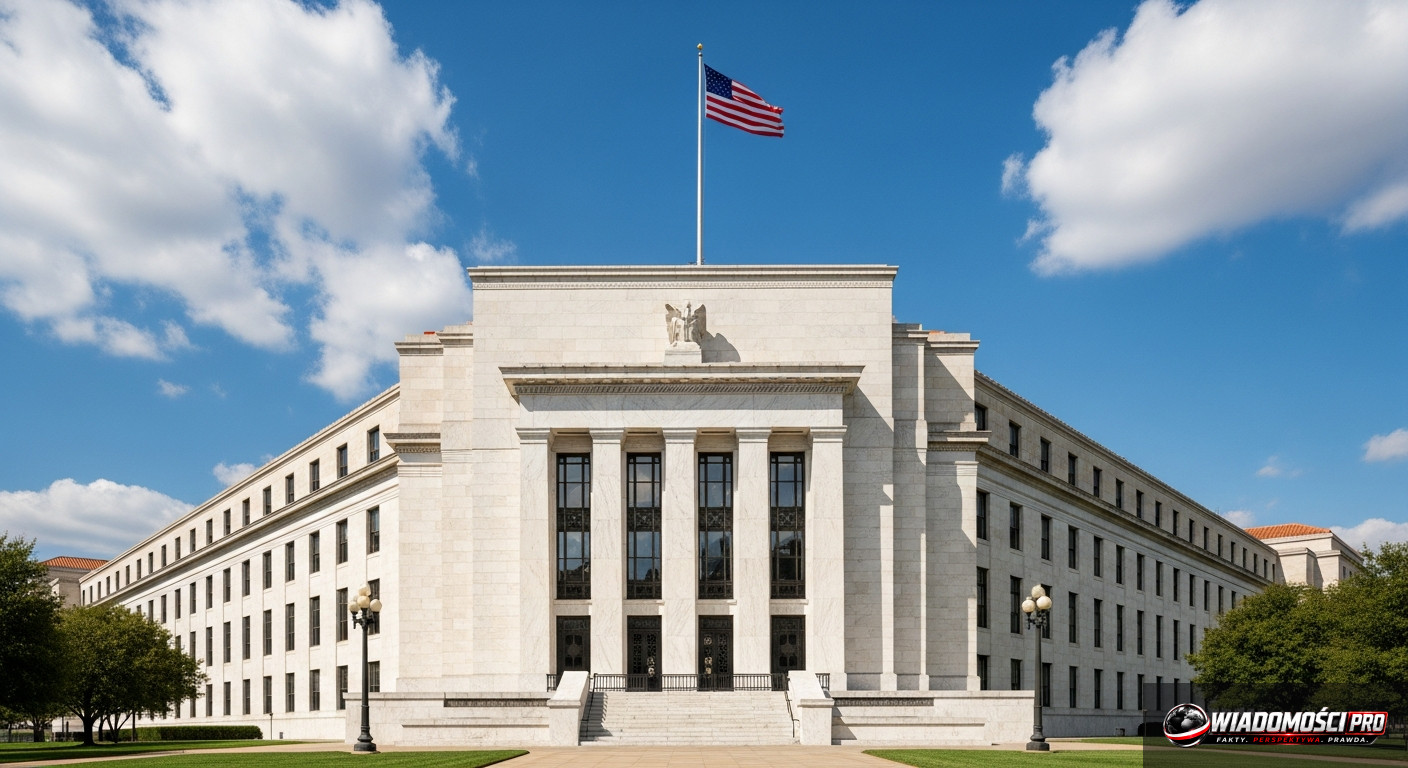
The interest rate cut by the Federal Reserve by 50 basis points to a range of 4.75–5.00 percent means a direct decrease in mortgage interest rates in the US and cheaper access to capital for companies, which may trigger a wave of optimism in global stock markets. For Polish borrowers, this move is a signal of the zloty strengthening against the dollar, which lowers the costs of importing goods and may exert pressure on the stabilization of fuel and electronics prices. At the same time, investors with exposure to US bonds will see an increase in their valuations, which forces a revision of strategies in the face of the upcoming monetary easing cycle.
A breakthrough FOMC decision: 50 basis points down
The Federal Open Market Committee (FOMC) has officially begun a cycle of monetary easing in the United States. The decision to cut by 50 basis points was not merely a technical adjustment, but a clear signal that the US central bank is prioritizing the protection of the labor market from excessive cooling. Jerome Powell, Chair of the Fed, indicated in his statement that confidence in inflation returning to the two-percent target has increased, which allowed for a bolder move than the standard 25 basis points.
For the US economy, this means a change in the financing paradigm. High interest rates, maintained over the last few quarters, acted as a safety brake, stifling corporate investment and increasing the costs of servicing consumer debt. Now that the cost of money is falling, commercial banks will begin to adjust their credit offers. First in line for cuts are products linked to the reference rate, including credit lines for businesses and variable-rate mortgages.
The US labor market became the main argument for the "dovish" part of the committee. Data on employment growth and the unemployment rate showed that the economy is losing momentum faster than initially assumed. The Fed did not want to wait until recessionary indicators became irreversible. Choosing such a strong cut is an attempt at a "soft landing," in which inflation falls but the economy avoids a deep collapse. For investors, it is a signal that the Fed is taking the helm to prevent uncontrolled unemployment growth.

Why now? Analysis of inflationary factors
The Fed's decision to cut rates came at a time when inflation indicators ceased to be the main bogeyman, and concerns about the stability of GDP growth came to the fore. For a long time, the Fed argued that "higher rates for longer" were necessary to root out wage pressure. However, the dynamics of consumer goods and services prices in the US began to show signs of a lasting slowdown.
Jerome Powell had to face the question of whether monetary policy had become too restrictive. Maintaining rates above 5 percent in the face of weakening readings from the manufacturing and service sectors threatened to trigger an unnecessary crisis. FOMC policymakers concluded that the current level of rates is inadequate to inflation expectations for the next 12 months.
A move of 50 basis points is also an attempt to regain the initiative. Previously, the Fed was criticized for reacting too late to inflation in 2022. Now the committee wants to show that it can act proactively. However, if inflation unexpectedly rebounds, the central bank will find itself in a difficult position. It would then have to either pause the easing cycle, which would destabilize markets, or risk losing credibility in the fight for price stability. Each passing month will bring new labor market data that will determine the scale of further cuts. The current strategy is balancing on a tightrope between avoiding a recession and avoiding re-igniting the fires of inflation.
The market in a new reality: Stock and currency reactions
Capital in financial markets reacted immediately to the Federal Reserve's change in stance. US stock markets reacted with gains, especially in the technology and real estate sectors, which suffered the most from high debt service costs. Investors who had previously kept cash in safe deposits are now frantically looking for alternatives with a higher rate of return, which is fueling a bull market in stocks.
The yield on US Treasury bonds fell, which is a natural reaction to expectations of lower rates in the future. Bonds, which until recently offered record returns, are becoming less attractive to new buyers, causing their market prices to rise. For an investor's portfolio, this is a critical moment. The change in Fed policy forces a revaluation of the entire asset portfolio.
The US dollar has lost value against the world's major currencies. This is a classic market reaction: when interest rates in a given country fall, the attractiveness of that currency decreases because capital flows out in search of higher interest rates in other jurisdictions. For American exporters, this is good news because their products become cheaper abroad. However, for the American consumer, it means an increase in the prices of imported goods.
Global investors are now watching how long the Fed intends to continue this cycle. If 50 basis points is just the beginning, the bond market could enter a phase of a long-term bull market. However, if the US economy shows unexpected resilience and inflation begins to rise again, the central bank will have to slow down. This means high volatility, which will accompany us over the coming months.

Borrowers and investors: Who will gain and who will lose?
The Fed's decision hits the foundations of financial planning for millions of people. Borrowers in the US with variable interest rates will soon feel relief in their monthly installments. This will release capital that can be directed toward consumption, which in turn will support US GDP.
On the other hand, savers are losing out. Bank deposits and short-term Treasury bonds offered attractive interest rates over the last year. That time is coming to an end. Deposit interest rates will gradually fall, forcing savers to move funds to the stock market or toward riskier financial instruments if they want to maintain the real value of their capital.
For Polish investors holding a portfolio in dollars, the Fed's decision is a signal for increased caution. The strengthening of the zloty, which results from the weakening of the dollar, means that assets denominated in the American currency lose value when converted to PLN. The profit from investments in American stocks may be "eaten" by an unfavorable exchange rate. Conversely, for companies importing components from the US, the drop in the dollar exchange rate is a real saving that can improve margins in Polish industry.
There are no winners without losers. Debtors and corporate bond issuers, who can roll over their debt more cheaply, gain. Those who counted on high, "maintenance-free" profits from safe monetary instruments lose. The market is entering a phase where selectivity will be rewarded, rather than blindly following the upward trend that dominated in the era of high rates.
USA vs Eurozone: Divergent monetary paths
The European Central Bank (ECB) is in a completely different position than the Fed. While a decision for a strong rate cut was made in Washington, Frankfurt is showing much more restraint. The Eurozone is struggling with structural problems, and inflation in individual member states is very uneven.
This divergence creates a unique situation in the currency market. Usually, when the Fed cuts rates and the ECB keeps them unchanged, the euro to dollar (EUR/USD) exchange rate should rise. Investors move capital to where rates are relatively higher. However, this puts European exporters in a difficult situation. A strong euro makes goods from Germany or France more expensive in global markets, which hits the competitiveness of European industry.
For Poland, which operates with its own currency, the situation is complex. On one hand, we are strongly linked to the Eurozone through trade. On the other, our monetary decisions must take into account what is happening across the ocean. If the Fed aggressively cuts rates and the ECB remains in place, the zloty may gain value against both of these currencies, which for the Polish consumer means cheaper fuel and electronics, but for Polish exports, it may be a burden.
Central banks in Central Europe, including the NBP, cannot ignore the moves in Washington. Every fluctuation in the zloty exchange rate affects domestic inflation through import prices. If the Fed "loosens" financial conditions in the world, the pressure on the Polish currency may bring both benefits (lower imported inflation) and challenges (loss of export competitiveness).
What next? Perspectives until the end of the year
The market is currently asking itself one question: how quickly will the Fed continue the cuts? Analysts expect that we will see at least one or two more downward moves by the end of the year, provided that labor market data does not deteriorate drastically. However, if unemployment begins to rise sharply, the Fed may decide on even faster cuts.
For investors, monthly CPI readings and labor market reports (the so-called payrolls) will be key. They will set the rhythm for subsequent FOMC meetings. One should not expect a return to the era of "free money" from 2020–2021. Interest rates will likely stabilize at a level that is neutral for the economy, which is significantly higher than zero.
The Polish economy will feel these changes with a delay. The most important transmission channel remains the zloty exchange rate. If US rates fall and the dollar weakens, the zloty has a chance for stabilization or strengthening. This is good news for people planning foreign vacations or purchasing imported equipment. At the same time, Polish borrowers should not count on the fact that decisions in the US will directly translate into installment cuts in Polish banks. Decisions of the Monetary Policy Council depend on local inflation, which is still higher than the NBP target.
The financial market does not like uncertainty, and current fluctuations are proof that central banks are looking for a new equilibrium point. Ending the tightening cycle is the first step, but the road to full economic stabilization is still long. Investors should prepare for volatility, which will be a constant element of the landscape until the US economy shows clear signs of lasting growth with stable prices.
What this means for you
For the average investor, the Fed's decision means a paradigm shift: cheaper capital favors the stock market but may weaken the dollar. Bondholders will see the biggest gain, while those saving in deposits must prepare for a gradual decline in interest rates. If you have a loan in a foreign currency, especially in dollars, now is the time to analyze currency risk. Conversely, for those planning purchases abroad or importing goods, the current situation may bring real savings in the coming months.
Questions and answers
Will the Fed rate cut directly affect my mortgage loans in Poland?
Not directly. Polish mortgage loans are based mainly on the WIBOR rate, which depends on the decisions of the Monetary Policy Council and domestic inflation. However, the Fed's decision affects global sentiment and the strength of the zloty, which can indirectly shape expectations regarding future NBP decisions.
Why did the Fed cut rates by 50 basis points instead of the standard 25?
It was a signal that the Fed is more concerned about a slowdown in the labor market than the persistence of inflation. The committee concluded that quick and decisive action would help avoid a deep recession, which is consistent with the Fed's mandate to support maximum employment.
What does "monetary easing" mean for cash holders?
For those holding cash in deposits, it means a drop in interest rates. The era of high profits from safe bank deposits is slowly coming to an end, which prompts investors to look for alternatives, such as corporate bonds or dividend stocks.
Is a weaker dollar beneficial for the Polish economy?
It depends. On one hand, a weaker dollar (cheaper fuel and electronics) lowers the cost of living and can act disinflationary. On the other hand, Polish exports to non-European markets may become less competitive if the zloty strengthens too much against the American currency.
Is this the end of the series of cuts in the US?
Most analysts believe that this is just the beginning of the cycle. Subsequent decisions will, however, be strictly dependent on incoming inflation data and the condition of the American labor market. If the data turns out to be strong, the Fed may slow the pace; if weak – it may continue aggressive cuts.
Sources
- Trump got his way. Fed resumed interest rate cut cycle - Bankier.pl
- Fed holds its breath. Market expects rate stabilization in the US - Money.pl
- Why the Fed cut interest rates, even though inflation in the US still causes concern - Business Insider Polska
- FED will decide on interest rates today. What decision will the FOMC make? - Strefa Inwestorów
- Rates in the Eurozone unchanged for the second time in a row - Analizy.pl
- Fed cuts rates for the first time this year. What will be the effects? - Subiektywnie o finansach
- Half the world was waiting for this decision. Fed indicated interest rates in the US - Money.pl
- RPP did not change interest rates in September '24 - Miesięcznik Finansowy BANK
Article prepared by the Wiadomości PRO editorial team with the support of artificial intelligence. Facts come from the sources listed above.


Komentarze (0)
Ładowanie komentarzy...