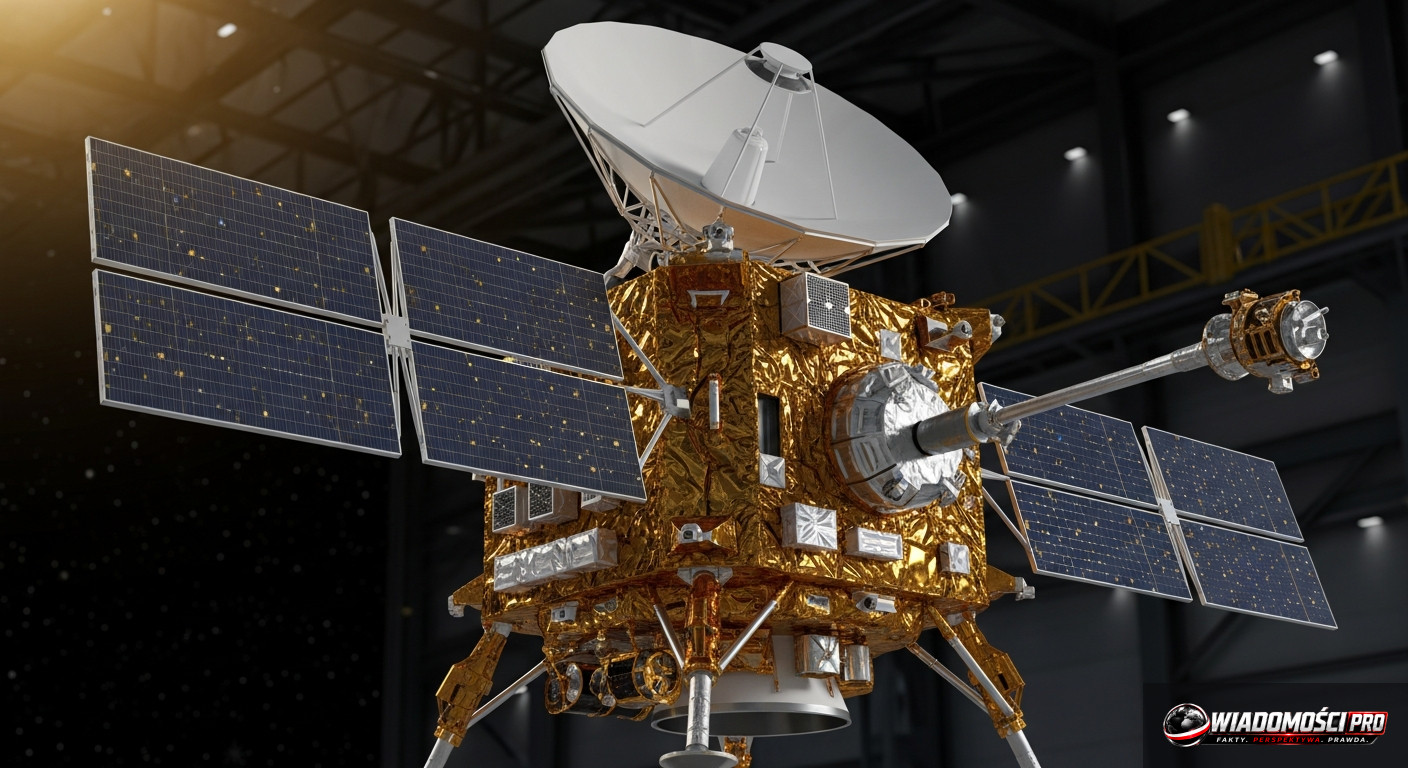
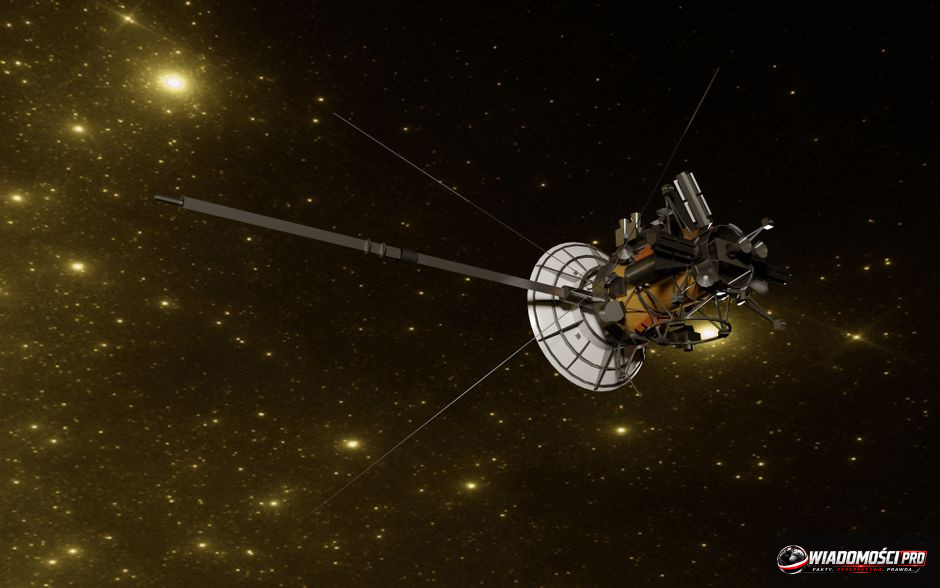
The cost of the Europa Clipper mission is 5 billion dollars. The probe's task is to determine whether conditions favorable to life exist beneath the icy crust of Jupiter's moon. It is the most ambitious astrobiological project in NASA's history, carried out using a Falcon Heavy rocket, which launched the spacecraft in October 2024.
Why Europa? The goal of the NASA mission
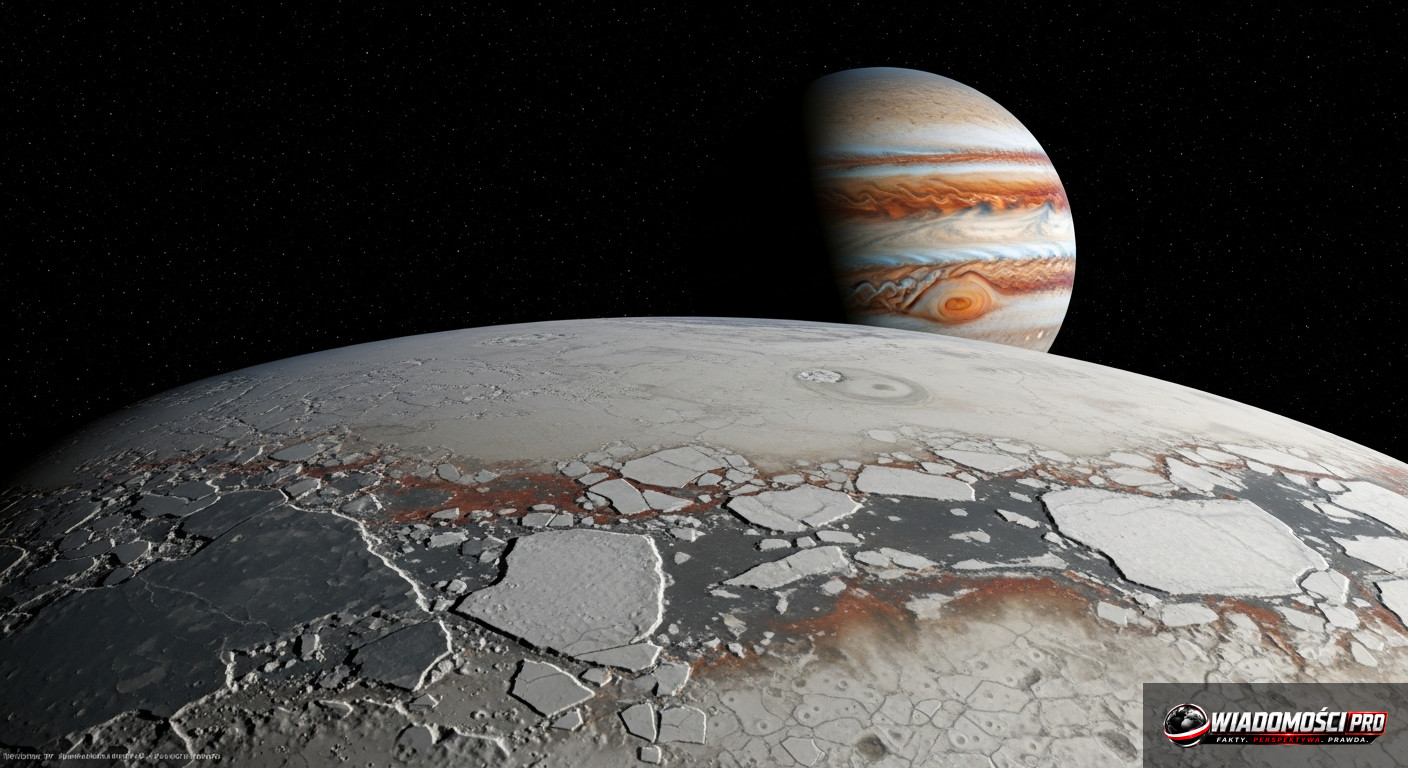
Europa, the fourth-largest moon of Jupiter, has been at the center of astrobiologists' attention for decades. It possesses a global ocean of liquid water hidden beneath a thick, icy crust. NASA assumes that this subsurface reservoir may contain all the ingredients necessary for biological processes to occur. However, researchers are not looking for the organisms themselves, but rather the chemical and geological conditions that would allow microorganisms to survive. The Europa Clipper probe is intended to provide data that will confirm whether an environment capable of sustaining life truly exists under the ice.
The fascination with this moon stems from its unique geological structure. Jupiter's gravitational tides stretch and squeeze Europa, generating heat in its interior. This heat keeps the water in a liquid state, despite the gigantic distance from the Sun. Scientists want to determine the thickness of this icy shield, which in some places may be 15 to 25 kilometers thick. Understanding its structure will allow them to assess whether water from the ocean has contact with the surface, which would enable the exchange of chemical matter.
Spending 5 billion dollars on such specific research naturally raises skepticism. Critics point to the enormous research needs on Earth, from climate change to medicine, which could have been funded with such a substantial budget. Supporters of the program argue that the answer to the question of the uniqueness of life in space is a foundation of our civilization. This is not just an ordinary expedition, but an advanced detective operation intended to verify whether we are the only possessors of liquid water in our planetary system.
The probe was designed to collect precise data about the moon's interior during multiple flybys of its surface. If it turns out that the ocean is sterile, billions of dollars and years of scientists' work will serve to confirm that life is not a common phenomenon in our planetary system. Each flyby will be a challenge because Europa is located inside Jupiter's powerful radiation belt, which destroys most electronics in a short time.
Mission budget: 5 billion dollars in the service of science
The total cost of the Europa Clipper project amounted to 5 billion dollars. This investment includes the construction of the probe, the development of research equipment, and operational costs associated with managing the mission over the years. NASA had to create a spacecraft that could handle not only the hardships of interplanetary travel but also the extreme radiation prevailing near Jupiter. These funds allowed for the creation of specialized shields that protect delicate instruments from ionizing energy.
These costs raise questions about the efficiency of public spending. Is 5 billion dollars an adequate price for attempting to answer the fundamental question about our place in the universe? Critics point out that these funds could have supported research programs on Earth, directly improving the quality of life for citizens. However, technological progress forced by such ambitious projects finds application in industry, agriculture, or medicine. Europa Clipper is a high-stakes bet. If the probe confirms the existence of an ocean of liquid water, and consequently biological potential, the cost of the mission will cease to be the main point of debate.
Then the discussion will shift to how quickly we can send another spacecraft there, this time equipped with a lander. Designing systems that must survive in deep space for many years stimulates the development of materials engineering. NASA had to develop new metal alloys and advanced computer systems that can operate in conditions where repair is impossible.

Launch with the Falcon Heavy rocket: The power of technology
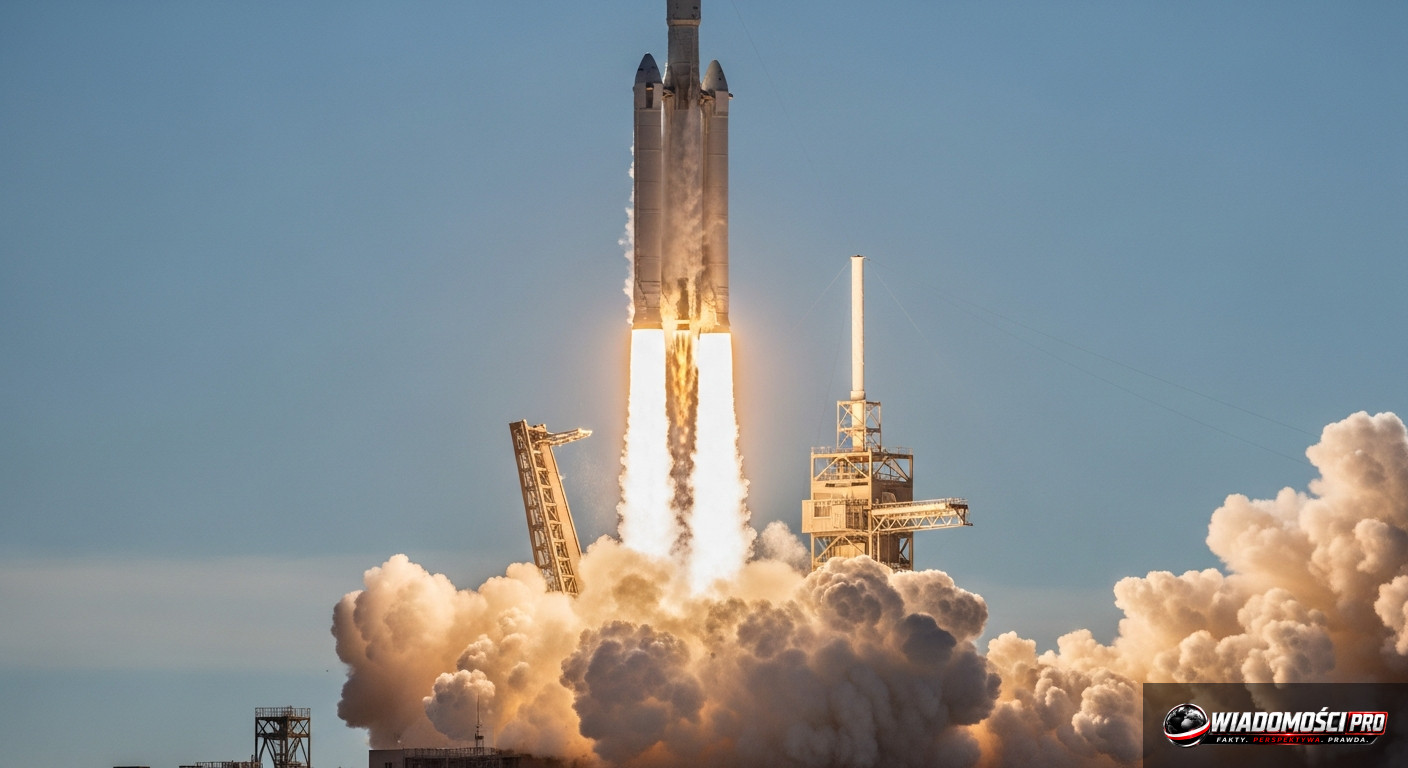
The launch of the Europa Clipper mission in October 2024 was an operation whose success depended on engineering precision at every stage. To place the multi-ton probe on an interplanetary trajectory, it was necessary to use heavy equipment. The choice fell on SpaceX's Falcon Heavy rocket. The decision to entrust such an expensive instrument to Elon Musk's design shows a change in the American space agency's strategy. The Falcon Heavy, with its powerful thrust, allowed Europa Clipper to be sent toward Jupiter without the need for complicated gravitational maneuvers that usually extend the time to reach the destination.
The probe has a specific task: to check whether conditions favorable to life exist beneath the icy crust of Jupiter's moon. It is an advanced laboratory that must survive in an extreme radiation environment. SpaceX technology operates here in a different mode than when launching telecommunications satellites. The rocket had to give the device a huge launch speed so that the probe could even consider reaching its destination in a reasonable time.
Some experts pointed to the risks associated with such a configuration, but the successful launch confirmed the effectiveness of the cooperation between the private sector and the government agency. The question of whether 5 billion dollars is an amount that will pay off in the form of scientific knowledge remains open. For now, the most important thing is that the key equipment has safely left the Earth's atmosphere, heading toward one of the most mysterious places in the Solar System. Engineers now face years of system monitoring.
Travel schedule: When will we reach Jupiter?
The 5 billion dollar investment that the Europa Clipper mission consumed is a signal to taxpayers that NASA is not just looking for landscape photos. The primary goal remains the verification of conditions favorable to sustaining life. The mission launch itself took place in October 2024. The probe is now traversing space on its way to the Jupiter system. This is not a straight-line flight. The journey is a multi-year process that requires engineers to perform precise planning and use complex gravitational maneuvers.
Every maneuver is a critical moment. It is a chance to gain speed with minimal fuel consumption, but also a risk that cannot be fully eliminated. The probe must perform flybys near Mars and Earth to gain the necessary momentum. For observers on Earth, the waiting time seems frustrating, but the mechanics of the heavens remain inexorable. The probe must cover hundreds of millions of kilometers to finally enter Jupiter's orbit and begin a series of close approaches to Europa.
We are paying billions for decades of planning and years of waiting for a signal that will confirm or exclude our assumptions about the existence of an ocean hidden under the ice. If the mission is successful, this cost will disappear in the shadow of a discovery that humanity has been waiting for for centuries. However, if the instruments do not provide conclusive evidence, questions about the legitimacy of such a gigantic expenditure will return with doubled force. For now, Europa Clipper is consistently sticking to its chosen course, and every maneuver performed brings us closer to the goal.
Probe equipment: Eyes turned to the icy crust
The cost of the Europa Clipper mission is 5 billion dollars. This is an amount for which the taxpayer demands almost surgical precision, because the probe is not landing, but only "scanning" Europa during multiple flybys. NASA engineers opted for a set of sensors that are intended to determine whether an ocean capable of sustaining life is indeed hidden beneath the thick icy crust.
The probe has been equipped with precise research instruments:
- Europa Imaging System (EIS): A set of high-resolution cameras that will map the moon's surface to identify geological features.
- REASON (Radar for Europa Assessment and Sounding: Ocean to Near-surface): A radar instrument that will send radio waves through the ice to detect the presence of an ocean and study the structure of the icy crust.
- MISE (Mapping Imaging Spectrometer for Europa): A mapping spectrometer that will allow for the analysis of the surface's chemical composition, identifying salts, organic compounds, and ice.
- ECM (Europa Clipper Magnetometer): A magnetometer measuring the magnetic field, which will help confirm the existence of a saltwater ocean.
- PIMS (Plasma Instrument for Magnetic Sounding): A sensor measuring the plasma that surrounds Europa, which is crucial for interpreting magnetic data.
- SUDA (Surface Dust Analyzer): A surface dust analyzer, studying tiny particles ejected from the moon into space as a result of meteorite impacts.
- MASPEX (Mass Spectrometer for Planetary Exploration): A mass spectrometer analyzing gases in Europa's atmosphere, which may reveal the chemical composition of the ocean by analyzing vapors escaping through cracks in the ice.
Scientists are not looking for little green men there, but for chemical traces that would confirm that the water under the ice is active. The challenge is enormous. Europa is located in Jupiter's strong radiation field, which means that the electronics on board must operate in conditions that would instantly destroy standard commercial equipment. Each of the instruments is tasked with collecting data that, when assembled into a whole, will create a picture of the moon's habitability.
If Europa Clipper returns with data confirming the existence of conditions favorable to life, this cost will go down in history as money well spent. If, however, the results are inconclusive, critics of NASA's spending will gain a powerful argument against subsequent, equally expensive missions. For now, we have to wait for the first readings from the sensors, which are supposed to answer the question of whether we are alone in the Jupiter system.
Significance of the mission for the future of astrobiology
The cost of the Europa Clipper mission is 5 billion dollars. It is a gigantic investment that, in the eyes of skeptics, may seem astronomical, but in the world of science, it is the price for an answer to a fundamental question: is Earth the only oasis of biology in the part of space known to us? The probe's task is to check whether conditions favorable to life actually exist beneath the icy crust of Jupiter's moon. It is the most advanced attempt to look deep into an alien reality hidden under thick ice.
For astrobiology, this research has an almost existential dimension. The Europa Clipper mission is intended to resolve the issue of Europa's potential habitability, which in practice means verifying the theoretical models on which we base our search for life outside the Solar System. If we discover chemical traces of biological processes under the ice, our current understanding of life will undergo a complete transformation. The definition of the habitable zone will change, and consequently, the list of objects in space that we should treat as a priority in future crewed missions.
The results of this research could permanently change our understanding of the human place in the Solar System. Despite huge financial outlays, the risk of failure remains inherent in every stage of this expedition. Even a lack of evidence for the presence of life will be a valuable result, because it will force scientists to revise the parameters that we currently consider sufficient for the emergence of living organisms. We are paying not only for equipment, but above all for data that will either confirm our thesis or send astrobiology back to the drawing board. The probe is heading toward Europa, and with it all our hopes for discovering something more than just dead ice.
What this means for you
The Europa Clipper mission is an investment in knowledge of fundamental importance. Scientists and humanity seeking an answer to the question of loneliness in the universe benefit. The catch is the huge financial cost (5 billion USD) in times when space agency budgets are being subjected to strict verification. If it is possible to confirm that water on Europa can be capable of sustaining life, the definition of a "place to live" in space will be expanded forever. This means that subsequent billions of dollars could be spent on lander missions that will attempt to take a physical sample of ice or water from inside the moon.
Such a perspective makes the mission a point of reference for all future NASA activities. The Europa Clipper probe is not an end in itself, but a tool intended to open the door to further exploration of the icy moons of Jupiter and Saturn. For the average person, this means that within the next decade, we may receive an answer to a question that has accompanied us for thousands of years: is life a phenomenon on a cosmic scale, or a natural phenomenon resulting from the laws of physics and chemistry.
Questions and answers
Will Europa Clipper land on the moon's surface?
No, the probe was designed to conduct research during multiple flybys near the moon. Landing is not planned for this mission because Europa's radiation environment is too dangerous for a lander without advanced protection, which would increase the mission's costs beyond the established budget.
How long will the journey to Jupiter take?
The journey is multi-year. The probe must cover a huge distance, using the gravitational assistance of planets, which is necessary to gain the appropriate speed without excessive fuel consumption.
Who is responsible for the implementation of this mission?
The main operator and initiator of the mission is the American agency NASA, with the support of subcontractors such as SpaceX, who provided the Falcon Heavy launch vehicle.
What will happen if the probe finds no traces of life?
The lack of evidence for the existence of conditions favorable to life will also be a valuable scientific result. It will allow for a better understanding of the geochemical processes occurring inside Jupiter's moons and a revision of current theoretical models regarding the formation of life in extreme conditions.
Why was Europa chosen, and not other moons of Jupiter?
Europa has the strongest evidence for the existence of a global ocean under a thick layer of ice, and also exhibits geological activity that suggests that materials from the moon's interior may escape to the surface. This makes it the most promising object for research in the search for potential biological habitats.
Will Jupiter's magnetic field affect the probe's operation?
Yes, which is why Europa Clipper has been equipped with special radiation shields that protect the electronics from the destructive influence of charged particles in Jupiter's radiation belts. The instruments are designed to withstand a radiation dose significantly exceeding what satellites in Earth orbit encounter.
Is this mission threatened by the contamination of Europa with Earth microorganisms?
NASA strictly adheres to planetary protection protocols to minimize the risk of contaminating the moon. The probe was sterilized before launch, and its orbit is planned in such a way that after the mission ends, the probe will not be allowed to accidentally impact Europa's surface, which could introduce Earth microbes into its ecosystem.
What data will the probe transmit to Earth?
The probe will transmit huge amounts of high-resolution photos, radar data on ice thickness, chemical compositions of the surface, and magnetic measurements. This data will be transmitted using a system of high-gain antennas, which will allow scientists to create a three-dimensional model of the moon's interior.
Is there a plan to send a crewed mission to this place?
Currently, there are no plans to send humans to Europa. Radiation conditions and distance make such a mission impossible from the point of view of modern technology. Europa Clipper is currently the best way to delve into the secrets of this moon without risking human life.
How long will it take to transmit data from Jupiter to Earth?
A radio signal takes from about 30 to over 50 minutes to cover the distance between Jupiter and Earth, depending on the relative positions of the planets in their orbits. This means that communication with the probe does not take place in real time, which requires it to have a high degree of autonomy in making operational decisions.
Are the costs of possible failures included in the 5 billion dollar budget?
The 5 billion dollar budget includes reserves for unforeseen situations, but any serious failure of a system with such a high degree of complexity poses a huge challenge for the agency. NASA manages risk through multi-level equipment testing before launch, which is intended to avoid costly mistakes during the mission.
What is the risk that the instruments will not work?
The risk of instrument failure is always present in space missions. However, thanks to system redundancy, i.e., having backup units for key components, NASA minimizes the chances of a total loss of research capabilities. Each instrument underwent thousands of hours of testing in conditions simulating vacuum and radiation before assembly.
When can we expect the first research results?
The first data will arrive after the probe reaches the vicinity of the Jupiter system and begins the scientific phase of the mission. The data analysis process will take months, so the most groundbreaking discoveries will be published after all readings have been carefully checked by research teams.
Will the Europa Clipper mission affect our chances of finding life on Mars?
These missions are complementary. Research on Europa allows for a better understanding of what chemical processes occur in aquatic environments, which provides a broader context for the search for traces of life on Mars, where water also existed in the past. Every discovery in the Solar System brings us closer to understanding how common life is in space.
What role does Poland play in the mission?
Although Europa Clipper is a NASA mission, Polish scientists and research centers often cooperate within international consortia on the analysis of data from space probes. Participation in data analysis from such prestigious projects is a chance for Polish science to join the global discussion about the origin of life.
Will the Europa Clipper probe be able to detect underground lakes in the icy crust?
Yes, the REASON instrument was specifically designed to detect pockets of water inside the icy crust. If such lakes exist, the radar will be able to identify their boundaries, which will provide valuable information about the dynamics of processes occurring inside the moon.
Are further missions planned after the end of Europa Clipper?
Everything depends on the results provided by this probe. If the discoveries are promising, there will certainly be proposals for subsequent missions, perhaps with a rover capable of drilling into the ice or an underwater drone that could explore the ocean from the inside.
What is the significance of the choice of the Falcon Heavy rocket?
The choice of this rocket was dictated by its high payload capacity, which allowed for carrying a large amount of fuel and heavy research instruments. Thanks to this, the probe could be sent on a more direct trajectory, which is crucial for the success of the mission in such a distant and difficult-to-navigate environment.
Does Europa Clipper have its own propulsion?
Yes, the probe is equipped with chemical engines that allow for orbital maneuvers and course correction during the journey and during flybys of Europa. Without its own propulsion, the probe would not be able to effectively interact with the moon's gravity.
Will the probe be destroyed after the mission ends?
Yes, after its work is finished, the probe will be directed to a safe place, likely into Jupiter's atmosphere, or it will be destroyed in a controlled manner to avoid the risk of collision with any moon, which could lead to its contamination with Earth biological matter.
Sources
- Start of the Europa Clipper mission to Europa - AstroNET – Polish Astronomical Portal
- NASA sends a probe to Europa. The Europa Clipper mission has launched - WP Tech
- Europa Clipper probe will search for life on Europa - Urania - Polish Astronomical Portal
- Start of the Europa Clipper mission [BROADCAST]. Americans will overtake Europeans in the search for life on Europa - Wyborcza.pl
- Europa Clipper launches. A key task ahead of them - Geekweek Interia
- Europa Clipper has launched. It will investigate whether there are conditions for life on Jupiter's moon - Polskie Radio 24
- Europa Clipper probe will search for life on Jupiter's moon, Europa - wszystkoconajwazniejsze.pl
- Flight to Jupiter for 5 billion dollars. Europa Clipper launch on board Falcon Heavy - Benchmark.pl
Article prepared by the Wiadomości PRO editorial team with the support of artificial intelligence. Facts come from the sources listed above.
Komentarze (0)
Ładowanie komentarzy...