
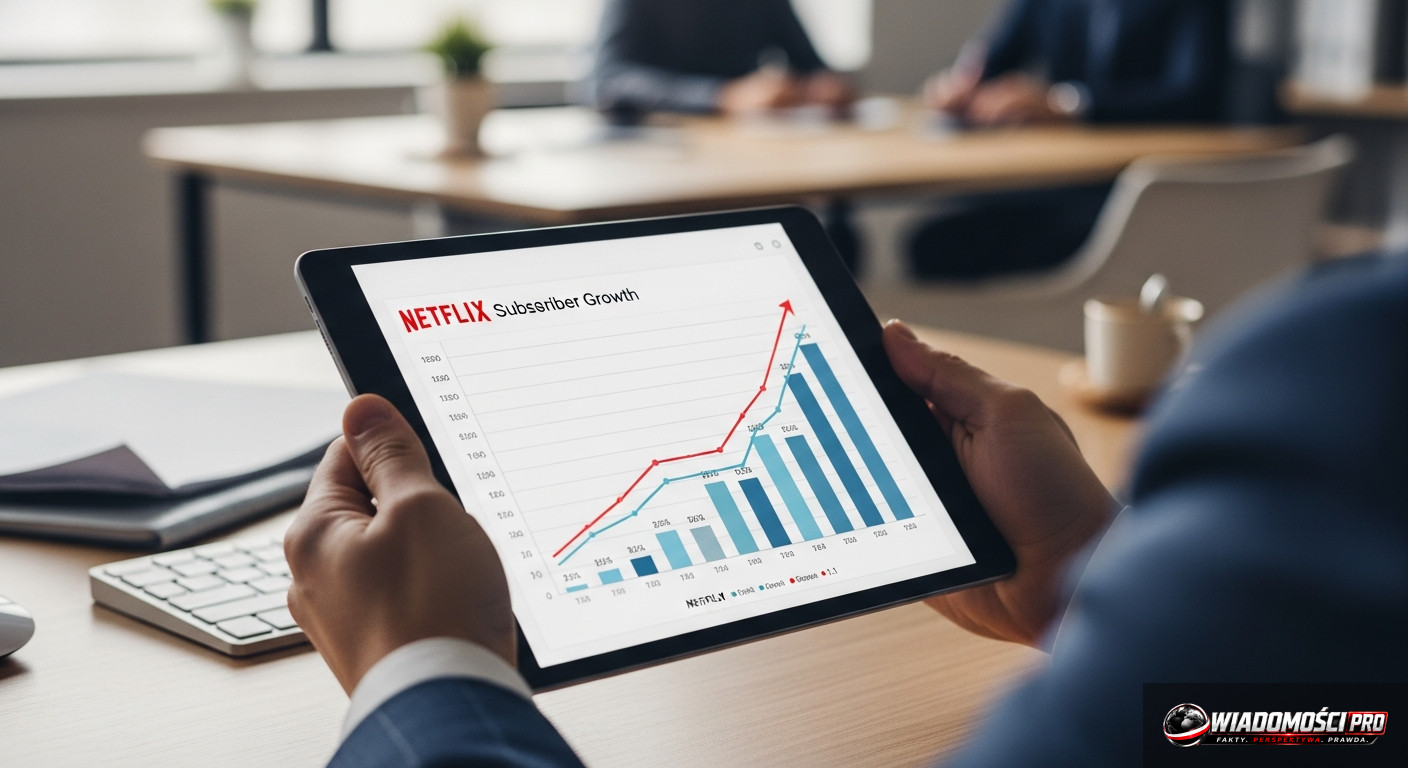
Netflix ended the third quarter of 2024 with a total of 282.7 million subscribers, marking an increase of 5.07 million new users over three months. These results are clear evidence that the strategy of monetizing every access point to the platform continues to generate real profits, despite the progressing saturation of the global VOD market. Wall Street investors have accepted this data as confirmation that the Los Gatos giant is effectively shifting its focus from merely fighting for reach to building operating margins.
The financial foundation of this growth is just as important as the number of subscribers itself. Netflix generated $9.82 billion in revenue in the third quarter of 2024, a significant jump compared to the same period last year. The company's net profit reached $2.43 billion, and the operating margin hit 30 percent. These figures show that the company has ceased to be just a cash-burning machine for productions, becoming a highly profitable media enterprise. ARPU, or average revenue per user, remains stable, although pressure to increase it through ad-supported tiers remains the management's main goal for the coming quarters.
User growth dynamics
The market feared that after the phase of intensive conversion of people using others' passwords into paying users, growth momentum would slow down sharply. The result of 5.07 million new subscribers in a single quarter puts these speculations to rest, showing that there is still a group of viewers who are only now deciding to create their own accounts. However, this is no longer organic growth driven by technological innovations, but the effect of systematically closing doors to non-paying viewers.
Analysts point out that Netflix is currently operating in a phase of so-called mature expansion. Each subsequent million users costs the company less in marketing because the brand is already recognizable in almost every corner of the globe. Instead of spending a fortune on reach campaigns, the company has redirected funds to optimize recommendation algorithms. The goal is simple: to ensure that a user who is already paying has no reason to cancel. In the industry, this is called retention, and in this aspect, Netflix has no equal.
The problem arises regarding the transparency of geographical data. The company consistently avoids presenting a detailed breakdown of revenue from advertising sales versus traditional subscriptions. Instead, investors receive aggregated data that allows for hiding weaker results in regions with lower purchasing power. Wall Street has long pushed for more precise reporting, but Netflix's management remains adamant. Such a strategy allows for maintaining a narrative of constant success, even if the churn rate—the rate at which customers cancel services—starts to rise dangerously in individual countries. For the average viewer, this means that Netflix feels secure enough to test further price hikes without fear of a mass exodus of customers.

Monetization mechanisms and advertising strategy
The success of recent months is the result of the ruthless execution of a business plan that assumed the complete elimination of account sharing outside of a household. Introducing fees for additional members has become a "gold mine" for the platform. Users who had grown accustomed to free access for years had to make a decision: either pay the full rate or accept a plan with ads. It is this second segment that has become the new engine of revenue.
The introduction of cheaper ad-supported plans was a preemptive move that allowed the company to avoid losing price-sensitive customers. Instead of losing a viewer, Netflix now receives double payment: once from the subscriber for access, and a second time from advertisers for displaying a spot. Although the company does not provide official data on the share of the ad-supported plan in total revenue, market estimates indicate that it is already a significant financial component.
A key element of this puzzle is the optimization of operating costs. Netflix has reduced spending on productions that do not generate sufficient engagement. Instead of financing dozens of niche titles, the company focuses on so-called "tentpole content," i.e., high-budget productions intended to attract millions of viewers during the first weekend of release. Such a strategy minimizes investment risk. However, it has not been confirmed what percentage of these 5.07 million new subscriptions fell into the cheapest packages, which raises questions about the real unit profitability of each new customer. The company wants the market to look at the total number of users, not at how much it actually earns from each of them in the long term.
Netflix against global competition
While Disney+, Max, or Paramount+ are still struggling with the unprofitability of their own streaming units, Netflix has reached a state where its VOD business is a stable cash generator. Most competitors are retreating from aggressive expansion, cutting production budgets, and selling licenses to their titles to patch budget holes. Netflix, on the other hand, maintains the status quo.
The industry has changed beyond recognition in the last year. The era of "streaming wars," in which every platform aimed to have the largest library at any cost, has come to an end. Now, margins matter. Netflix won this stage because it was the first to understand that the market has its limits. The rest of the players are only now implementing solutions that Netflix tested two years ago, such as blocking password sharing or ad-supported packages.
The lack of detailed data from competitors makes a reliable comparison difficult, but analysts point out that Netflix currently has the largest base of paying users in the world. Investors treat this as proof that in the digital ecosystem, the winner takes all. If the competition does not build loyalty as strong as Netflix has, they will be reduced to the role of content suppliers for the leader's library. This is a dangerous prospect for film studios, which are becoming hostages to the algorithms of a single platform.
Investments in content vs. quality of the offer
The strategy of spending billions of dollars on original content is a double-edged sword. On one hand, it allows for the monopolization of viewer attention; on the other, it leads to a phenomenon known in the industry as "algorithmic redundancy." Netflix does not hide the fact that its productions are tailored to specific viewer profiles, which often comes at the expense of artistic originality.
The success of Q3 2024 was driven by several high-profile premieres that dominated social media discussions. This is a classic retention model: the viewer pays for a subscription to see a hit, and then stays in the service because the algorithm suggests more, similar proposals. Analysts, however, warn against the risk of material fatigue. If there is a lack of production capable of breaking into the mainstream in a given quarter, this strategy may stop generating such spectacular growth.
The question of the quality of the offer remains open. The company has not disclosed what portion of the budget went to productions actually appreciated by critics, and how much projects cost that were meant only to fill empty space in the library. This disparity is felt by viewers, who increasingly complain about the redundancy of the offer. Nevertheless, 282.7 million subscribers is an army that cannot be fed exclusively on average-quality entertainment indefinitely. The coming quarters will show whether the budget machine can maintain its pace without running out of breath.
Financial results by region
Netflix's success is not a coincidence, but the result of precise market management. The EMEA region, i.e., Europe, the Middle East, and Africa, remains the main driver of growth. It is there that the company recorded the highest number of new subscriptions. This confirms that despite saturation, European markets still have potential, especially in terms of migrating users from paid cable TV offers to streaming.
The APAC region, i.e., Asia-Pacific, shows solid growth thanks to emerging markets. The strategy of cheaper ad-supported plans worked best there, attracting millions of people for whom the full subscription price had previously been an insurmountable barrier. LATAM, i.e., Latin America, shows stabilization, which suggests that the potential for organic growth has been largely exhausted, and the company is now focusing on retaining existing customers by raising prices and fighting account sharing.
The most problematic region in terms of dynamics is UCAN, i.e., the USA and Canada. This is the most mature market, where subscriber growth is the slowest. Profits in this region are built mainly through aggressive price increases, not mass acquisition of new customers. The lack of a detailed financial breakdown for individual countries within these regions is a deliberate move. The company thus hides weaker results in specific countries, masking them with better data from neighboring markets. For shareholders, this means having to trust general trends without the ability to verify whether the giant's strategy is actually working in their local environment.
Forecasts for the end of 2024
The company's management indicated in an official statement to investors that it expects higher subscriber growth in the fourth quarter of 2024 than in the third. However, no specific numerical forecasts regarding the scale of this growth or detailed financial expectations for December were provided. This confidence suggests that Netflix possesses data it does not share with the public, which testifies to a strong "pipeline" of upcoming premieres.
Investors are carefully watching how the company intends to continue squeezing money from its current user base. Netflix's strategy is clear and ruthless. Instead of focusing solely on acquiring new people, the giant is focusing on maximizing revenue from existing accounts. A key tool remains limiting password sharing and encouraging switches to ad-supported plans, which generate higher revenue per individual user for the platform.
The question of the growth ceiling remains relevant. Although the numbers are still climbing, management avoids declaring how long this model will maintain its pace without the risk of viewer boredom. No plans for drastic subscription price hikes in the coming months have been confirmed, but Netflix's historical decisions suggest that every price list adjustment is only a matter of time. The company operates in a model where every subsequent quarter must look better than the previous one to satisfy market analysts. The question is how many more people can be convinced to pay before the market becomes saturated with the offer. For now, it is successfully managing to avoid stagnation, but the space for further, equally spectacular growth is slowly shrinking.

What this means for you
Investors have received a clear signal: Netflix has successfully transitioned from a purely growth-oriented model to a high-profitability model. The catch remains market saturation in developed countries, which forces the platform to seek growth in ad-supported plans, which inevitably changes the user experience. For the subscriber, this means that Netflix is ceasing to be a "cheaper alternative to television" and is becoming another paid medium with advertisements, with which it is increasingly difficult to negotiate terms of account usage.
Questions and answers
Exactly how many subscribers does Netflix have after the third quarter of 2024?
Netflix ended the third quarter of 2024 with 282.7 million subscribers.
How much did the number of users increase compared to the previous quarter?
In the third quarter of 2024, the platform gained 5.07 million new subscribers.
Are these data officially confirmed?
Yes, the data comes directly from Netflix's official financial report for the third quarter of 2024.
A base growth of over five million people in such a short time is a signal that the VOD market has not yet said its last word. Although Wall Street analysts warn against the so-called saturation point, current results show that Netflix can still beat the competition not only with its film library, but above all with iron consistency in enforcing the rules of using the service. For the end user, however, this means the end of the era of "free" access shared with friends or extended family.
It is worth looking at these numbers in a broader economic context. Netflix has become a "utility" type platform, comparable to electricity or gas bills – a service that is increasingly difficult for most households to cancel. It is this habit effect, combined with aggressive monetization, that allows the company to keep margins at a high level even as production costs rise.
The question of the future remains: will Netflix decide on another wave of price hikes in 2025, or will it focus on even deeper integration of ads into its productions? The company has not disclosed its plans in this regard, but the history of its business decisions shows that it is not afraid of drastic steps if only the numbers in quarterly reports stop growing at the expected rate. For shareholders, this is a reason for satisfaction; for viewers, it is a harbinger of further changes that will not necessarily work in their favor.
Ultimately, 282.7 million subscribers is a powerful force that everyone must reckon with: from cinema creators to tech giants. Netflix is no longer just a streaming platform. It has become a center of digital entertainment that tightens the loop around its user base with every quarter. Will this approach prove sustainable, or will it sooner or later lead to a rebellion of viewers tired of rising costs and ads? We will find the answer to this question in subsequent reports, which will be crucial for assessing the giant's long-term strategy. For now, however, the numbers speak for themselves. Netflix is growing, and the competition remains far behind, unable to develop an equally effective business model. What is a "growth ceiling" for others turns out to be just another stage on the road to dominance in the global entertainment market for Netflix, where every second of viewer attention is valued in dollars. In this race, there is no room for sentiment, only pure calculation, which, so far, is working exceptionally well.
Article prepared by the Wiadomości PRO editorial team with the support of artificial intelligence. Facts come from the sources provided above.



Komentarze (0)
Ładowanie komentarzy...