Within a year, Poland has produced 90,000 helmets, supplying, among others, the Canadian army and the US Marine Corps, and integrating its technologies into the arsenal of the Rheinmetall AG group. Achieving this scale in such a short time shifts the center of gravity in the European defense industry, making Polish plants a strategic link in the North Atlantic Alliance's supply chain.
Gdańsk production line: Engineering at scale
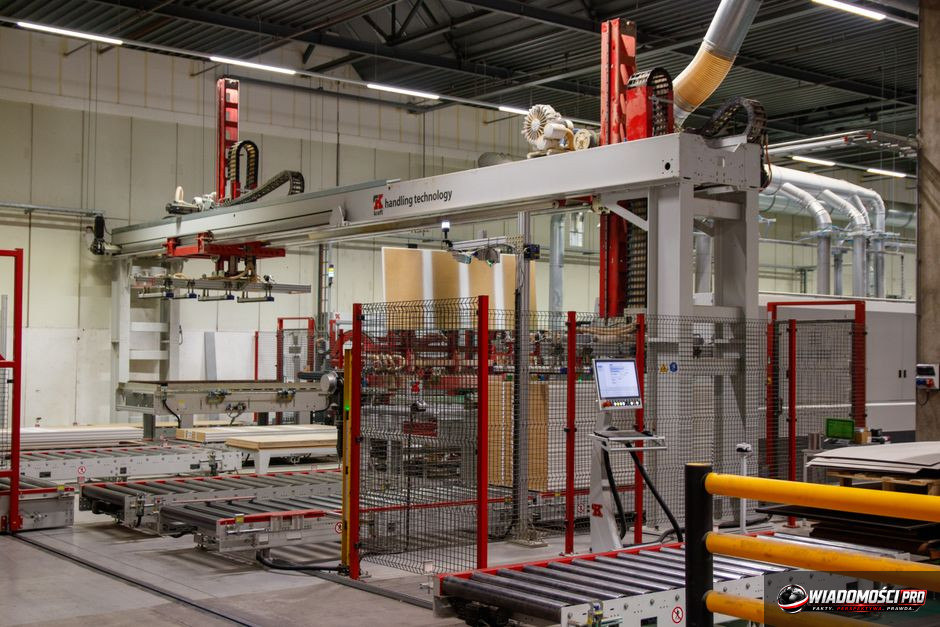
The plant in Gdańsk, opened on June 27, 2025, forms the foundation of current export potential. From the beginning, this facility was designed as a highly automated unit, which allowed for the avoidance of bottlenecks typical of traditional defense manufacturers. The key to success proved to be the implementation of automated high-pressure hydraulic presses, which enable precise forming of ballistic composites while maintaining the repeatability of protective parameters for every single unit.
This process uses advanced industrial robots for trimming helmet edges and applying protective coatings, which reduces human error to a minimum. The use of CNC technology in finishing allows for a perfect fit of the helmet with communication systems and night-vision mounts, which is a standard required by modern special units. Instead of building a dispersed network of smaller workshops, the focus was placed on a single, centralized line operating in a continuous cycle. This enables not only mass production but, above all, strict quality control at every stage – from raw material to the finished product.
Logistics within the plant have been optimized so that the time a component spends on the line is as short as possible. The automation of loading and unloading processes from the presses is a response to labor shortages in the engineering industry. Thanks to this, the Gdańsk factory was able to deliver 90,000 units in twelve months, a result that exceeds the capabilities of many traditional manufacturers on a European scale.
USMC and Canada: Why choose a Polish product?
The contracts concluded with the US Marine Corps and the Canadian army are not a matter of chance or price. The Americans, famous for having the most restrictive ballistic equipment certification procedures in the world, decided on Polish solutions after conducting a series of field tests. As reported by the Defense Portal on March 9, 2026, the Polish helmet beats the competition in the balance between weight and degree of protection.
For a Marine, the weight of equipment has a direct impact on operational capability. Polish helmets offer a higher level of resistance to shrapnel and bullets while maintaining a lower total kit weight. This was achieved through the use of innovative polymer composites with increased aramid fiber density. In turn, Canada, by ordering 29,000 units through the company Galvion, confirmed that Polish plants are able to fill huge gaps in equipment without compromising on quality.
Cooperation with the Canadian Ministry of Defense, confirmed by Defence24 in March 2026, shows that Poland has become a guarantor of supply continuity for NATO. In a situation where the supply chains of many Western corporations suffered due to component shortages, Polish factories maintained production fluidity. It is precisely this reliability that has become the main asset in negotiations for further contracts.
Partnership with Rheinmetall AG: Technological integration
The cooperation with the Rheinmetall AG group, announced in February 2026 by MILMAG, goes beyond the simple supply of equipment. Polish head protection technology has become an integral part of the German giant's arsenal, which means that our solutions are being incorporated into the "soldier of the future" equipment systems built by Rheinmetall. This is the highest form of recognition for Polish engineering.
This integration involves not only supplying finished helmets but also exchanging data on ballistics and ergonomics. Joint research on new materials allows Polish engineers to use the experience of the German corporation, which drives further product development. For Rheinmetall, the Polish partner provides access to production capacities that they were unable to scale up quickly enough themselves.
The strategic importance of this partnership is immense. The presence of Polish equipment in the Rheinmetall arsenal opens doors to markets where the "Made in Poland" brand in the defense sector was not previously widely recognized. This is a transition from the role of a subcontractor fulfilling simple orders to the role of a critical technology supplier.
Innovations from Silesia: Materials of the future
While Gdańsk is responsible for mass production, Silesia has become a center of innovation. Information from July 29, 2026, provided by "Dziennik Zachodni," points to intensive work on new protective technologies. Polish companies are focusing on developing alloys and structures that are intended to replace existing composite solutions.
A key direction is the use of titanium. On May 28, 2026, Wojsko-Polskie.pl confirmed that work is underway on titanium helmets for the Polish armed forces. Titanium, characterized by an extraordinary strength-to-weight ratio, allows for the creation of shields that are thinner yet more resistant to penetration. However, the challenge lies in processing this material – it requires specialized high-power presses and precise laser welding technologies, which are currently being implemented in Silesian plants.
These innovations do not remain only on paper. Incorporating the results of the work of Silesian engineers into the portfolio offered to Rheinmetall AG shows that the Polish defense industry can translate laboratory research into a real military product. It is this cycle – from an idea in Silesia, through testing, to mass production in Gdańsk – that creates Poland's competitive advantage.
Risks and challenges: Is the scale sustainable?
Maintaining production at a level of 90,000 units per year is not only a success but also a huge burden on the plants. The defense market is characterized by high volatility, and the pressure to maintain quality standards at such a high pace is enormous. Any delay in raw material deliveries or a failure of the machine park in Gdańsk could result in the termination of contracts and the loss of trust of key NATO contractors.
There is also the risk of dependence on a single production center. Concentrating all potential in one hub in Gdańsk, while cost-effective, makes the supply chain vulnerable to local disruptions. The question is whether it will be necessary in the future to diversify production by building other, equally modern units in other regions of the country.
Another challenge is the pace of development of protection technology. The competition does not sleep – Western corporations are investing billions in graphene coatings and active head protection systems. To maintain its position, Poland must constantly reinvest contract profits into research and development (R&D). If the pace of innovation implementation slows down, the current success may become only a short-lived episode.
Geopolitical significance of the Polish hub
Poland's status as a key supplier of helmets for NATO changes the perception of our country within the Alliance's structures. We are no longer just a recipient of technology, but an active participant in building collective security. This gives Poland a stronger bargaining chip in talks about purchasing other, more advanced military equipment.
By relying on Polish equipment, the Americans, Canadians, and Germans are building relationships based on technological interdependence. This is a more lasting bond than any political declaration. If Polish helmets prove themselves in real conflict conditions, their position on the global market will be solidified for decades to come.
However, it must be remembered that success in helmet production is still just a segment of individual protection. The real test for the Polish industry will be the ability to transfer these management and automation standards to the production of heavier equipment, such as artillery systems or armored vehicles. If the Gdańsk model proves scalable, Poland could become a European defense hub on an unprecedented scale.
The defense industry as a pillar of the economy
The growth in arms exports, of which helmets are only one element, has a real impact on Poland's GDP. Investments in modern production lines generate demand for high-class specialists, which drives the domestic engineering job market. Thanks to contracts for the USMC or Canada, Polish defense companies have gained access to capital that allows for further modernization of the machine park.
However, one cannot forget about the social and environmental costs of such intensive production. Managing composite waste, operating machines working in a shift system, and training staff are challenges that local governments in the locations of the factories must face. Industrial success is also a responsibility for the local community, which must support the expansion of infrastructure necessary for the operation of such large plants.
The outlook for 2027 appears to be a time of verification for the Polish industry. Will it be possible to maintain growth dynamics while simultaneously introducing titanium technologies? The answer to this question will define the future of the Polish defense industry for years to come. For now, the facts are undeniable – 90,000 pieces of equipment produced in a year is proof that Polish engineering can win in the most demanding markets in the world.
What this means for you
Poland's transition from an importer to a key supplier of critical equipment for NATO means a profound change in the country's economic and defense structure. For the average citizen, this means an increase in Poland's importance on the international stage and the building of real industrial competencies that are difficult to replicate. The challenge, however, remains to maintain the pace of innovation so as not to lose the technological race when competition from the USA or Germany introduces next-generation solutions to the market.
Questions and answers
Where are the helmets for NATO produced?
The main production center is a modern plant in Gdańsk, which was launched on June 27, 2025, and has been operating in an automated cycle since then.
Which armies use Polish equipment?
The main recipients are the armed forces of Canada (a contract for 29,000 units), the US Marine Corps, and the Rheinmetall AG group, which has included Polish helmets in its standard arsenal.
What distinguishes Polish helmets from the competition?
Polish helmets are distinguished by an optimal balance between weight and the level of ballistic protection, which has been confirmed by rigorous US Marine Corps tests. Additionally, innovations developed in Silesia, including work on titanium elements, allow for staying ahead of older generations of equipment used by allies.
What technologies allowed for such a rapid production jump?
The key was the implementation of automated high-pressure hydraulic presses and the robotization of finishing processes (CNC). Thanks to this, it was possible to ensure high quality repeatability at a mass production scale, which was impossible to achieve with traditional methods.
Is the production of 90,000 helmets per year safe for supply stability?
Although this result is a success, concentrating production in one hub carries operational risks. Maintaining this level requires continuous maintenance of the machine park and securing the raw material supply chain, which is why further investment in R&D facilities and possible diversification of production capacities in the future will be key to stability.
Sources
- 90,000 helmets in a year. Polish factory flooded NATO with equipment - Spider's Web
- Company from Silesia will develop new technology for the military. This is a solution for soldiers - Dziennik Zachodni
- 29,000 helmets for Canada from Galvion. The company has a plant in Poland - Strefa Obrony
- This helmet will save lives. Why is the US Marine Corps choosing technology from Poland? - Portal Obronny
- Canada orders tens of thousands of helmets (+) - Defence24
- Titanium helmets for the Polish Army - Wojsko-Polskie.pl
- New combat helmet in the Rheinmetall AG group's arsenal - MILMAG
- Helmets for NATO. Modern factory opened in Gdańsk - Gdańsk - official city portal
Article prepared by the Wiadomości PRO editorial team with the support of artificial intelligence. Facts come from the sources listed above.

Komentarze (0)
Ładowanie komentarzy...