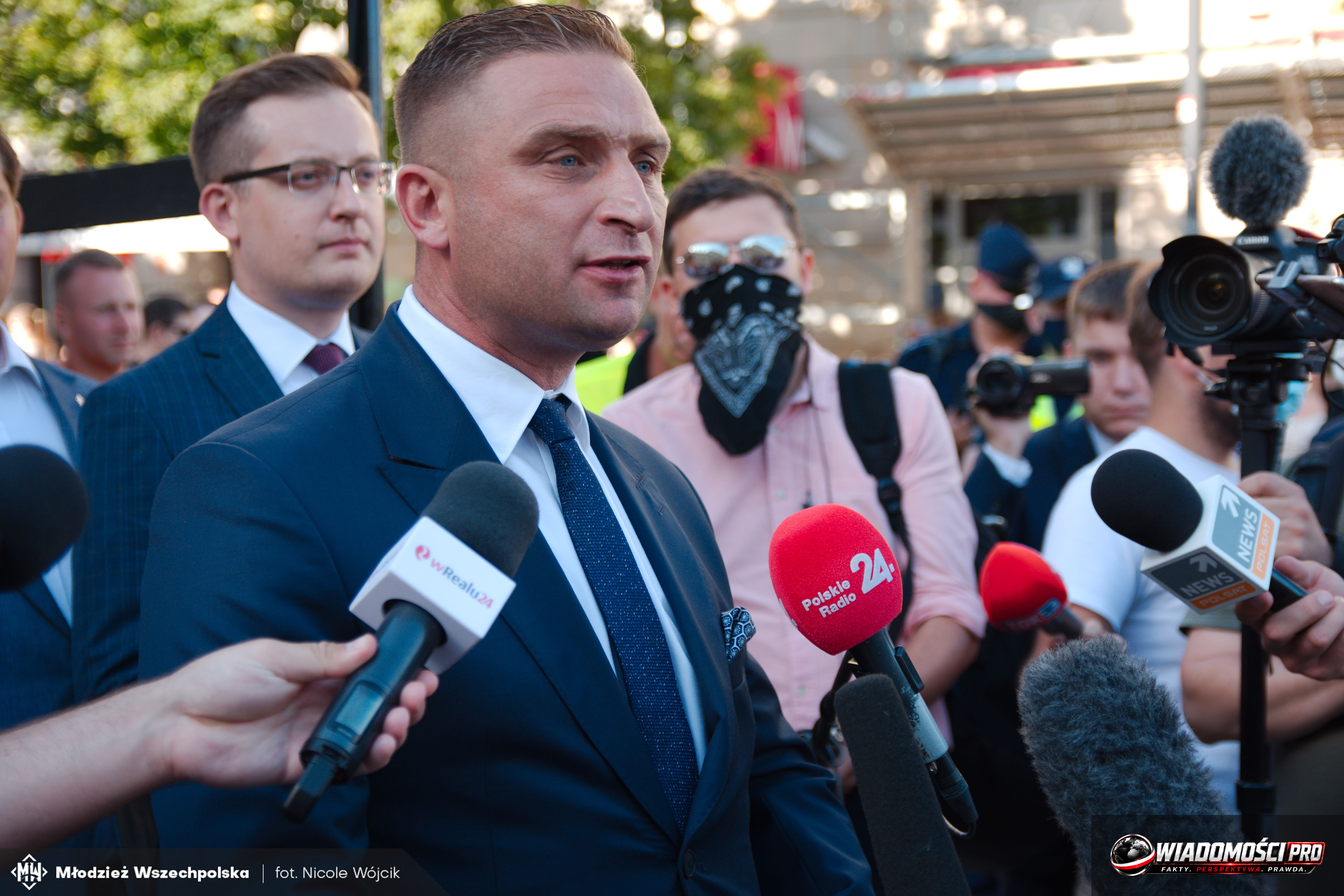
Tens of thousands of people took part in this year's Warsaw Uprising March, and Robert Bąkiewicz, in his speech, appealed by stating that "every peasant in Poland must" take responsibility for the fatherland. This gathering, organized on the 82nd anniversary of the outbreak of the fighting, ceased to be merely a traditional tribute to the insurgents, becoming a manifestation of the strength of nationalist circles, which in 2026 have at their disposal professionally managed financial and legal resources. This event is groundbreaking because it shows how historical memory becomes fuel for contemporary political mobilization, completely changing the rules of the debate on Polish patriotism.
Mobilization mechanism on the 82nd anniversary of the uprising
On August 1, 2026, the capital's streets were filled with demonstrators, whose presence was the culmination of many weeks of preparations. The assembly marched through the center of Warsaw, being one of the most visible points of the anniversary celebrations. Media reports, including WP Wiadomości and Portal Samorządowy, indicate high crowd dynamics, and data from PCH24.pl confirms the presence of tens of thousands of people. However, no precise figures were provided by the police, which leaves the question of the exact scale of attendance compared to previous years open.
The organizers, led by Robert Bąkiewicz, had been conducting an intensive mobilization campaign for weeks. The attendance success is not a coincidence, but the result of specific operational actions. Fundraisers, reported by "Wprost," brought in gigantic sums, which allowed for the professional logistics of the event. This is no longer a spontaneous social action, but a complex mechanism that uses the anniversary of the Warsaw Uprising to build lasting political structures.
Bąkiewicz's words that "every peasant in Poland must" take responsibility for the fatherland define a new stage in the rhetoric of this environment. It is a call for an active stance, which is intended to transform historical memory into everyday civic activity. For the march participants, who in 2026 still place a strong emphasis on the division between victims and perpetrators, such a narrative seems consistent with the ethos of struggle that was present in 1944.
Legal triumph and its consequences for public space
The legal situation of the march before August 1 was tense. As early as July 24, 2026, Robert Bąkiewicz announced success when the court made a decision favorable to the organizers, rejecting attempts to block the assembly. Commenting on the verdict, the march leader described previous actions aimed at banning the demonstration as an "absurd attempt" that "lay in ruins." This ruling became a key argument for the organizers in the narrative about overcoming institutional resistance.
From an organizational point of view, the court victory gave Bąkiewicz a sense of legitimacy and stability. For the thousands of people who came to Warsaw, the court's decision was confirmation that their presence on the streets is not only desirable but also protected by law. This is significant, as in previous years, disputes over the course and legality of the marches were a frequent flashpoint. Currently, nationalist circles are able to navigate the legal system efficiently, which makes their actions more predictable and resistant to administrative attempts to limit them.
Funding, based on gigantic fundraisers, allows for full independence from state or local government structures. Organizing such a demonstration requires not only funds for sound systems, but above all for securing the route and logistics, which with tens of thousands of participants must be flawless. Bąkiewicz has proven that he can manage such resources, which makes him a person who must be reckoned with in any discussion about street patriotism.
Rhetoric of "peasant responsibility" in a historical context
In his speech, the march leader did not limit himself to memories of 1944. He directed an appeal directly to the men present, using the phrase about "every peasant" who must take responsibility for the fatherland. This rhetorical shift in emphasis is a signal of changes in communication strategy. Instead of focusing solely on martyrology, the organizers are betting on activism and building a sense of defensive and social duty.
Framing the matter this way refers to traditional values, but in the conditions of 2026, it takes on a political dimension. Bąkiewicz seems to expect an active, even mobilizing, stance from his electorate. For observers, this is a signal that the anniversary of the uprising serves as a platform for consolidating nationalist circles around postulates concerning the future of the country, and not just settling accounts with history.
During the march, the division between victims and perpetrators was repeatedly emphasized. The slogan: "Honor and glory to the Heroes, eternal memory to the fallen! Eternal shame to the German executioners!", derived from rhetoric known from RadioMaryja.pl, effectively set the ideological framework of the event. This juxtaposition leaves no room for discussion about the complexity of wartime fates. It is an unambiguous narrative that convinces thousands of people looking in history for simple answers to today's challenges.
Memory of 1944 as a political tool
The Warsaw Uprising March in 2026 shows that this anniversary remains one of the most vibrant elements of public debate. High attendance, counted in tens of thousands of participants, is a fact that cannot be ignored. For a large part of society, participation in the march is a duty that goes beyond the standard laying of flowers at a monument or participation in official state ceremonies.
The organizers are not looking for space for reconciliation. They have opted for sharp contrasts that are intended to mobilize Bąkiewicz's political base. Is this crowd a permanent ideological electorate, or just a phenomenon resulting from the natural need to commemorate the tragic anniversary of 1944? The answer to this question divides Warsaw just as much as issues of international disputes or internal frictions in the state. It is certain, however, that this year's celebrations, despite the passage of 82 years since the outbreak of the fighting, still constitute a hot spot on the map of political disputes over Polish memory.
For outsiders, this march is a manifestation of a specific vision of history. A vision in which there is no room for relativism, and every generation is a direct heir to the insurgent struggle. Bąkiewicz, who recently succeeded in court, feels more confident than ever. This self-confidence, combined with the mass presence of people, makes the march something more than just a memory of the past. It is a political manifesto that in 2026 does not lose its strength, but changes its tone to be more demanding and confrontational toward contemporary challenges.
Evolution of organizational strategy
Attendance and legal successes cement Robert Bąkiewicz's position in the segment of patriotic circles. Organizing such a large undertaking has ceased to be an amateur challenge and has become a professionally operational mechanism. The ability to obtain large financial support from donors allows the leader to become independent of conventional political structures.
Money turns into real infrastructure – sound systems, route security, and promotion, which was visible on the streets of Warsaw. Bąkiewicz is playing va banque. Making such a large-scale event dependent on efficient financial management and a judicial "to be or not to be" creates a system in which every legal failure will be perceived as a personal defeat for the movement, and not just the organizer. For now, however, the scale of attendance proves that this strategy, based on confrontation and direct social engagement, still attracts thousands of people ready to march under his banners.
Analysis of differences in reporting the scale of gatherings
The attendance dynamics of this event are a constant element of sociological analysis, although the numbers themselves are the subject of disputes between organizers and law enforcement services. In 2026, the media unanimously report "tens of thousands of participants," however, there is a lack of official, detailed police data that would allow for an accurate comparison with previous years.
- Warsaw Uprising March 2026 — tens of thousands of participants (PCH24.pl)
- Robert Bąkiewicz's speech — "every peasant in Poland must" (Interia Wydarzenia)
- Fundraiser for the march — amounts described as "gigantic" (Wprost)
Attendance success is not just statistics, but above all political capital, which Bąkiewicz skillfully translates into real influence. While other anniversary celebrations often close themselves in the rigid framework of official state ceremonies, here one can see a clear attempt to take over the narrative about patriotism. The question remains open: is this crowd a permanent ideological electorate, or just a phenomenon resulting from the natural need to commemorate the tragic anniversary of 1944? The organizers seem to have no doubts, opting for a radicalization of the message.
Historical memory and contemporary divisions
82 years after the outbreak of the Warsaw Uprising, the Polish street is still looking for a language to tell the story of that August. Today's events in the capital showed that this anniversary is not turning into a dusty history textbook, but is becoming a living, albeit polarizing, form of manifestation of historical memory. On the march route, alongside white-and-red flags and insurgent symbols, current political emotions were clearly heard.
Bąkiewicz, a key figure of the gathering, used the time of the speeches to give the event a mobilizing character. In his speech, he did not limit himself to recalling the insurgent uprisings of 1944. Instead, he directly appealed to the participants, stating that "every peasant in Poland must" take responsibility for the fatherland. This is rhetoric that targets the sense of agency in the ordinary citizen, referring to traditional values and the need for a strong national stance.
The Warsaw Uprising, as every year, becomes a mirror in which our current divisions are reflected. Every participant, walking in this crowd, carries their own interpretation of what "responsibility for the fatherland" means in 2026. The question of whether these declarations will translate into something lasting after the march ends, or whether they will remain only an August echo that will fade with the last shout on Krasiński Square, remains key to understanding the dynamics of Polish society in the coming months.
What this means for you
Bąkiewicz's attendance and legal success cements his role in organizing large street events, which may influence deep polarization around historical commemorations. For the reader, this means that participation in such events is no longer just an act of memory, but participation in a specific political narrative that is becoming increasingly professionally managed and financed.
Questions and answers
How many people took part in the march?
Tens of thousands of people took part in the march, although exact police data were not made public.
What was Bąkiewicz's main message?
Robert Bąkiewicz in his speech emphasized patriotic duty with the words: "Every peasant in Poland must" take responsibility for the fatherland.
Was the organization of the march threatened?
Yes, but on July 24, 2026, Bąkiewicz succeeded in court, which allowed for the trouble-free conduct of the assembly.
Why is this event significant in 2026?
It shows the transition from spontaneous celebrations to a professionally financed and legally protected political mechanism that uses historical memory to mobilize the electorate.
Did the sources state the amount of funds collected?
The sources only mention "gigantic amounts" collected for the organization of the march, without giving specific sums of money.
What rhetoric dominated the march slogans?
The slogans focused on an unambiguous division into victims and perpetrators, emphasizing the need for eternal memory of the fallen and condemnation of the German executioners.
Was the march exclusively a historical commemoration?
No, the organizers used the anniversary as a platform to voice current political postulates and call for an active civic stance.
What was the result of Bąkiewicz's legal battle?
On July 24, 2026, the court ruled in favor of Bąkiewicz, which allowed him to organize the march without legal obstacles, which the leader described as his victory.
Is the anniversary of the uprising ceasing to be a historical topic?
In the narrative of the march organizers, it becomes primarily the foundation of contemporary national identity and a tool for building political mobilization.
What role does Robert Bąkiewicz play in this?
He is the central figure who, thanks to legal and financial successes, has become the undisputed leader of this trend of anniversary celebrations in the capital.
Did other social groups take part in the march?
Reports indicate tens of thousands of participants, but the main message was created by nationalist circles led by Bąkiewicz.
Did the march affect social polarization?
Yes, by imposing a sharp, non-negotiable tone in the assessment of history, which deepens the differences in the perception of patriotism in Poland.
What were the main slogans carried by the participants?
Slogans related to reverence for the heroes of the uprising and the demand for eternal shame for the German executioners dominated.
Did the organization of the march require large financial outlays?
Yes, sources point to gigantic amounts collected through public fundraisers, which confirms the professionalization of the undertaking.
Was Bąkiewicz's message directed to all Poles?
The message was specific, directed mainly to patriotic circles, with a strong emphasis on mobilizing "peasant responsibility" for the state.
Were the celebrations in 2026 peaceful?
Reports do not indicate serious incidents, emphasizing instead a solemn, albeit politically charged atmosphere.
Why did the organizers opt for such rhetoric?
It is intended to consolidate the electorate and translate the emotions associated with the anniversary into concrete political engagement.
Do the media agree on the significance of the march?
The media are divided in their assessment – some focus on attendance and tribute, others (e.g., OKO.press, although in a general context) on polarization and the political dimension of the event.
What does "peasant responsibility" mean in Bąkiewicz's mouth?
It is a call for a stern, traditional civic stance, where patriotism is identified with a personal duty to the fatherland.
Will the march be continued in this form?
The attendance and legal success in 2026 suggests that the current formula of the march, based on confrontation and mass participation, will be continued in subsequent years.
Are official attendance estimates known?
There is no official police data in the source publications; the term "tens of thousands" is used.
Was Bąkiewicz's court victory important for the participants?
It was crucial, as it confirmed their belief in the rightness of their actions and the ineffectiveness of attempts to administratively block the march.
Was the march the only form of celebration in Warsaw?
No, it was one of many points of the celebrations, but the most massive and politically expressive one.
What role does funding play in Bąkiewicz's success?
Funding allows for professional organization, which attracts crowds and makes the organizer independent of state subsidies.
Were political divisions visible in the march?
Yes, the march is perceived as a manifestation of a specific ideological camp, which distinguishes it from official state ceremonies.
What role does August 1 play in the Polish calendar?
It is a date with the highest emotional charge, which makes it an ideal place to build political capital.
Did Bąkiewicz refer to German perpetrators?
Yes, during the march, the guilt of the "German executioners" was strongly emphasized, which fits into the adopted historical narrative.
Did the march attract new social groups?
Attendance suggests that it still enjoys great popularity in the permanent electorate, although its radicalism may discourage people outside this circle.
Were there any legal changes after the march?
No legal changes resulting directly from the course of the march were noted, however, the very fact of Bąkiewicz's victory in court set a precedent for future gatherings.
Is Bąkiewicz planning further fundraisers?
The success of this year's fundraisers suggests that this mechanism will continue to be used in future years.
Was the march a form of protest against the government?
To some extent – by emphasizing "civic duty" and the need to take responsibility, the march positions itself in opposition to the official, often perceived as "soft," historical policy.
Is 82 years a long time for the participants?
For the participants, time does not erase memory, quite the contrary – it consolidates it as an element of identity, which can be seen in the enthusiastic reception of Bąkiewicz's slogans.
Is there a risk of further radicalization?
The rhetoric of "must" and "responsibility for the fatherland" suggests that the organizers will continue to move toward an even more firm message.
Did the march affect the image of Warsaw?
The march has become part of the capital's landscape as a mass event that arouses emotions, but becomes an inseparable element of anniversary celebrations.
What challenges do the organizers face in the future?
Maintaining attendance and funding capacity while managing legal and social pressure.
Do the march participants feel excluded?
In Bąkiewicz's rhetoric, one can see notes of a sense of exclusion by the "mainstream," which effectively unites participants around his figure.
Was the march observed by foreign media?
There is no information in the sources about direct foreign interest; the focus was mainly on domestic media.
What does this mean for Polish politics?
It shows that the street is still a strong tool, and social organizations can effectively compete with state institutions for the right to define historical memory.
Can we speak of Bąkiewicz's success?
In terms of attendance, finance, and law, the year 2026 is a confirmation of the effectiveness of the chosen path for him.
Does the march end peacefully?
Reports do not mention breaches of order, which confirms the high organizational discipline of the gathering.
Sources
- March in Warsaw, Bąkiewicz spoke. "Every peasant in Poland must" - Interia Wydarzenia
- Tens of thousands of people at the Warsaw Uprising March. Reminded who was the victim and who was the perpetrator - PCH24.pl
- A march marched through the streets of Warsaw. Robert Bąkiewicz took the floor - WP Wiadomości
- The Warsaw Uprising March marched through the streets of Warsaw - Portal Samorządowy
- Ceuta divides Europe. What do EU leaders want from Spain? - OKO.press
- 82 years ago the Warsaw Uprising broke out. Honor and glory to the Heroes, eternal memory to the fallen! Eternal shame to the German executioners! - RadioMaryja.pl
- Bąkiewicz announced a fundraiser for the march in Warsaw. Gigantic amounts - Wprost
- Bąkiewicz triumphs after the court's decision. "Absurd attempt lay in ruins" - Interia Wydarzenia
Article prepared by the Wiadomości PRO editorial team with the support of artificial intelligence. Facts come from the sources listed above.


Komentarze (0)
Ładowanie komentarzy...