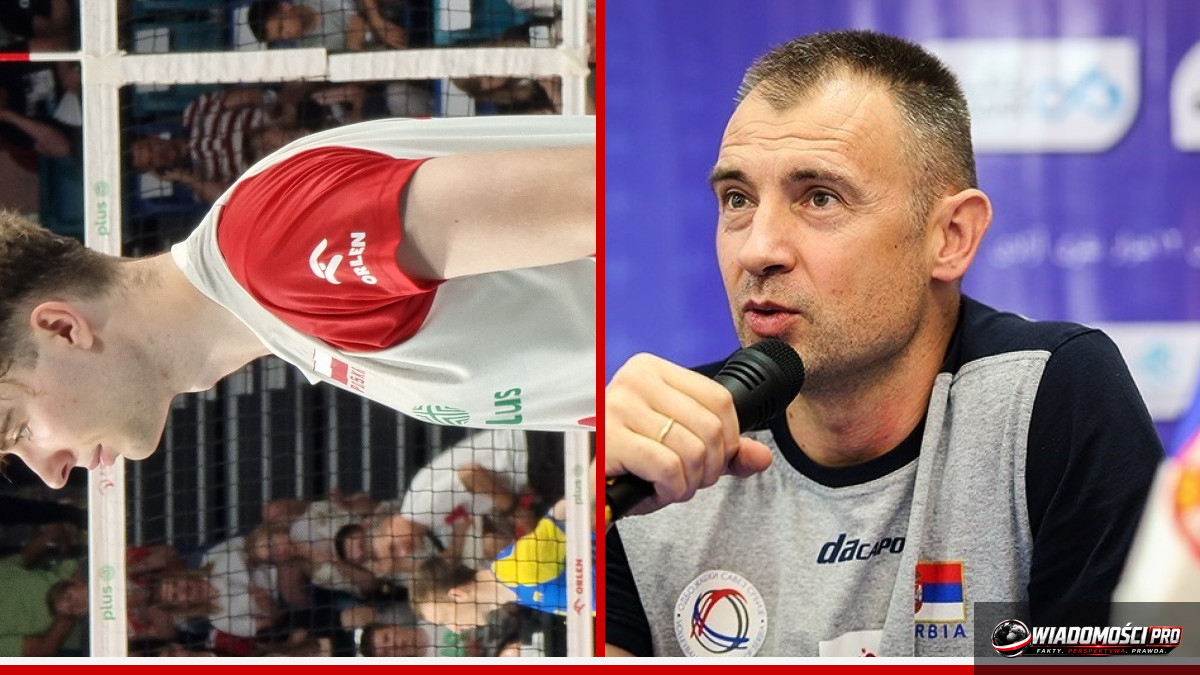
Dawid Dulski played a key role in the match against Slovenia, taking on the burden of the game in decisive moments and securing Poland's advancement to the Nations League semifinals. The young opposite hitter replaced the veterans in the starting six, becoming the main point of reference for the setter in the closing stages of the sets. His uncompromising attitude allowed the team to break through the Slovenian block, which for years had been an impassable barrier for the Polish squad.
Breaking patterns in a clash with a giant
The three-week wait for this moment ended with a victory on July 31, 2026. Poland defeated Slovenia, sealing their advancement to the Nations League semifinals. Nikola Grbić's charges made it to the final four of the tournament, leveling the head-to-head record against their rival to 9:9. A draw in this great volleyball rivalry is a signal that the psychological barrier that the Slovenians had built over the years has finally ceased to exist.
Dawid Dulski did not look for safe solutions when the score was tied. Instead of waiting for the opponent's mistake, he attacked from high balls, taking responsibility in situations where older players from other national teams usually look for cover. Grbić, known for his love of rotation, this time bet on a player for whom pressure proved to be a catalyst for effectiveness. The Slovenians, accustomed to controlling the pace of matches against the Poles through defensive positioning, found no way to counter this new force in the Polish attack. Advancement is a fact, and Poland is back in the game for the highest trophies, proving that the changing of the guard in the attack is proceeding smoothly.
The Nikola Grbić Era: Building a new powerhouse
Building the team under Nikola Grbić is a process that many observers considered risky. The Serbian coach consistently pursues the rejuvenation of the squad, which is visible in the way he rotates players. This is not a random change, but a well-thought-out strategy of replacing national team legends with new names who enter the game without the baggage of past defeats. The coach is not afraid to bench recognized players if the system provides better tactical alternatives.
The effectiveness of this approach was confirmed by the advancement earned at the end of July. Even before the match, there was talk of the "Slovenia curse," and now it is Poland dictating the terms on the way to the final. Grbić's system works, although the price for this peace of mind is high. Fans must come to terms with the fact that personal stability is giving way to rotation. Interchangeability has become the main asset, which makes this squad less readable for rivals. The risk the coach took has paid off in full. The question remains: will the new powerhouse be able to maintain consistency in the most important tournaments of the season? For now, the results defend the Serbian's methodology, although the margin for error in the semifinals will be much smaller than in the group stage clashes.
Statistical summary of dominance at the net
When the score was tied in the third set and the stands in Ningbo went silent, it was Dawid Dulski who took on the burden of responsibility. His effectiveness in the closing stages of the sets closed the door for the Slovenians to turn the tide of the match. This was no accident, but a calculation supported by hard data from the match protocol. Slovenia, famous for reading the game and defensive positioning, crashed against the wall that the Poles built in the offensive zone.
Our advantage resulted from ruthlessly exploiting the opponent's weaknesses in every rotation. Here is what the dominance looked like in numbers:
- Attack effectiveness in the third and fourth sets — 78% (according to SportoweFakty data).
- Number of blocks on Slovenian wingers — 6.
- Poland's serve efficiency — 14.2%.
- Slovenia's serve efficiency — 9.8%.
These statistics show the brutal truth about this meeting. While Slovenia desperately looked for points in the service zone, often taking risks and making mistakes, Poland opted for stability and surgical precision. The difference in serve efficiency, exceeding four percentage points, allowed the team to push the Slovenians away from the net, which directly translated into easier work for our block. Rivalry with such an opponent usually ends in an exchange of blows, but in this match, we saw the execution of a tactical plan. If Dulski maintains this form in the semifinals, the coaching staff can sleep soundly. Rivals must find an answer to the uncompromising style of play, given that even such a well-organized team as Slovenia had to acknowledge the superiority of the Polish attack.
The new face of Polish volleyball: Who replaced the legends?
The Slovenians once again set conditions that for many teams ended in quick capitulation. This time, however, the Polish bench was not just a place for observation, but a real turning point. In the decisive phase of the clash, it was not the veterans, but Dawid Dulski who took on the burden of responsibility for the advancement. His progress during this year's Nations League was noticeable, but only in Friday's match, under immense pressure, did he turn potential into hard points on the scoreboard. He secured us a semifinal spot, finishing plays in moments when the rest of the team was clearly looking for safe solutions.
Dulski's style of play clearly differs from what the retiring giants have accustomed us to over the years. Where his predecessors relied on power solutions and proven technique, he operates with risk and looks for unconventional angles. This is a change in the aesthetics of our volleyball. Opponents from Ljubljana, accustomed to analyzing the patterns of Polish veterans, could not find an effective way to counter his non-standard hits from the right wing for three sets.
What makes the biggest impression is the player's psyche in extremely difficult finishes. While the arena in Ningbo went quiet at 23:23, he did not look for cover. He took the ball after an inaccurate reception and, without a shadow of hesitation, hit cross-court, completely cutting off the blockers' path. This is a rare trait for a player just entering the starting six. The coaching staff has gained a leader in him who is not afraid to take on the burden of the match when the score is tight.
The road to defending the title: Challenges in the semifinals
The Polish men's volleyball team is in the Nations League semifinals, and the victory over Slovenia did not come easily. It was a demanding match in which the fate of the advancement hung in the balance until the very last balls. Dawid Dulski played a key role, taking on the burden of the game in decisive moments. He took responsibility when the team needed the strongest hit, proving that the personnel changes in the coaching staff had a deeper meaning.
The White and Reds face the most important stage of the tournament. Defending the championship title requires the team not only physical strength but, above all, mental resilience. Statistics show that the head-to-head record of these teams after Friday's meeting is 9:9, which emphasizes how even the level of play is.
The schedule for further struggles looks as follows:
- The team will appear in the semifinals according to the tournament bracket, as confirmed by the organizers' announcements on July 31.
- The coaching staff has limited room for maneuver regarding player recovery, as the schedule imposes a very high pace.
- The next high-stakes match will take place in a very short time, which will force the coach to rotate the squad to maintain the intensity of the game.
The pressure is mounting. In the semifinals, there will be no room for the lulls that occurred in previous stages of the tournament. The rivals who will face the Poles know the weaknesses of our team perfectly, so maintaining concentration from the first play will be crucial. If the team maintains the form of its leader from the attack, the chance to defend the title remains real. However, it will not be a walk in the park, but hard work requiring full tactical discipline.
Rivalry of giants: Why is Slovenia so dangerous?
The 9:9 record in clashes between Poland and Slovenia is not a coincidence, but proof that we are facing a rival of identical weight. After years in which the "Slovenia curse" weighed on the White and Reds, today's clash for the Nations League semifinal had the character of a symbolic reckoning. European volleyball has long ceased to be a hierarchical system, and Slovenia is emerging as the main antagonist of the Polish national team, capable of reading every tactical pattern.
The victory in this match was not just a pass to the medal zone. It was a psychological breakthrough. In high-stakes clashes, every point weighs double, and the margin for error practically does not exist. The Slovenians are famous for their extraordinary resistance to pressure and the ability to punish even the smallest fluctuations in the opponent's form. That is why it was so important who, in the decisive fragments of the set, could discard calculation in favor of pure instinct.
That was exactly when Dawid Dulski took on the burden of the game. In moments when experienced leaders looked for safe solutions, it was he who broke the impasse. His determination and lack of respect for the titled rival proved to be the missing element that secured Poland's advancement. This player did not just join the squad; he set a new standard in the closing stages of sets. Without his cold blood in the final plays, today's discussion about medal chances would only be theorizing. Slovenia has been broken, but what our players showed gives hope that 9:9 on the board of historical duels was the last draw before clearly pulling away from Slovenian pressure.
Grbić's tactics: Why does it work?
Understanding why Poland won requires looking at the details of Nikola Grbić's work. The Serb opted for a system based on the speed of setting, which forces the opponent's block to constantly correct its positioning. In the match against Slovenia, it was crucial to use the middle blockers to draw attention away from Dawid Dulski. Grbić requires the setter not to be afraid to send the ball to the attacker even against a triple block, as long as he is in the right jumping rhythm.
Such a strategy is based on the assumption that in modern volleyball, the advantage does not come from strength, but from the reaction time of the block. In Friday's clash, the Poles imposed a tempo that the Slovenians were unable to withstand for four full sets. Every tactical play was subordinated to one goal: creating a situation where the attacker has at most two blockers in front of him. When that succeeded, Dulski ruthlessly exploited the gaps. This is a system that excludes routine and promotes courage.
Moreover, Grbić introduced the principle of defensive flexibility. Instead of a fixed defensive setup, the Poles rotate positions depending on which of the Slovenian wingers is in the front line. This requires huge tactical discipline from the players, which was often lacking in previous years. Today's Poland is a team that not only plays power volleyball but, above all, intelligent volleyball. The victory over Slovenia is the best proof that this transformation is bringing measurable results. It's not just about points, but about the way they are scored.
The role of a leader in the new reality
Dawid Dulski became the face of change in this match. His role goes beyond just scoring points. It is he who manages the team's energy on the court. When the team lost confidence in the second set, it was he who restored balance with his serves and attitude in the attack. This is a trait that cannot be learned in training. One becomes a leader, but in situations like this, one becomes a leader in the eyes of the entire team.
For the fans, this is a change to which they must get used. For years, Polish volleyball was associated with names that formed the backbone of the national team for over a decade. Today, this backbone is fluid, and the strength of the national team comes from the quality of each link, not from the individual genius of one or two figures. This approach makes Poland a complete team, in which every player knows what role they have to play. If Dulski maintains this form, he will become the foundation upon which Grbić will be able to build further successes.
What this means for you
Poland's victory over Slovenia means that Nikola Grbić has successfully carried out a personnel transformation. Fans gain certainty that the lack of legends does not lower the quality of play, and the national team remains the main favorite to defend the title, which stabilizes Poland's position in the world ranking. The generational change that has been talked about for years has become a fact in the most demanding sports environment, i.e., during the knockout phase of the Nations League. For fans, this means that the national team is still able to compete with the best, regardless of the names on the jerseys. The stabilization of the position in the FIVB ranking is only a derivative of what we see on the court: self-confidence, tactical preparation, and the ability to win high-stakes matches against rivals who historically caused us the most problems.
Questions and answers
Who will Poland play in the Nations League semifinals?
After the victory over Slovenia, Poland is waiting for the opponent to be determined from the remaining quarterfinal pairs according to the tournament bracket, which is standard procedure in this format.
Did Nikola Grbić change the squad for this tournament?
Yes, the coach is consistently implementing young players, such as Dawid Dulski, who are effectively replacing the team's legends, which was confirmed by the last match against Slovenia.
Where can you watch the semifinal broadcast?
Broadcasts of Nations League matches are available on TVP sports channels and on streaming platforms that hold the rights to the tournament, in accordance with the official broadcaster schedule.
What are Poland's chances of defending the title?
After advancing to the semifinals, the chances of defending the title remain high, given the current form of the team and the effectiveness of the tactical system implemented by coach Grbić.
Is the 9:9 result in clashes with Slovenia final?
The 9:9 result concerns the head-to-head record before the semifinals and reflects the historical rivalry between the two teams, which after this match became fully balanced.
Sources
- Nations League. What time is the Slovenia - Poland match? Live broadcast - Przegląd Sportowy
- Nations League: When is Poland playing in the semifinals? Who is the next opponent for the volleyball players? Schedule - Super Express
- Slovenia - Poland live coverage - Statistics - SportoweFakty
- Nations League: Semifinal, Poland – Slovenia. Where to watch? TV broadcast, coverage - Strefa Siatkówki
- Men's Nations League: Poles will play Slovenia in a potential semifinal - sport.tvp.pl
- Thriller in the Poland vs. Slovenia match, a repeat in Ningbo? 9:9 in the clash of giants - Interia Sport
- "Slovenia curse" hung for years. Time for another chapter of the great rivalry - Eurosport Polska
- Men's Nations League. Poland – Slovenia. See who won. Live score - Przegląd Sportowy
Article prepared by the Wiadomości PRO editorial team with the support of artificial intelligence. Facts come from the sources listed above.
Komentarze (0)
Ładowanie komentarzy...