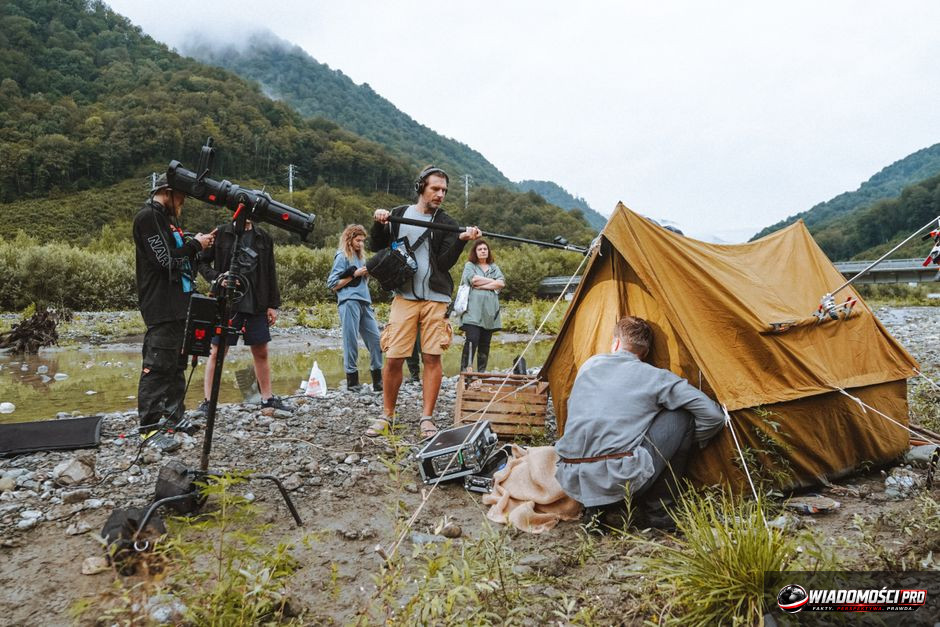
The film "In the Rearview," directed by Maciek Hamela, won the main award at the Vilnius festival on March 28, 2024, which became a key moment in promoting the production before its wide international release. This distinction was not merely a gesture of recognition, but a precise signal sent to global sales agents, confirming the commercial and artistic potential of this documentary. Thanks to the Vilnius verdict, the film gained the necessary credibility that opened a path for its selection at subsequent prestigious European festivals.
The mechanics of the Vilnius triumph
The jury's verdict in Vilnius on March 28, 2024, was not a matter of chance, but the result of a conscious construction of the film, which forces the viewer into full concentration from the very first minutes. Hamela, abandoning the classic reportage distance, placed the camera inside an evacuation vehicle. This technical limitation became the production's greatest asset. The lack of external narrators, voice-overs, or invasive lighting allowed the subjects to forget about the presence of the equipment. The jury appreciated this editing decision, which transformed a raw account into an intimate record of trauma.
Unlike productions that rely on reconstructions, "In the Rearview" is based on chronological editing, emphasizing the growing fatigue of the passengers. Each cut serves to highlight the change in the behavior of the refugees, from initial shock to later resignation. This technique, combined with the sound of the engine as a constant background, builds a claustrophobic tension that cannot be achieved in a traditional interview. Hamela did not look for flashy shots. He focused on the micro-expressions of faces, which, in wartime conditions, required the cinematographer to sense the moment when a person opens up to honesty.
Such an approach to documenting reality differs from the methods used in productions awarded at other events, such as the Mastercard Off Camera festival in May 2025, where Nelicia Low's "Pierce" won. While Low's film relies on refined aesthetics and narrative fiction, "In the Rearview" focuses on the total transparency of the image. It was this difference in technical approach that allowed Hamela's film to stand out from other proposals presented in 2024.
Festival landscape 2024–2025: Where to look for quality
An analysis of the success in Vilnius requires placing it in the broader context of Polish cinema from 2024–2025. During this period, Polish productions appeared on the festival map in a scattered manner, which made it difficult to build a coherent national brand. The Thessaloniki International Film Festival (TIDF) in March 2025 became a venue for presenting documentaries that largely drew from Hamela's experience regarding the directness of the message. In turn, the results of the 64th Krakow Film Festival in June 2024 showed that the Polish jury is increasingly bold in awarding films with a high degree of hermeticism, which acts as a counterweight to the Vilnius distribution model.
It is worth recalling the dates that shaped the Polish industry at that time. On September 27, 2025, we learned the first awards in Gdynia, where the emphasis was placed on feature films, which clearly stood apart from the documentary successes of the beginning of the year. On September 21, 2025, the winners of the Snakes (Węże), or the Polish Golden Raspberries, were announced. This contrast – between awards for outstanding achievements and the pointing out of artistic failures – shows that the Polish viewer and industry do not have a uniform evaluation system. The success in Vilnius was significant in that it tore the film out of this local, often brutal, cycle of evaluation, moving it to the international stage.
In January 2026, the industry's attention shifted toward short films competing for the Blaue Blume award. This shows that the market is becoming increasingly specialized. Documentary filmmakers, wanting to make a name for themselves, must precisely choose festivals that fit their aesthetics. Hamela chose Vilnius as a start, which turned out to be a sound strategic decision, allowing for the gradual building of interest before entering more competitive markets.
Distribution strategy as the foundation of success
From a producer's point of view, the award in Vilnius is primarily a concrete argument in negotiations with sales agents. In 2024, when the film entered circulation, distributor interest was correlated with the number of festival laurels. Although the exact numbers of contracts are trade secrets, it is known that after March 2024, the film "In the Rearview" gained priority in offers sent to distributors in Western European and North American markets.
This mechanism works in a predictable way for those familiar with festival realities. Selectors of the most important events, such as Cannes (where the Palme d'Or was awarded in May 2024), rarely risk including titles in the program that have not previously passed the so-called quality selection at smaller festivals. Winning in Vilnius acted as a kind of filter. Thanks to this, distributors knew that the film already had verified quality, which reduced the investment risk associated with promoting a documentary on a difficult war-related topic.
Modern documentary distribution is not just about movie theaters. It is also about VOD platforms, which began imposing their own standards in 2025. Hamela's film had to meet the technical requirements of these platforms, which was possible thanks to the high quality of the source material. The lack of staging, which delighted the jurors in Vilnius, also proved attractive to viewers looking for authenticity on streaming services. This is a rare case where the artistic requirements of the jury coincided with the preferences of streaming platform algorithms.
Technical aspects of Hamela's work
The camera in "In the Rearview" is not just a recorder. It became the third passenger in the car, which forced the director to take a specific approach to framing. Hamela used natural light coming through the vehicle's windows, which, combined with the vibrations of the car, creates the impression of being in the middle of the events. The jury in Vilnius especially appreciated the way the director avoided showing war actions directly, focusing on their effects visible in people's psyches.
The editing in this film is a lesson in discipline. Many hours of footage were reduced to the final runtime, which excludes everything that does not lead to a deeper understanding of the passengers' emotional state. Hamela abandoned dynamic cuts in favor of long takes, which allow the viewer to empathize with the silence that often falls between conversations. Such an aesthetic is contrary to the fast pace of modern media, which makes the film an even more distinctive element in distributor catalogs.
Attention should be paid to the sound design. The lack of illustrative music in the climactic moments is another decision for which the film received praise from critics. Ambient sound – the hum of tires, conversations, breaths – creates a unique soundtrack that is more engaging than any orchestration. It is precisely these technical details that determine the film's longevity in the viewer's memory. The success in Vilnius confirmed that minimalism in documenting conflicts is a more effective method of building a narrative than attempting to show the full spectrum of military operations.
Competition for attention in 2026
The year 2026 brings new challenges for the Polish documentary. After successes like the one in Vilnius, the bar has been set high. Filmmakers must now reckon with the expectations of audiences who have become accustomed to high-quality documentary images. Festivals such as TIDF in Thessaloniki or the Krakow KFF are becoming arenas where Polish documentary filmmakers must prove that their works are more than just a record of current events.
However, the market situation is full of pitfalls. Not every award translates into commercial success. The example of "Pierce" by Nelicia Low, which won Off Camera in 2025, shows that even international co-productions gain recognition from local juries, which does not always guarantee them a wide audience. Polish cinematography is currently at a point where it must decide whether to follow the path of festival successes or look for new ways to reach the viewer outside the traditional circuit.
For a young filmmaker planning a debut in 2026, the lesson from Vilnius is clear: success requires a prior strategy. It is not enough to make a good film. You have to know how to sell it at the right stage. The award in Vilnius is a model example of using a local distinction to open doors to global markets. It is a strategy that, if copied, could be the key to survival in an industry that becomes more demanding for new talent every year.
Perspectives for the Polish documentary
The Polish documentary in 2026 is facing an opportunity to permanently establish itself in the European circuit. The successes of the last two years show that Polish filmmakers possess a unique sensitivity to social issues, which is valued by international juries. However, having sensitivity alone is not enough. It is necessary to understand the mechanisms that make a film noticeable in a sea of thousands of productions available online.
Festivals act as gatekeepers. Without their acceptance, the chances of reaching a wide audience are negligible. That is why it is so important for the Polish film community to invest not only in the production process itself but also in festival strategy. Each title must have its own plan – from Vilnius to festivals in Thessaloniki or Cannes. Only in this way can Polish cinema maintain its current position in the European market.
One cannot forget the role of criticism. Reviews that appear after festivals shape the image of the film in the eyes of distributors. In 2025, we saw how criticism can influence the reception of even such high-profile titles as those awarded in Gdynia or at the Snakes. The industry needs reliable assessments that will help viewers navigate the maze of premieres. The film "In the Rearview" proved that an honest approach to the topic, supported by solid technical work, will always find its place on the festival map.
Challenges for future generations of filmmakers
What awaits Polish cinema after 2026? It can be assumed that the emphasis on authenticity will be even stronger. Viewers are increasingly rejecting scripted stories in favor of honest, raw records of reality. This is an opportunity for documentary filmmakers who can work in difficult conditions, much like Hamela. However, to take advantage of this opportunity, they must have the appropriate financial and logistical support that will allow them to devote enough time to the implementation of the project.
The issue of funding is key here. Successes in Vilnius or at festivals in Krakow are important, but they do not directly fuel the budgets of subsequent productions. The industry must develop support systems that will allow creators to focus on quality, rather than fighting for survival between one festival and another. If Polish cinema wants to be competitive, it must invest in project development at every stage, from the idea to distribution.
Looking at the data from 2024–2025, it is clear that the Polish documentary has the potential to win against feature films with much larger budgets. This is proof that in the world of film, what counts above all is the idea and the way it is executed. "In the Rearview" is not just an awarded documentary. It is a symbol of the changes taking place in Polish cinema – a departure from large, expensive spectacles in favor of stories close to the human experience, which gain recognition thanks to their honesty and precision of execution.
The role of festivals in building prestige
Film festivals are not just red carpets and statuettes. They are primarily a market for the exchange of knowledge and experience. Every meeting of filmmakers in Vilnius or Thessaloniki is an opportunity to establish contacts that can result in further co-productions. In 2025, we saw how important these relationships are for the development of Polish cinematography. International cooperation has become an inseparable element of success, and festivals are the main place where these partnerships are built.
For the viewer who observes these processes from the sidelines, festival awards should be a signal that a film is worth watching. However, this is not always the case. Sometimes festival choices diverge from the expectations of the mass audience, which leads to disputes between critics and the public. The success of Maciek Hamela's film was unique in this respect because it reconciled both worlds – the recognition of the jury in Vilnius went hand in hand with positive reception from viewers, which was confirmed by subsequent distribution results.
Understanding this phenomenon is the key to success in the future. Creators who can maintain a balance between artistic vision and the needs of the viewer will be able to succeed on the international stage. "In the Rearview" set standards that others will strive for. It is a documentary that proved that even in the most complicated times, an honest story told with passion can break through the information noise and move thousands of people around the world.
What this means for you
A film's success at a festival before its premiere is a strategic move that allows producers to build the work's reputation, facilitating the sale of licenses to cinemas and streaming platforms around the world. Creators and the Polish image benefit, but the catch is the necessity of maintaining high artistic quality, which does not always guarantee commercial success with a wide audience.
Questions and answers
Why are festival awards so important for a film before its premiere?
The award confirms the high artistic quality of the film, which attracts the attention of distributors and the media even before the production enters theaters, acting as a certificate of credibility.
Where did the premiere of the awarded film "In the Rearview" take place?
Maciek Hamela's film won the main award at the film festival in Vilnius, which took place on March 28, 2024.
Do Polish documentaries often win international awards?
Yes, Polish documentary cinema regularly achieves success at festivals such as those in Thessaloniki (TIDF) or Krakow, as confirmed by rankings from 2024 and 2025.
What influenced the jury's verdict in Vilnius?
The jury appreciated the raw realism, the innovative technique of placing the camera inside the evacuation vehicle, and the editing, which allowed for an intimate portrayal of the characters' emotions without unnecessary embellishments.
What is the significance of festival results for the viewer?
Awards act as a filter in the sea of premieres, helping viewers choose productions of the highest artistic value that have already been verified by professional judging panels.
Sources
- Gdynia 2025: First awards presented - Filmweb
- Great Polish short films for free online! Competing for the Blaue Blume award - Telemagazyn
- SNAKES 2025: we know the winners of the Polish Golden Raspberries - Filmweb
- We know the winners of the 77th Cannes Film Festival. Who received the Palme d'Or? - Vogue Polska
- Here are the winners of the 64th Krakow Film Festival - Magiczny Kraków
- Polish documentary films at the 27th TIDF festival in Thessaloniki - Gov.pl
- "Pierce" by Nelicia Low is the winner of the 18th Mastercard Off Camera festival - TVP Kraków
- "In the Rearview" by Maciek Hamela with the main award of the film festival in Vilnius - Dzieje.pl
Article prepared by the Wiadomości PRO editorial team with the support of artificial intelligence. Facts come from the sources provided above.


Komentarze (0)
Ładowanie komentarzy...