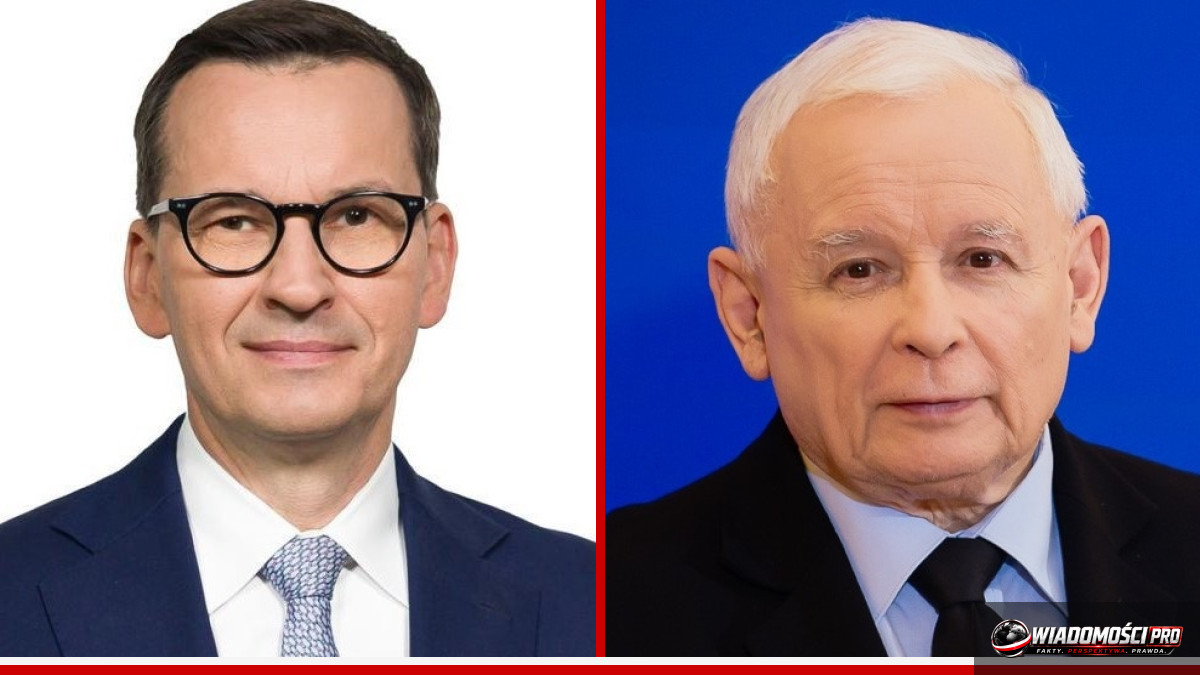
The split stems from a growing conflict over party structures and political vision; Jarosław Kaczyński concluded that "in a sense, it is over," while Mateusz Morawiecki is not abandoning his own "Development Plus" project. This final severance of ties between the leader of Law and Justice and the former head of government is not merely the result of personal animosities, but the effect of a long-term process in which Morawiecki's technocratic approach collided with the conservative "concrete" of Nowogrodzka Street.
The last meeting and the words that changed everything
The atmosphere at Nowogrodzka on Friday, July 24, 2026, was thick with unspoken tension. The meeting, which was supposed to be an attempt to resolve the crisis, became the final turning point. Jarosław Kaczyński, when asked about his relationship with the former prime minister, uttered a short sentence that circulated through the media: "In a sense, it is over." This was not an emotional declaration, but a cold statement of fact. The PiS chairman decided that Morawiecki's continued presence in the party's structures in its current form was untenable.
Kaczyński, when asked about the moment the fracture occurred, pointed to specific actions taken by the former prime minister. "That broke him," the chairman stated, referring to the moment Morawiecki began openly promoting his own political agenda. For the party leader, loyalty to the common project was a paramount value. However, when his former protégé began building his own base, the rules of the game changed. Kaczyński does not tolerate the creation of alternative centers of influence. He believes the party must speak with one voice, and any attempt to break away is treated as sabotage.
A completely different picture of the situation emerges from the accounts of Mateusz Morawiecki's inner circle. The former prime minister, commenting on the course of the talks, admitted that he was surprised by their tone. "I was a bit surprised," he conveyed in a statement on July 24. This surprise likely stems from the conviction that his actions were merely an attempt to save the party from stagnation. Morawiecki believes that without modernization and opening up to new voter groups, PiS has no chance of returning to power.
The catch in this situation is that both sides are right in their diagnoses, but their solutions are mutually exclusive. Kaczyński bets on fidelity to the foundations, believing that only a hard-core electorate will allow them to survive difficult times. Morawiecki, on the other hand, wants to go beyond this circle, which in the eyes of Nowogrodzka looks like a betrayal of ideological assumptions. This is a clash of two worlds where there is no room for compromise. For the PiS chairman, the loss of control over the former prime minister is a signal that the order he has built for decades is beginning to crumble under the influence of people he himself brought into politics.
The "Development Plus" project as the spark of conflict
The "Development Plus" project has ceased to be merely an economic slogan. It has become a political manifesto that defines the division within Law and Justice. Despite clear opposition from headquarters, Mateusz Morawiecki maintained his commitment to this initiative on July 21, 2026. For Nowogrodzka, this project is proof that the former prime minister is building his own independent center of gravity.
When Kaczyński says that "it is over," he is referring primarily to the autonomy that Morawiecki has granted himself. In the structures of PiS, there is no room for two visions of the future. Either you accept the line set by the chairman, or you leave the party. "Development Plus," in Kaczyński's eyes, is an attempt to create a party within a party. This is a situation the PiS leader could not accept, fearing it would lead to permanent destabilization of the structures.
Morawiecki, on the other hand, believes that "Development Plus" is the only path to modern conservatism. In his view, the party must evolve so as not to become a relic. The former prime minister's statements suggest that he does not feel limited by party frameworks. This approach arouses fury in the chairman's immediate circle, which perceives every move by Morawiecki as an attempt to seize power over the party.
It is clear to political observers that "Development Plus" is not just an economic program. It is a political vehicle. If Morawiecki does not withdraw from this initiative – and there is no sign of that – it will lead to a formal split. Kaczyński must now decide whether to exclude the former prime minister, which will certainly affect polling, or tolerate a state of dual power that destroys morale in the party. Each of these decisions carries enormous political risk.
It is worth noting that the dispute over "Development Plus" reflects a deeper aversion between technocrats and ideologues. Morawiecki, who comes from the world of banking, views politics through the prism of indicators and strategies. Kaczyński sees it as a constant struggle for identity. This clash could not have ended in anything other than conflict. "Development Plus" became a symbol of what, in the eyes of the old guard of PiS, is the greatest threat: modernity that does not ask for permission from Nowogrodzka.
Accusations of attempting to take over party structures
Internal tensions in Law and Justice reached a critical point when suspicions of behind-the-scenes attempts to take control of the party apparatus came to light. Newsweek, in a report from July 24, 2026, described how deep the distrust between the former prime minister and the PiS leader runs. Kaczyński, confronting Morawiecki's ambitions, felt threatened in his own creation.
For the PiS chairman, Morawiecki's attempt to build his own structures is a form of attack on the unity of the group. In internal conversations, the chairman does not hide that he will not allow anyone who owes their position to him to break away from party discipline. The words about it being "over" were spoken precisely in the context of the loss of trust, which in politics is a currency with limited supply.
Morawiecki's political base is trying to tone down the mood, suggesting that it is merely a difference of opinion. However, in the corridors, there is open talk of preparations for building a new formation. It is precisely these preparations, reported by sources close to the party, that were the final straw. Kaczyński, who for years successfully suppressed all signs of rebellion, this time faced a challenge he cannot handle with the methods used so far.
The catch is that Morawiecki has his own political and media base. His position is much stronger than that of typical party rebels whom the chairman has removed with a bang in the past. This makes the split in PiS a unique phenomenon. It is not an ordinary argument over seats, but a fight over who will hold the reins of the right after Kaczyński eventually retires.
Accusations of attempting to take over structures are used as a weapon in this fight. Kaczyński tries to portray Morawiecki as a disloyal player who wants to destroy the party from within. Morawiecki, in turn, portrays himself as a politician of the future who wants to save the legacy of the right from ossification. Both sides are playing for the highest stakes, and the victim of this conflict is the cohesion of the entire United Right camp.
A voice from within: Dworczyk warns against a gift for Tusk
Michał Dworczyk, a key figure in the structures of the ruling camp, issued a warning on July 24, 2026, that casts a shadow over the PiS chairman's strategy. His words, published by Newsmax Polska, were a clear signal to Nowogrodzka: pushing Morawiecki out of the party is a gift for Donald Tusk. Dworczyk, known for his pragmatic approach, believes that any attempts to force loyalty with "loyalty pledges" are doomed to failure.
The loyalty pledges mentioned by Dworczyk are the last resort for Kaczyński. The chairman wants every politician in the party to declare full support for the current line. However, in an atmosphere where Morawiecki feels free in his "Development Plus" project, such declarations lose their meaning. Dworczyk notes that no one will sign a paper that could become a death sentence for their own career if Morawiecki creates a new force.
Dworczyk's warning about a gift for Tusk is extremely accurate in the context of the current polling situation. PiS, being in crisis, needs unity more than ever. Meanwhile, the internal conflict drains the party's resources, which should be directed against the government. Dworczyk suggests that marginalizing the former prime minister will only weaken the opposition, making it less effective and more susceptible to attacks from the ruling coalition.
It is worth considering whether Dworczyk's voice is the beginning of a wider rebellion. If other PiS politicians feel that Kaczyński is leading the party astray, they may join Morawiecki. Then the situation will become even more complicated. Dworczyk, being close to the chairman, sees what Kaczyński does not want to notice: that in politics, it is not just power over structures that counts, but also the ability to keep allies.
Dworczyk's words about a "gift for Tusk" are also a signal to voters. They show that there is no unity within PiS on how to win elections. This undermines the party's image as a monolith that always knows what to do. Kaczyński, having ignored these warnings, is taking a huge risk. If the polls continue to fall, it is he, not Morawiecki, who will be accused of breaking up the right.
The polling reality: Kaczyński under pressure
A TVN24 poll published on July 22, 2026, was a bucket of cold water for PiS leaders. The results show that voters are not indifferent to internal friction. The drop in support is clear and directly correlated with reports of the conflict between Kaczyński and Morawiecki. For a party that has built its success on unity for years, this is an existential warning signal.
Chairman Kaczyński, known for disregarding polls, cannot remain indifferent this time. The data shows that the PiS electorate is tired of internal disputes. People expect the opposition to hold Donald Tusk's government accountable, not to air dirty laundry at Nowogrodzka. If Kaczyński does not draw conclusions from this, it may turn out that the party will lose its main political fuel.
It is worth citing data that worries PiS strategists:
- The outflow of the centrist electorate, which saw Morawiecki as the face of a party capable of governing in a modern way.
- A decline in intra-party discipline, which translates into less effectiveness in parliament.
- A lack of a clear message that would be able to cover up information about the conflict.
Kaczyński, declaring that "in a sense, it is over," seems to ignore the fact that this "everything" is not just the relationship with the former prime minister, but the entire structure of PiS support. If the polls continue to fall, the chairman will have to look for someone to blame, and then the conflict with Morawiecki will enter a new, even more brutal phase.
Morawiecki, observing these polls, feels confirmed in his conviction about the need for change. His "Development Plus" project takes on a new meaning in this context. It is no longer just an economic proposal, but a potential alternative for voters who are turning away from PiS. Kaczyński, by fighting Morawiecki, paradoxically accelerates the process he fears most: the marginalization of his own group.
Morawiecki's reaction: no feeling of betrayal
Mateusz Morawiecki, even though he has been pushed to the margins of party life, has not taken on the role of the victim. On July 21, 2026, in a short statement, he declared: "I absolutely do not feel betrayed." This sentence is key to understanding his further strategy. The former prime minister does not feel betrayed because he had assumed the possibility of parting ways with the party from the beginning.
For political observers, this is a signal that Morawiecki had been preparing for this scenario for months. His involvement in "Development Plus" was not accidental. It was a contingency plan that is now becoming the main plan. Morawiecki knows that there are no sentiments in politics, and the only currency is effectiveness. If PiS does not want him in its ranks, he will find a place for himself on the political map.
The lack of a feeling of betrayal is also an attempt to show that it is Kaczyński who has lost touch with reality, not him. Morawiecki wants to be seen as a politician who is not afraid of challenges and is not attached to party seats. This is a narrative that may attract the younger generation of voters to him, for whom the disputes at Nowogrodzka are incomprehensible and archaic.
However, skepticism is advised. Does Morawiecki really believe that he will manage to build a new force on the ruins of PiS? History teaches that splits within the right rarely end in success for those leaving. Kaczyński has the party apparatus, media favorable to the party, and a faithful electorate behind him. Morawiecki has only his project and his own ambitions. This balance of power is not favorable to him.
Nevertheless, Morawiecki shows no signs of capitulation. His calm in the face of attacks from Kaczyński may be a tactical move. The former prime minister is counting on time working in his favor. The longer the conflict lasts, the more weakened Kaczyński will be. Morawiecki is patiently waiting for the situation in PiS to become difficult enough that it will be the chairman who has to ask for a truce.
The end of an era in Law and Justice
The date July 24, 2026, will go down in history as the moment when Law and Justice ceased to be a monolith. The split has become a fact, and Jarosław Kaczyński's words that "in a sense, it is over" mark the end of an era. This is not just a personnel change in the party leadership, but a change in the paradigm of how the right operates in Poland.
The causes of this state of affairs are deep and date back to when Morawiecki became prime minister. From the beginning, he was a foreign body in the structures of PiS, a man who brought corporate culture into a party based on loyalty and ideology. For years, it was possible to reconcile this, but over time the differences became too great. "Development Plus" was just the spark that lit the fuse.
The consequences of this move are unpredictable. On one hand, we have a party that will radicalize, trying at all costs to maintain the purity of its ranks. On the other hand, we have Morawiecki, who will try to build a new quality on the right. This clash will define politics for the coming months, and perhaps even years.
It is worth noting that both sides are suffering losses in this conflict. Kaczyński is losing an influential leader and part of the electorate; Morawiecki is losing his base and the support of the party machine. Who will gain from this? Most likely the competition, which is watching with satisfaction as PiS destroys itself. Donald Tusk and his coalition can now calmly pursue their goals while the right is busy with itself.
The end of an era in PiS is also a signal to voters. It shows that even the most powerful party can succumb to internal divisions if it stops listening to its own leaders and begins to be managed by fear and distrust. Kaczyński must now decide whether he wants to remain the leader of a niche party or if he can unite the right once again. For now, however, there is no indication of that.
What's next for the right in Poland?
The future of the right in Poland is in question. The split in Law and Justice creates a vacuum that someone will have to fill. Will it be Morawiecki with his "Development Plus," or perhaps another formation that will emerge from the chaos? One thing is certain: PiS in its current form is losing its monopoly on representing the conservative electorate.
Michał Dworczyk was right to warn against a gift for Tusk. Every day of conflict in PiS is a day when the government can feel safer. Right-wing voters feel confused seeing their leaders fighting each other instead of fighting the opposition. This leads to apathy and a drop in mobilization, which can be seen in recent polls.
What's next? Three scenarios are possible:
1. PiS consolidates around Kaczyński, pushing "modernizers" to the margins. The party becomes more radical, but also smaller.
2. Morawiecki creates a new force that attracts disillusioned PiS activists. The right divides into two factions, which in practice means losing the chance for power in the next election.
3. Both sides reach an agreement at the last minute, but it is an unstable truce that breaks at the first opportunity.
Each of these scenarios is risky for the right. Kaczyński, by declaring that "it is over," has likely chosen the first variant. This means that PiS faces a difficult time in which it will have to prove that it can survive without Morawiecki. Will it succeed? History shows that parties based on a single leader tend to disintegrate after his departure or after losing control over his surroundings.
It is worth paying attention to Morawiecki's own attitude. If he consistently builds his project, he will become the greatest threat to Kaczyński. This is a clash where there is no room for mercy. Both sides are playing for everything, and the stake is the future of the Polish right. Will it be possible to rebuild unity after all this? It seems that the crack is too deep to ever be fully patched.
What this means for you
For the average voter, the split in PiS means the end of a certain stability on the political scene. It also means that the next election will be a race not only between the ruling coalition and the opposition, but also a fight over who on the right will take over the legacy of Kaczyński. If you value predictability, the coming months may be a time of uncertainty for you, because every decision from Nowogrodzka may be questioned by Morawiecki's wing.
Questions and answers
Does Mateusz Morawiecki feel betrayed by Jarosław Kaczyński?
No, the former prime minister publicly declared on July 21, 2026, that he absolutely does not feel betrayed, which suggests that he had been preparing for the possibility of parting ways with his previous base from the beginning.
What is the main reason for the conflict between the leaders?
The main reason is a dispute over the political vision of the state and accusations of an attempt to take over party structures by Morawiecki, which led to Kaczyński's words that "in a sense, it is over."
What is the significance of the "Development Plus" project?
This is Morawiecki's original project, which he does not intend to abandon, which is one of the flashpoints in relations with Chairman Kaczyński, building an alternative decision-making center outside the structures of PiS.
What follows from the polls cited in the context of the split?
A TVN24 poll from July 22, 2026, indicates a clear outflow of the PiS electorate, which confirms that internal disputes negatively affect the party's support, making the situation critical for Nowogrodzka.
What warning did Michał Dworczyk issue?
Dworczyk warned that attempts to force loyalty with "loyalty pledges" are ineffective, and pushing Morawiecki out of the party is merely a gift for Donald Tusk, which weakens PiS's chances for electoral success.
Why did Kaczyński decide that "it is over"?
The PiS chairman decided that further coexistence with Morawiecki is impossible due to the former prime minister's attempt to build his own influence and his rejection of the party's vision based on full subordination to the leader.
Is reconciliation within the party possible?
At the current stage, the conflict seems too deep, and the differences in the vision of the future of the right too clear for the parties to reach a compromise, which is confirmed by the declarations of both leaders from July 2026.
What are the consequences for the political scene?
The right is entering a phase of deep restructuring, in which PiS is losing its monopoly on representing the conservative electorate, which creates space for new political projects and destabilizes the existing balance of power.
Sources
- PiS chairman on the key moment in his relationship with Morawiecki. "That broke him" - Onet News
- The split in PiS is a fact. Kaczyński: In a sense, it is over - edgp.gazetaprawna.pl
- The real reasons for the split in PiS. We explain everything you need to know - Newsweek
- Conflict in PiS and a new poll. "This is the worst news for Kaczyński and he must draw conclusions from it" - TVN24
- "I was a bit surprised". Morawiecki revealed the backstage of the meeting with Kaczyński - Interia Events
- Dworczyk on the dispute in PiS: no one will sign "loyalty pledges", and pushing Morawiecki out would be a gift for Tusk - Newsmax Polska
- Morawiecki does not back down. He does not intend to give up the "Development Plus" project - Wyborcza.pl
- Mateusz Morawiecki spoke out. "I absolutely do not feel betrayed" - Fakt
Article prepared by the Wiadomości PRO editorial team with the support of artificial intelligence. Facts are derived from the sources provided above.
Komentarze (0)
Ładowanie komentarzy...