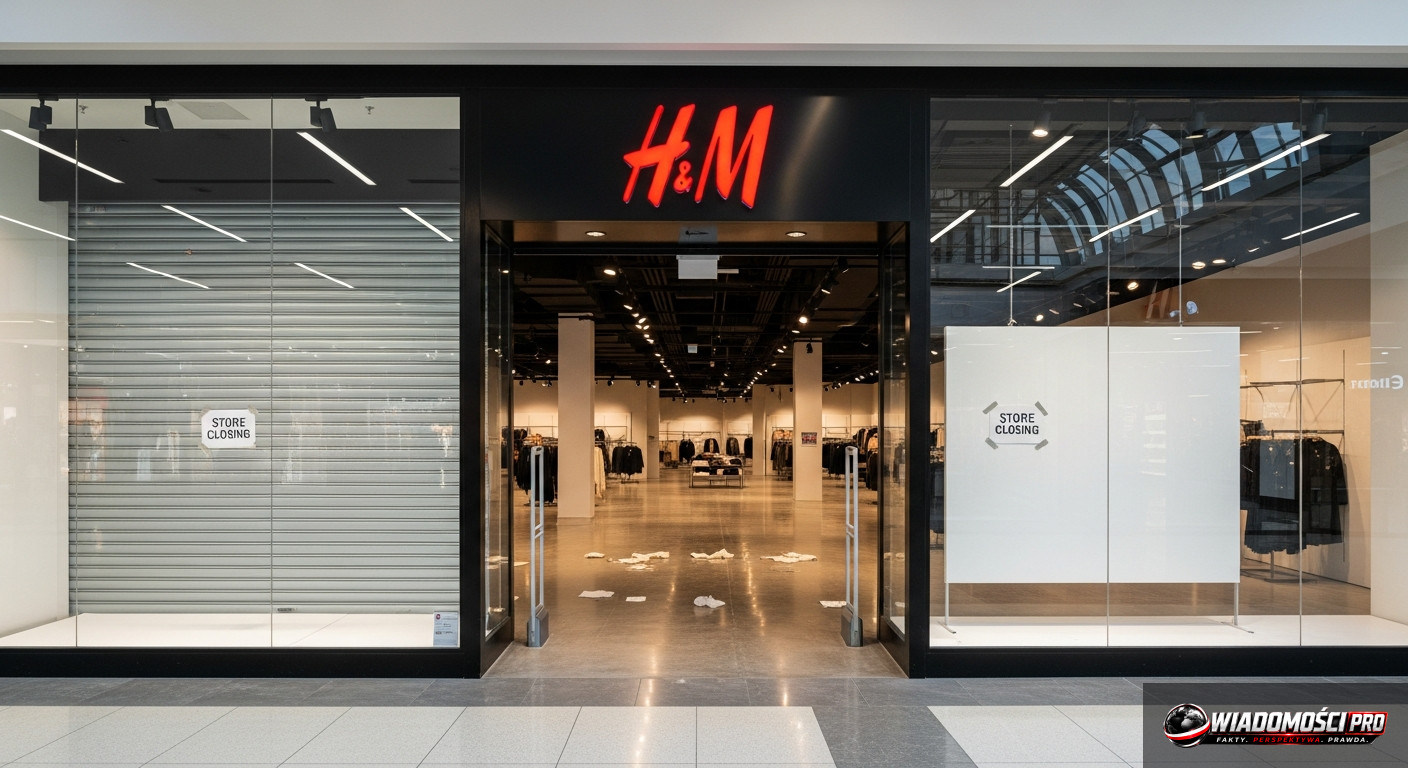
H&M is closing 130 stores as part of a global cost optimization strategy, which is a continuation of the process of liquidating over 1,000 locations and involves layoffs affecting groups of over 400 people. The Swedish clothing chain is giving up on maintaining unprofitable brick-and-mortar points, responding to rising rental costs and changing consumer shopping habits. This decision is part of a broader restructuring that will drastically change the map of the brand's presence in European markets in the coming months.
Evolution of the sales model and rental pressure
European clothing chains are verifying their expansion plans. For decades, H&M based its growth on occupying thousands of square meters in prestigious shopping malls. Currently, this business model is generating losses. The ratio of rental costs to revenue per square meter has become unacceptable to the board in Stockholm. Retail properties in Europe require high maintenance costs, which, with a declining number of visitors, is becoming a financial burden.
Customers are shifting their spending to the online channel. A brick-and-mortar store that was a "must-have" for the brand five years ago now generates a negative operating margin. The company's management takes into account not only rent in its calculations, but also the costs of electricity, security, technical service, and delivery logistics to a specific location. When these expenses exceed the revenue generated by customers, the only solution is to shut down operations.
The growing importance of online retail forces a shift of funds from maintaining physical sites toward distribution centers. Instead of paying rent in malls, the chain is investing in the automation of warehouse processes. Freeing up capital frozen in rent allows for the digitalization of sales. Competition from marketplace platforms and brands operating exclusively online makes maintaining an extensive physical infrastructure no longer profitable.

Mechanisms of employment reduction in the face of change
Closing sales points has consequences for the employment structure. The process of shutting down a location goes beyond taking the sign off the facade. It requires carrying out procedures related to the termination of employment contracts, often in the form of group layoffs. The scale of these actions is noticeable in the company's reports. Data from October 22, 2024, confirm that layoffs at that time affected a group exceeding 400 employees simultaneously.
Employment optimization is a way to reduce fixed costs. In European countries, where labor law is strict, every wave of layoffs must be preceded by consultations with trade unions. H&M faces different regulations in every country where it closes its branches. This process takes place in stages, which results from the need to meet legal requirements.
The company offers transfers to other locations, provided they are within geographical reach. However, with the mass scale of store closures, relocation opportunities are limited. As a result, many employees lose their jobs, which affects the condition of local labor markets. Personnel costs are one of the main items subject to cuts in quarterly reports, which is directly correlated with the number of liquidated sales points.
Market perspective: Why are giants losing momentum?
H&M's situation is not an isolated case. We are observing a trend in which traditional retail chains are losing their dominant position to more flexible business models. The example of the company Kodi, which announced on May 5, 2025, that it would reduce its store network by one-third, shows that the problem affects a wide range of companies in the non-food sector. The market is becoming demanding, and barriers to entry for new digital players are lower than ever.
For clothing giants, the challenge remains managing huge inventories of goods. Brick-and-mortar stores require constant supply and display, which involves high operating costs. In the online model, inventory turnover is easier to control, and storage costs are optimized in central warehouses. H&M is transforming its business model to compete with companies that do not have the burden of thousands of sales points.
Investors expect an improvement in profitability ratios. Every closure of an unprofitable store improves the company's operating result. However, the question arises about the reach and recognition of the brand. A brand that disappears from main streets becomes less visible, which affects customer loyalty. The company is balancing between short-term profit and maintaining long-term market share.
Geography of change: Where is the wave of restructuring hitting?
Official announcements often focus on global numbers, but the effects of the board's decisions are felt in specific regions. Europe is a place of intense change. In cities where several chain stores operated for years, now only one remains, or the brand is withdrawing completely. This strategy involves focusing on flagship locations that generate the most traffic, while abandoning smaller points in medium-sized cities.
Poland is subject to the same mechanisms as Western markets. Shopping malls, which for years were the main place of the brand's presence, must now compete for tenants with retail parks. Retail property owners in Poland are in a difficult situation, as the exit of such a large player as H&M creates a gap in the mall's offering. It is difficult to fill it with another entity with similar drawing power.
The company's board in Stockholm analyzes data from each market separately. This leads to a situation where the chain is growing in one country and drastically shrinking in a neighboring one. A data-driven approach, rather than one based on sentiment, is the foundation of modern management in the era of the retail crisis. According to reports from February 21, 2026, the total number of liquidated locations exceeded 1,000, which proves that the scale of the cuts is systemic.
Financial discipline versus customer sentiment
Decisions to close stores result from the analysis of spreadsheets. H&M's management aims to return to satisfactory profitability, which has been under pressure in recent years. For customers accustomed to the brand's presence in their neighborhood, this is a negative change. The ability to try on clothes before buying, direct contact with staff, and immediate pickup of goods are advantages that e-commerce does not fully replace.
The company faces a challenge: how to maintain a relationship with the customer when physical presence becomes a luxury? Some brands are creating smaller showrooms where the customer views the goods but places the order online. Will H&M follow this path? Currently, the priority remains cutting costs, not costly format transformation. The board is betting on survival in a leaner version, which is a safer strategy in the face of high market uncertainty.
For stock market investors, cost reduction is received with moderate optimism. The market expects the company to stop losing money on unprofitable points and focus on generating margins where it still makes sense. In the long term, the brand's success depends on its ability to adapt. If H&M does not find a way to attract younger generations, closing stores may turn out to be merely delaying the inevitable loss of its leadership position.
Analysis of operating cost structure
To understand why H&M is closing stores, one must look at the structure of operating costs. Apart from rent, which is a fixed cost, electricity costs, which have risen drastically in Europe, play a huge role. Large retail spaces require intensive lighting, air conditioning, and heating. At current energy prices, this is a burden on the budget of every salon. Additionally, labor costs are rising in almost all countries where the brand is present, which forces the search for savings on a global scale.
Another factor is logistics. Maintaining a supply chain to hundreds of stores in different countries is a process requiring extensive transport infrastructure. Optimizing this network by closing stores allows for the consolidation of deliveries and increased transport efficiency to points that remain in the portfolio. Fewer points to supply means lower logistics costs and a higher margin on the sold product.
Inventory management is another area where the company is looking for savings. In brick-and-mortar stores, goods often sit on shelves, which forces frequent sales and price reductions, negatively affecting the margin. In the online channel, inventory management is centralized and allows for better matching of supply to demand. A company that manages inventory better achieves better financial results. Closing stores is a tool for better controlling the flow of goods and limiting losses resulting from inefficient brick-and-mortar sales.
Future of the industry: Does physical retail still have a chance?
The question about the future of physical retail remains open. Will shopping malls transform into places of entertainment and meetings, where shopping will only be an addition, or are they facing slow degradation? The current trend indicates that the role of brick-and-mortar stores is changing from transactional points to image-building points. A brand that is not physically present in the most important places loses out in the eyes of consumers, even if it is strong online.
Maintaining such a presence, however, requires huge financial outlays. H&M is at a turning point, deciding how many stores are necessary to maintain its image and how many are a financial ballast. The decision to close 130 locations is a signal that the company is shifting its center of gravity toward efficiency. Every subsequent decision to close a point will be more difficult because it will concern stores that likely still generate a profit but do not meet the board's stringent expectations.
For the labor market, this means uncertainty. The retail industry, which for years was one of the largest employers, is becoming a sector where employment stability is decreasing. Employees of clothing chains must reckon with the need for retraining. This is a challenge not only for the company itself but also for the economies of countries where H&M plays the role of an important employer.
Conclusion: Balance sheet of changes
The strategy currently being implemented by H&M is a painful, multi-year process of withdrawing from physical retail on a mass scale. The current phase of restructuring includes 130 stores, which is a continuation of the cost-cutting policy. The company is implementing this scenario as part of cost optimization, which for rank-and-file employees means job losses. The scale of layoffs is measurable, involving groups of over 400 people. This is a systemic reduction of jobs, fitting into a trend for those employed in the retail sector.
For the reader, these numbers mean one thing. The brand that for years defined the look of shopping malls is becoming an increasingly virtual entity. The question of whether a digital presence will compensate for such a drastic reduction in physical presence remains open. Investors may be satisfied with cost optimization, but for local labor markets, every closure is a loss of tax revenue and a loss of jobs. The industry is on the defensive. H&M is one of many players that had to adapt to new realities. The future will show whether this path proves effective or leads to further marginalization of the brand in the minds of consumers.
What this means for you
For customers, this means less availability of brick-and-mortar stores and the need to use e-commerce more often. For investors, it is a signal of financial discipline, but for employees, it is a risk of losing employment stability as part of global reductions. Every closed store in your area is a signal that the brand has stopped seeing business potential in that location, which is often preceded by a decline in service quality or lower availability of goods on shelves.
Questions and answers
Why is H&M closing so many stores?
The company is implementing a global portfolio optimization strategy, closing unprofitable locations, which has already totaled over 1,000 locations as part of a long-term restructuring.
Does closing stores involve layoffs?
Yes, restructuring processes bring with them job cuts; in the past, one of the waves of layoffs affected over 400 people, which is a constant element of the operating cost-cutting strategy.
Does this mean the end of H&M's presence in Poland?
No, this is a global optimization process, however, the Polish market, like others, is subject to verification in terms of the profitability of each location, which may lead to further limiting the number of sales points.
What are the main financial reasons for these actions?
The main reasons are rising rental costs for retail space, high energy costs, and the need to shift capital toward digital customer service and e-commerce logistics.
Are other clothing chains also closing stores?
Yes, this is a common phenomenon in the retail sector, which is confirmed by reports of restructuring at other players, such as Kodi, which also had to drastically reduce its sales network.
Business context: How H&M is building an advantage in a crisis
An analysis of the recent decisions of the Swedish giant's board points to a radical change in priorities. The company is no longer treating the physical sales network as the main channel for building reach. Instead, the company aims to gain full control over the margin through centralized logistics. In an era of high inflation, which has hit labor and property maintenance costs in Europe, every square meter of retail space is being converted into potential net profit.
The aforementioned restructuring, initiated by a series of layoffs reported in October 2024, is not a momentary move. It is the result of years of neglect in the area of adapting to the omnichannel model. Competitors, such as marketplace platforms, have been building their advantage for years without the burden of costly leases in shopping malls. H&M is making up for this backlog in a way that is brutal for the labor market.
It is worth noting that the closures primarily concern those locations that have lost their status as a "destination point" for the customer. In today's shopping model, where the consumer comes to the store with a specific intent, rather than to look for inspiration, small and medium-sized salons are becoming redundant. The company is betting on "flagship store" formats, which are meant to serve as a showcase for the brand, not a mass sales point.
Investors watching the company's stock market listings are paying attention to the decline in fixed costs. Reducing the number of sales points by 130 units is a real saving of millions of euros per year, resulting from the termination of lease agreements and operating costs. For local communities, where an H&M store was one of the main points attracting customers to the local mall, this often means the beginning of problems for the entire facility.
Social responsibility in the shadow of restructuring
Closing stores is not just numbers in a report, but also real consequences for thousands of families. The company tries to communicate its decisions in a subdued way, emphasizing the need to "adapt to market conditions." Nevertheless, for an employee with 10 years of seniority, a change in the company's strategy means losing stable employment. Severance packages, although required by law, rarely compensate for the loss of a source of income in regions with lower economic potential.
In 2026, the situation in the retail market became even more tense. Competition from cheap Asian platforms, which are flooding the market with inexpensive clothing, is forcing giants like H&M to further withdraw from costly locations. The company cannot afford to run unprofitable stores, as the pressure on the margin is too great. Every point that does not show year-over-year sales growth is a candidate for closure.
This is a defensive strategy. Does H&M have a plan to exit this defense? The board claims that digitalization and personalization of the online offer are to be the key to success. However, the fight for the customer online is even more expensive than the fight for the customer in a shopping mall. Customer acquisition costs (CAC) online are rising, which means that savings from closing stores may be quickly consumed by spending on internet marketing.
Is this the end of the era of big chains?
Analyzing reports from the last year, it is clear that the era of the "store in every city" has come to an end. Customers expect the convenience that their smartphone provides, not a visit to a shopping mall. For H&M, this means the need to be where the customer is, and the customer is less and less often in traditional stores. Closing 130 stores is just the tip of the iceberg. It can be expected that in the coming years, this process will continue.
What does this mean for the Polish market? Poland, being one of the key markets for the Swedish giant, will also witness a further reduction in the number of locations. Smaller cities that do not have enough purchasing power to maintain a profitable salon will lose access to the brand in its traditional form. This will be an inevitable process, forced by hard financial mathematics that cannot be bypassed by consumer sentiment or brand attachment.
In summary, the decision to close 130 stores is the result of a long-term strategy that prioritizes capital efficiency. A company that wants to survive in a world dominated by e-commerce must be leaner, more mobile, and above all – less burdened by fixed costs. For the consumer, this means the end of an era in which clothing shopping was an inseparable part of a visit to a shopping mall. The future of retail is digital, impersonal, and based on algorithms that do not know sentiment. H&M, like every other giant, must adapt to this, even at the cost of losing part of its physical heritage.
In the face of these changes, the key question remains: will the brand manage to maintain its identity in a world where it is becoming just another interface in a shopping app? We will know the answer to this question within the next few years, when financial results show whether the "fewer stores, more digitalization" strategy brought the expected profit growth, or led to the marginalization of the brand. At this moment, the numbers are merciless – over 1,000 closed locations is a clear signal that the change in the business model is irreversible and affects the foundations of the brand's functioning around the world.
Sources
- H&M continues to close stores! A total of over 1,000 locations have been liquidated. What about stores in Poland? - Super Express
- Design giant on the edge. It is closing stores and fighting for survival - Fashion Biznes
- Restructuring: Kodi reduces its store network by one-third - Handelextra.pl
- H&M is closing its stores again. This time, layoffs will affect over 400 people. What's next for H&M? - Super Express
Article prepared by the Wiadomości PRO editorial team with the support of artificial intelligence. Facts come from the sources listed above.



Komentarze (0)
Ładowanie komentarzy...