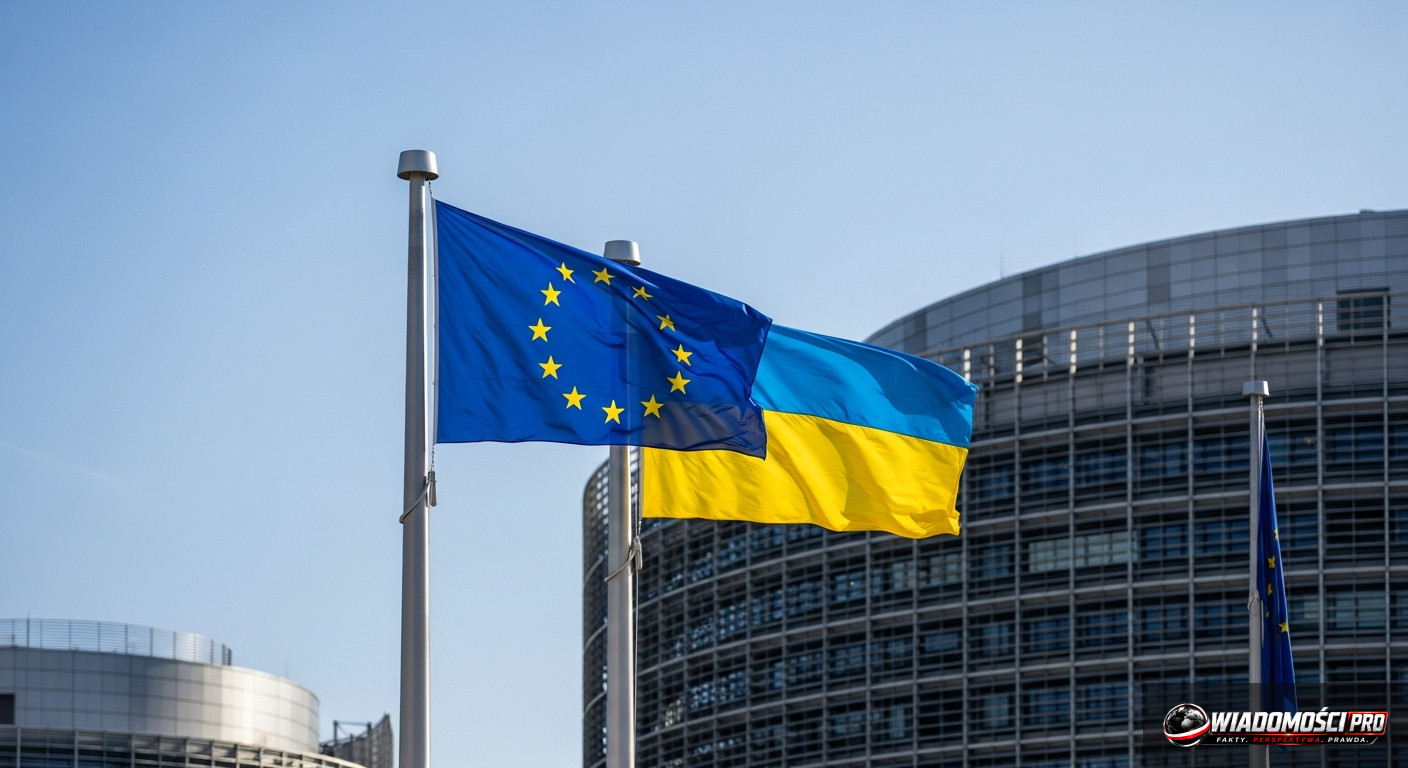
Ukraine recognizes the opening of negotiations as a historic milestone; however, the process is being slowed down by Hungarian opposition and internal political disputes in Poland. The enthusiasm from Kyiv, which celebrated the start of formal talks on June 15, 2026, is giving way to a brutal verification of EU decision-making mechanisms. The situation in which Ukraine finds itself is no longer just a matter of technical adjustment to EU standards, but is becoming a hostage to political calculations in the capitals of member states.
Kyiv celebrates: Negotiations as a milestone
President Volodymyr Zelensky announced the opening of accession negotiations on June 15, 2026, as a turning point in the nation's history. For the Ukrainian Ministry of Foreign Affairs, this was a signal that their efforts to date—both military and reformist—had gained formal recognition from Brussels. The narrative of success, built in Kyiv during the first days after the decision was announced, was based on the conviction that the European Union's political will was unwavering. However, by the second half of June, signals began to emerge that this enthusiasm was cooling.
A chronological analysis of events shows that the optimism was premature. Just ten days after the success announced by Kyiv, media began reporting on the first serious problems. On June 25, 2026, "Do Rzeczy" warned that the accession process was slowing down, and that Budapest was proving to be the main brake. Hungarian diplomacy, using its standard tools of pressure, effectively blocked the momentum of the arrangements, calling into question the realistic pace of further work. Instead of a fast track, Kyiv found itself in a situation where every subsequent step must be negotiated in the face of opposition from a member state for whom Ukrainian accession serves as a field for its own disputes with Brussels.
In this puzzle, Kyiv cannot count on full stability from its western neighbors. Poland, which for a long time was seen as the strongest advocate for Ukraine's interests within European structures, has itself become an arena of internal conflict. Political disputes in Warsaw regarding the scope of support and national priorities have begun to affect the perception of the entire enlargement strategy. Kyiv must therefore manage not only relations with EU institutions but also react to the unstable internal situation in countries that, theoretically, should be its most reliable allies.
Blockades and delays: Hungarian opposition and realities
From the very beginning, Budapest did not hide its distance toward the accelerated path of Ukraine's integration. Hungary's opposition, clearly signaled at the end of June 2026, is not merely an expression of current tensions, but an element of a long-term strategy of blocking decisions that require unanimity. Hungarian policymakers are effectively paralyzing subsequent stages of negotiations, using EU rules for their own political goals. For Ukrainian diplomats, this means the necessity of seeking compromises where European solidarity should formally apply.
This problem takes on a new dimension in the media context. On July 1, 2026, Interia reported on growing attacks from Ukrainian media against Poland, which only deepens mutual distrust. Allegations regarding the manipulation of history, which appeared in the public sphere, caused the climate of the discussion on accession to change from constructive to confrontational. At the same time, on June 29, Onet drew attention to the Polish perspective, pointing out that protecting its own national interest is becoming a priority for Warsaw, which may outweigh the previous rhetoric of unconditional support.
The Hungarian veto, combined with Polish tensions, creates a toxic mix. On one hand, Ukraine faces the necessity of implementing reforms; on the other, it faces a political wall built from the interests of states that, in theory, should strive for the expansion of the community. Brussels, trapped in procedures requiring unanimity, currently lacks the tools that would allow it to bypass these blockades without risking conflict with Budapest or Warsaw. As a result, the accession process, which was supposed to be a symbol of a new era for Ukraine, is turning into a long-term, high-stakes game in which each side tries to gain something at the expense of Ukrainian ambitions.

The Polish context: From opposition to debate
Warsaw, which until now had acted as an advocate for Ukraine, is struggling with internal division. A key event that set a new dynamic was July 14, 2026, when a draft bill authored by Przemysław Czarnek, aimed at blocking Ukraine's path to EU structures, reached the Sejm. This legislative initiative, described by "Polityka Super Express," poses a direct challenge to the government's current course. Moving the dispute from behind the scenes to parliament means that the issue of accession has become an element of an internal fight for voter support.
It is worth comparing this with the declarations made just a week earlier. Jan Truszczyński, speaking on July 7, 2026, in the columns of "Wszystko co najważniejsze," assured that Poland does not intend to block Ukraine's entry into the European Union. This expert declaration, intended to calm the mood, was, however, almost immediately overshadowed by the opposition's parliamentary actions. The discrepancy between official diplomacy and parliamentary initiatives means that Warsaw is ceasing to be perceived as a predictable partner.
The Polish strategy is beginning to resemble an attempt to reconcile fire with water. On one hand, the government wants to maintain its position as a leader in the region; on the other, it must face growing social and political pressure demanding a firm defense of interests, especially in areas such as agriculture or transport. The media, reporting on mutual accusations since July 1, are effectively heating up the atmosphere, making every decision regarding accession a politically explosive topic. This means that even if the government in Warsaw wanted to continue supporting Kyiv, its room for maneuver is becoming increasingly narrow.
For observers of the accession process, Poland's stance is a warning signal. If a country considered the closest ally begins to introduce legislative blockades, other member states that are more skeptical of enlargement gain ready-made arguments to halt the entire process. Poland, wanting to look after its own interest, has inadvertently become a piece of a puzzle that makes it difficult for Ukraine to join the community.
The German alternative: Entering through the 'back door'?
In the face of the decision-making paralysis reported by the media on July 8, 2026, Friedrich Merz, leader of the German opposition, proposed a concept that caused a storm in Brussels and Kyiv. It concerns Ukraine's entry into EU structures through the "back door." This idea, although presented as a way out of the impasse, raises huge controversies. For Kyiv, it means a proposal for second-class membership, which is contrary to the stated goals of President Zelensky.
Merz's proposal is a testament to how deep a crisis the current negotiation formula is in. Since the traditional accession path, blocked by the Hungarian veto and Polish disputes, is no longer viable, German politicians are looking for alternatives. The "back door" is intended to be a solution that will allow Ukraine economic and political cooperation without full inclusion in EU decision-making mechanisms. However, it is a solution that may be unacceptable to Ukraine, as it does not provide the full membership rights for which Kyiv is fighting.
This situation shows that Europe is beginning to think in terms of half-measures. Instead of solving real problems, such as Hungarian opposition or internal tensions in Poland, Brussels policymakers are beginning to consider scenarios that may disappoint both sides. Ukraine needs full access to the market and funds, not symbolic membership that leaves it in a political vacuum. Merz, by proposing this solution, takes on the risk of conflict with the Ukrainian administration, which expects a partnership on equal terms.
This entire process is also a test for Germany's role in Europe. Germany, as the economic leader of the community, is trying to manage a crisis that it largely helped create by failing to develop disciplinary mechanisms within the EU. If Brussels decides on the "back door" model, it will risk a conflict with Kyiv, which will feel deceived by its Western partners. Instead of accelerating integration, we may get even greater chaos, in which each side will feel like a loser.
Balance sheet of opportunities and threats for Ukraine
Today, July 14, 2026, brings another announcement regarding accession, as confirmed by the PolsatNews.pl service, but the weight of this announcement is different than in June. The balance of opportunities and threats for Ukraine is currently unequivocally pessimistic in the short term. On one hand, the opening of negotiations remains a fact, which gives Kyiv political legitimacy. On the other hand, the list of obstacles is longer than ever before.
Hungary (position from June 25) has effectively blocked the pace of work. Poland (initiative from July 14) has introduced legislative uncertainty. The media (reports from July 1) have sharpened the social climate. Friedrich Merz (proposal from July 8) has undermined the sense of full membership by suggesting the "back door." This set of facts shows that Ukraine is no longer just a negotiator, but an object of a game between capitals.
For Kyiv, the key threat is time. Every month of delay means reputational and political losses. Ukraine must prove its credibility while its partners increasingly talk about "looking after their own interest." This is not rhetoric that favors integration. On the contrary, it builds a wall of distrust that may be difficult to break through in the future.
It is worth noting that all parties to this dispute use the rhetoric of "European solidarity," while in practice each of them strives to secure their own interests. Hungary wants concessions from Brussels, Poland wants guarantees for its own economy and security, and Germany wants stability, even at the cost of weakening accession standards. In this arrangement, Ukraine becomes an entity whose fate depends on how these interests are balanced in the coming months.
For the average reader, these reports mean one thing: Ukraine's road to the EU is not a technical procedure, but a brutal fight for a place in the European security and economic architecture. If Ukraine fails to break the blockades, the EU summit will remain only a place for grand words, not concrete actions. This is the most disturbing conclusion from the analysis of the last few weeks.
What next? Perspectives for autumn 2026
The coming months will be decisive. The optimism of June 15, when President Zelensky celebrated the first step, has evaporated in the face of political reality. Autumn 2026 promises to be a period of intense bargaining, in which Ukraine may be forced to revise its expectations. If Budapest's veto is not broken, and the Polish political scene does not reach a consensus on accession, the entire process could remain at a standstill for many years.
The systemic blockade used by Hungary forces other capitals to revise their original assumptions. In this context, Friedrich Merz's concept, suggesting the inclusion of Kyiv in the community through the "back door," ceases to be just a journalistic proposal and becomes a scenario actually discussed behind the scenes. The Polish political scene, with the Czarnek project at the forefront, adds its own internal dispute, which affects the climate of negotiations and undermines the credibility of Jan Truszczyński's earlier declarations.
All these facts lead to one conclusion: Europe is not ready to accept Ukraine in the way Kyiv imagined. The lack of unity within the Union makes Ukraine a hostage to conflicting interests. The upcoming autumn EU summits will be a test of whether the EU is even capable of carrying out an enlargement process under current geopolitical conditions. Every day of delay is for Ukraine not only lost time, but also a growing risk that European support will become merely theoretical.
The question of whether Poland will maintain consistency in its actions toward Kyiv remains open. The discrepancy between the declarations of diplomats and initiatives within parliament makes Warsaw cease to be a predictable ally. Such uncertainty is grist to the mill for countries skeptical of enlargement, which gain a perfect argument to slow down the integration process under the guise of caring for EU stability. Ukraine must therefore prepare for a long and painful fight for every subsequent stage of accession, in which success is by no means guaranteed.
What this means for you
Editorial angle: The situation shows that the road to the EU is not just a matter of internal reforms, but primarily a complex game of interests within the community. Proponents of enlargement are losing, countries with complicated historical relations are losing, and the 'catch' remains the internal politics of member states such as Poland and Hungary. For the average citizen, this means that the accession process will drag on, affecting investment decisions and regional stability. There is no longer any talk of a fast track; instead, there is a fight for the survival of every promise written in the treaties.
Questions and answers
Will Poland block Ukraine's entry into the EU?
Positions are divided; while politicians such as Jan Truszczyński declared on July 7 that there would be no blockade, projects (including by Przemysław Czarnek) are being processed in the Sejm on July 14 to hinder this process, which undermines the credibility of the government's assurances.
Why is the accession process slowing down?
The main reason is the opposition of Hungary, signaled as early as June 25, and the need to reconcile the national interests of member states, which are increasingly placing their economic security above solidarity with Kyiv.
What is the 'back door' proposal for Ukraine?
This is Friedrich Merz's proposal from July 8, 2026, assuming an alternative model for including Ukraine in European structures, which is intended to be a response to difficulties in the standard accession process, but for Ukraine, it means the risk of limited membership.
What is the significance of Polish-Ukrainian tensions?
These tensions, visible especially since July 1 in the media, concern historical manipulation and the protection of one's own national interests, which weakens Ukraine's negotiating position and provides arguments to countries skeptical of enlargement.
Who is the main brake on the process?
According to reports from June 25, Hungary remains the main brake on the accession process, although Polish internal disputes further complicate the situation on the international stage.
Is Ukraine closer or further from membership?
Despite the formal start of negotiations on June 15, the real seat at the EU table is moving further away in time due to growing political blockades, which means Ukraine is entering a phase of a long-term game with an uncertain finale.
What is the role of the German opposition in this process?
Friedrich Merz, leader of the German opposition, is actively pushing for alternative paths of integration, which shows that even within countries supporting Ukraine, there is growing pressure to seek half-measures instead of full membership.
Can a quick resolution be expected?
All facts gathered by July 14, 2026, indicate that this process will be long-term and full of political squabbling, and a quick resolution is currently impossible due to the conflicting interests of key member states.
What does this mean for Ukraine in practice?
In practice, it means the necessity of constantly striving for every stage of negotiations, with the awareness that allies may change their position at any time under the influence of internal political tensions.
Are EU promises still valid?
The promises remain in the sphere of political declarations, but real legislative actions, such as those in the Polish Sejm or the Hungarian veto, make their implementation increasingly difficult and politically costly for Kyiv.
How do the media influence this process?
The media, by highlighting historical and political disputes, sharpen the climate around accession, which means politicians have less space to seek compromises, and societies become more distrustful of partners.
What is Poland's position in the context of national interests?
Poland, according to reports from June 29, emphasizes a hard defense of national interests, which in practice means that support for Ukraine cannot come at the expense of the country's economic and political stability.
Is there an alternative to full membership?
The "back door" proposal is currently the only alternative that is actively discussed, although it meets with opposition from Kyiv, which does not accept the status of a second-class associated country.
What are the prospects for autumn 2026?
Prospects for the autumn assume further decision-making paralysis and the intensification of political bargaining, in which Ukraine will have to prove its usefulness to the community in the face of growing skepticism from member states.
Is the situation dynamic?
The situation changes from week to week, which is confirmed by the chronology of events from June 15 to July 14, where each subsequent announcement brings new challenges for Ukrainian diplomacy.
What are the biggest threats to Ukraine?
The biggest threat is the loss of credibility as a partner and fatigue with the topic of enlargement within the European Union, which may lead to a complete freezing of the process.
Can the finale of the negotiations be predicted?
The current political situation does not allow for predicting the finale of the negotiations, as it depends on factors completely independent of Ukraine, such as elections in member states or internal conflicts within the EU.
What must Ukraine do to accelerate the process?
Ukraine must primarily maintain political unity and continue reforms, while effectively communicating its needs and repelling propaganda attacks that are used by opponents of accession.
Is the European Union united on the issue of Ukraine?
No, the European Union is deeply divided, which can be seen in the Hungarian veto and internal disputes in Poland, which effectively paralyzes the decision-making process and calls European solidarity into question.
What role do political elections in EU countries play?
Elections in member states, such as Poland, directly affect the rhetoric and actions toward Ukraine, making accession a topic of election campaigns, which always leads to the hardening of positions and the search for populist arguments.
Sources
- What next for Ukraine's accession to the European Union? There is a statement - PolsatNews.pl
- Czarnek wants to block Ukraine's path to the EU. The draft has reached the Sejm - Polityka Super Express
- Ukrainian media attack Poland. "They manipulate not only history" - Interia Wydarzenia
- Will Poland say "no" to Ukraine in the European Union? "We will look after our interest" - Wiadomości Onet
- Poland will not block Ukraine's entry into the EU [Jan TRUSZCZYŃSKI] - Wszystko co najważniejsze
- Ukraine's accession to the EU is slowing down. Hungarian opposition and change of plans - Do Rzeczy
- Ukraine in the EU? There is a first step, Zelensky is satisfied - wPolityce.pl
- Ukraine is waiting for a seat at the EU table. Merz proposes entry through the back door - Onet
Article prepared by the Wiadomości PRO editorial team with the support of artificial intelligence. Facts come from the sources listed above.
Komentarze (0)
Ładowanie komentarzy...