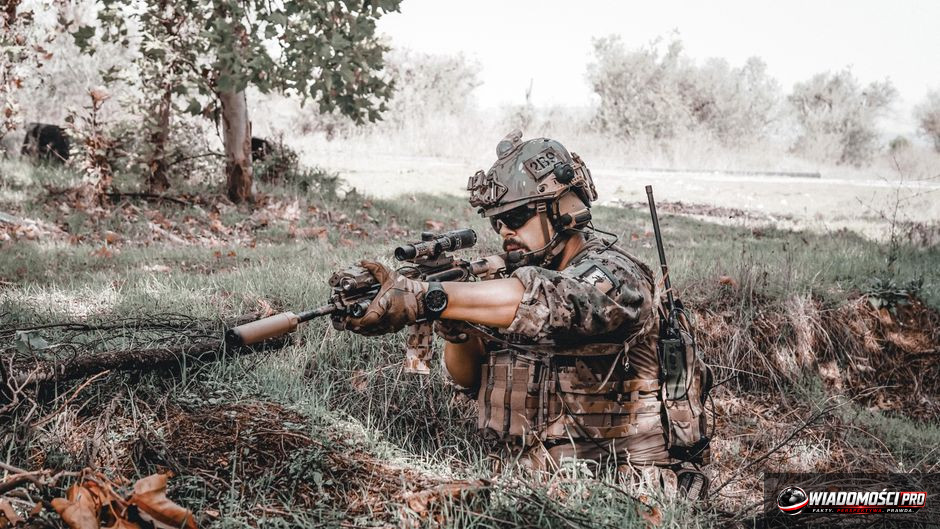
In this year's military exercises, Sweden officially admitted that it lost a simulated drone battle to Ukrainian operators, which confirms the high effectiveness of Kyiv's war tactics. A report published on May 17, 2026, by the Swedish command points to glaring differences between the theoretical preparation of NATO armies and the realities of the battlefield. This admission of defeat marks a turning point in the discussion on the modernization of NATO operational procedures.
The Ukrainian advantage in the air does not stem from having better electronic components, but from a unique adaptation of systems under conditions of constant combat pressure. While Swedish operators function within strictly defined communication protocols, their Ukrainian counterparts have developed a methodology based on lightning-fast frequency reconfiguration and improvised targeting algorithms. This approach eliminates rigid command points, which become the main weakness of Western units under conditions of electronic jamming.
The lesson from these maneuvers is brutal. The Ukrainian school of drone warfare goes beyond standard academic textbooks. Kyiv has become a kind of technological hub, where innovations are created at a pace forced by the necessity of survival. For the Swedish army, which possesses high-class equipment, the confrontation with the tactics of a "living" opponent became a test whose results undermine the existing monopoly on the effectiveness of the Alliance's technological solutions.
In June 2026, Poland became the arena for the largest interoperability verification program in NATO history. As part of these maneuvers, exactly 40,000 system tests were conducted, representing an unprecedented logistical and engineering effort. The goal was to check whether the distributed defense systems of individual member states could exchange data in real-time without disruptions that could lead to command paralysis in the face of a real threat.
The scale of this undertaking reveals how complicated it is to integrate armies with different technological traditions. While American radars must cooperate with Polish command systems, German reconnaissance drones send streams of data that require immediate interpretation by Swedish or Romanian units. Each of the 40,000 tests was an attempt to avoid communication errors, which on the modern battlefield translate directly into a loss of combat capability.
However, data analysis from these maneuvers shows that even the most advanced digital network is useless without a properly trained operator. In simulations involving Ukrainian specialists, it turned out that even with full system interoperability, the traditional approach to managing a drone swarm loses out to the flexibility of Ukrainian tactics. These tests showed that NATO must move from the phase of building common networks to the phase of learning from an adversary who knows how to effectively bypass these networks.
Havoc AI technology, tested in the waters of the Baltic Sea since July 31, 2025, represents a response to the specific challenges faced by naval units. These American surface drones, equipped with advanced artificial intelligence algorithms, were designed for autonomous patrolling of water areas where the risk of detection by the enemy is minimal. Poland, as the country conducting these secret tests, is trying to fill the gap in the protection of the eastern maritime flank by using technologies that are ahead of the standard equipment of most NATO fleets.
The difference between Havoc AI and the solutions used by the Ukrainians is fundamental. The American system relies on computational predictability and stability, while Ukrainian technical thought focuses on asymmetry and rapid adaptation to changing jamming conditions. Havoc AI performs well in controlled conditions, where the task is to monitor enemy activity and secure transmission lines. However, in situations where the enemy uses high-intensity electronic warfare measures, American algorithms may show less effectiveness than simple but repeatedly modified Ukrainian solutions.
The implementation of Havoc AI in Polish defense infrastructure is a long-term process. It is not about a one-time delivery of equipment, but about integrating algorithms with Polish reconnaissance systems. Experts note that the success of this project depends on how quickly Polish engineers learn to modify AI operating parameters in response to signals from real incidents. The Baltic Sea is becoming an environment where technological dominance is constantly redefined by the ability to learn quickly from mistakes.
Modern regional security is constantly tested by events that go beyond the traditional concept of armed conflict. The incident on July 24, 2026, when Romania shot down a drone violating its airspace, is a clear signal that the margin for error in border protection has practically ceased to exist. Such events force NATO commands to make decisions in seconds, which, at the current level of disinformation, is an extremely difficult task.
The hybrid threat facing Poland intensified in 2025. Analysts point to six identified waves of disinformation that struck the stability of the country's defense structures. Their main goal was to polarize public opinion around the issue of army modernization and undermine trust in new technologies, such as the aforementioned Havoc AI drones. Disinformation has become a tool that paralyzes the decision-making process. In an atmosphere of uncertainty, every official confirmation of successes or failures in military exercises is immediately used to build false narratives.
In the shadow of these information operations, the actual defense capabilities of NATO are subject to constant verification. While 40,000 system tests in Poland are proof of the Alliance's technical efficiency, the need to deal with daily aerial and maritime provocations requires completely different competencies from commanders. Poland is at the forefront of these challenges, having to balance the implementation of American technologies with the necessity of repelling psychological operations.
From the perspective of regional command, the priority remains the tightness of early warning systems. Incidents like the Romanian drone shoot-down confirm that the response procedure must be automated to the greatest extent possible, while maintaining full human control. The challenge for the coming months remains the integration of experiences from the Ukrainian battlefield with NATO procedures. If the Alliance fails to accelerate this process, technological superiority will remain only a theoretical asset, which in a real clash may not be enough to maintain the initiative.
Effectiveness in modern conflict depends on the speed of information flow. The Ukrainians have shown that in drone warfare, the winner is the one who can change system operating parameters faster than the opponent can identify them. For NATO, which has historically relied on long-term procurement cycles and certification procedures, this is a paradigm shift. Poland, by testing Havoc AI and engaging in the largest interoperability maneuvers, is becoming a testing ground where the future of the entire Alliance's defense doctrine is being decided.
The results of these actions will be crucial for the security of the eastern flank. Every test, every shoot-down, and every disinformation campaign are pieces of a puzzle that commanders must solve in real-time. There is no room for errors that could be exploited by entities conducting destabilizing activities. Resilience to these attacks depends on the consistency of data transmitted within the 40,000-test system and on the determination to continuously improve autonomous technologies.
Poland's role in this process goes beyond just being the host of the exercises. Our military is becoming a link that must connect American technological thought with the brutal lessons learned from Ukraine. This is a process that requires not only capital, but above all, the courage to abandon old command habits. Time works in favor of those who can most quickly draw conclusions from failures, such as the Swedish one on May 17, and translate them into new operational capabilities.
Questions and answers
Are Ukrainian drones better than Swedish ones?
In direct exercises on May 17, 2026, Ukrainian operators proved to be more effective, defeating Swedish units in a simulated battle, which resulted mainly from their rich combat experience and flexibility in action.
What drones is Poland testing in the Baltic Sea?
Poland is testing American Havoc AI naval drones, which has been crucial for maritime security since July 2025 and represents an attempt to strengthen the eastern flank using autonomous systems.
How many system tests were conducted in Poland in June 2026?
As part of the largest interoperability exercise in NATO history, which concluded on June 25, 2026, exactly 40,000 defense system tests were conducted to verify their mutual cooperation.
What was the context of the incident with Romania in July 2026?
On July 24, 2026, Romania shot down a drone violating its airspace, which highlighted the growing challenges related to border security and the need for rapid decision-making by NATO commanders.
What disinformation challenges did Poland encounter in 2025?
Analyses point to six waves of disinformation directed against Poland in 2025, aimed at paralyzing the assessment of military capabilities and undermining trust in new defense technologies.
Sources
- Romania shoots down drone that breached its airspace - polskieradio.pl
- Sweden admits soldiers lost drone battle to Ukrainians in military exercise - polskieradio.pl
- NATO's largest interoperability exercise wraps up in Poland with 40,000 system tests - polskieradio.pl
- Poland/United States • Poland secretly testing US-made Havoc AI sea drones in Baltic - 31/07/2025 - Intelligence Online
- Poland targeted by six disinformation waves in 2025, analysts say - polskieradio.pl



Komentarze (0)
Ładowanie komentarzy...