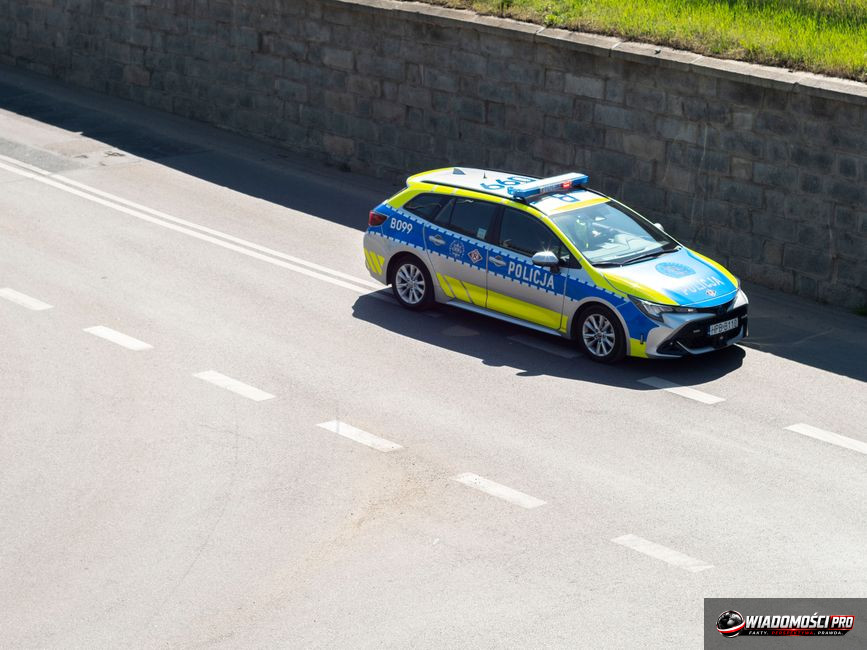
Krzysztof Stanowski received a fine of 3000 PLN and lost his driving license for a period of 3 months for speeding in a built-up area, where he was traveling at 110 km/h. The incident occurred on August 30, 2026, and the intervention by traffic officers resulted in the immediate suspension of his driving privileges. The police actions in this case were dictated by rigorous regulations that eliminate the possibility of applying leniency toward perpetrators of gross traffic offenses.
The legal mechanism of a severe penalty
The legal basis for the officers' actions was Article 135, paragraph 1, point 1a of the Road Traffic Law Act. This provision imposes an obligation on the police officer to physically seize the driving license against a receipt in the event of discovering an act consisting of exceeding the speed limit by more than 50 km/h in a built-up area. In the case of Krzysztof Stanowski, the speedometer indicated 110 km/h in a 50 km/h zone. The excess was therefore 60 km/h, which automatically triggered the administrative procedure.
The law does not provide any margin for negotiation in this regard. The officer's decision is binding, which means that the officer does not evaluate the situation for mitigating circumstances or the driver's intent. The suspension of privileges occurs at the moment of the inspection, and information about this fact reaches the central CEPiK system almost in real-time. From that moment on, the driver is prohibited from operating vehicles, and an attempt to ignore this decision results in extending the document suspension period to six months. A third instance of violating this ban ends in the revocation of privileges, which forces the driver to go through the full training and examination process at a road traffic center again.
The amount of the fine, 3000 PLN, results directly from the current fine schedule. This amount was updated as part of a road regulation reform aimed at deterring drivers from drastically breaking speed limits. In a situation of exceeding the limit by 60 km/h, the legislator provided not only for a high financial penalty but also for the assignment of 15 penalty points, which, under the current point system, constitutes a significant burden on any driver's account.
The physics of a collision in a built-up area
Driving a vehicle at 110 km/h in a place where the legislator has set a limit of 50 km/h changes the physics of a traffic incident diametrically. Kinetic energy increases with the square of the speed. This means that a car moving at 110 km/h hits an obstacle with a force more than four times greater than at 50 km/h. The braking distance at such a speed is drastically longer, which, in urban conditions, with the presence of pedestrian crossings, intersections, and bicycle infrastructure, makes it impossible to react to a pedestrian suddenly stepping onto the road.
In a built-up area, every second of delay in the driver's reaction translates into tens of meters of distance covered. At 50 km/h, a car travels about 14 meters in one second. At 110 km/h, this distance increases to over 30 meters, not counting the braking distance itself after pressing the pedal. It is precisely these numbers that form the foundation upon which the severity of Polish regulations is based. The legislator decided that a speed of 110 km/h in a built-up area is a factor creating a direct and real threat to the lives of bystanders, which is why the sanction of losing one's driving license for three months is treated as a preventive measure, not just a punitive one.
The realities of traffic police work in 2026
The patrol that conducted the journalist's inspection acted based on standard procedures implemented in the Polish police in recent years. Modern traffic police have advanced measuring equipment that eliminates doubts about the measurement result. Video recorders in police cars are coupled with data transmission systems, which makes the evidence in the form of a recording and speed log available immediately. Officers no longer have to conduct long negotiations. Their task is to verify documents, perform the measurement, prepare documentation, and secure the driving privileges.
Media reports that appeared immediately after the incident – including reports from TVP Kielce, Onet, or WP – confirm that the procedure went according to the adopted scheme. The inability to avoid consequences is a signal that privileges resulting from social status have disappeared in the area of road safety. The police do not seek publicity in such cases but implement guidelines regarding so-called zero tolerance for road pirates. Every detention of a well-known person is widely commented on, which paradoxically strengthens the disciplinary nature of the penalty. Society receives a clear message: traffic law is enforced in an automated and impersonal manner.
The logistics of daily life without privileges
Losing a driving license for a period of 90 days forces a driver to completely reorganize their lifestyle. Krzysztof Stanowski, commenting on the situation, mentioned the need to switch to a bicycle. For a person professionally engaged in content creation, often traveling between different locations, the inability to drive a car is a real operational hindrance. In Polish conditions, where public transport between cities or on the outskirts of metropolises does not always offer full time flexibility, the loss of mobility is a more severe punishment than the financial fine itself.
People with sufficient financial resources often use the services of private drivers or corporate transport in such a situation. This allows for the continuity of work, but it does not change the fact that having the privilege to operate a vehicle is a privilege that can be temporarily lost. The three-month ban is a period in which the driver must plan every move in advance. This means giving up spontaneous trips, the necessity of using rail or air carrier services, and a complete change in daily commuting habits.
Skeptics often argue that for wealthy people, a 3000 PLN fine is merely a cost of doing business, not a real hardship. However, this is a one-sided view. A driving license is an asset that cannot be bought back for any amount of money. Even if the perpetrator has the funds to hire a driver, they lose autonomy and the ability to operate a vehicle themselves, which in the eyes of many drivers is a superior value. The legal system has created a situation where the financial penalty is only an addition to the administrative penalty, which is the driving ban.
Impact on social attitudes
Stanowski's case sparked a wave of comments that focus on two aspects: the effectiveness of the penalty system and the clarity of the regulations. In public debate, the question often arises whether 110 km/h in a built-up area should always result in the same penalty, regardless of road conditions. The current interpretation of the law is relentless on this issue. The traffic code does not provide for exceptions due to the time of day, traffic intensity, or the technical condition of the vehicle. The speedometer is the only determinant that the legislator takes into account.
For many observers, the fact that even a well-known public figure is subject to the same restrictions is proof of equality before the law. This phenomenon has its educational dimension. When information about the detention of a recognizable person appears in the media, thousands of drivers subconsciously pay more attention to speed limit signs. This is a side effect that the police use in their communication. Showing that no one is "untouchable" works on the imagination more effectively than any social campaign.
What this means in practice
For every road user, this case is a reminder of the automatic nature of procedures. In 2026, monitoring systems and traffic patrols create a dense network where the margin for error is minimal. A 3000 PLN fine and a 3-month ban is the standard procedure for anyone who exceeds the speed limit by more than 50 km/h in a built-up area. The journalist is not an exception here, but merely another name in the database of people who had to face the consequences of their own bravado.
After three months, the privileges return to the driver automatically. There is no need to retake exams, provided that no traffic laws were broken during the ban period. However, this is a moment when many drivers re-evaluate their approach to speed. The loss of independence that one's own car provides is often the best teacher of humility.
It is worth noting that in recent years, the number of speed checks conducted by the police has increased significantly. Statistics show that in 2026, traffic police are focusing on mobility and the unpredictability of their actions. Police cars equipped with cameras and radars operate in places where checks rarely occurred before. This tactic, called by some "speed hunting," is a direct response to the increase in the number of accidents in previous years. The point system, high financial penalties, and automatic suspension of driving licenses are elements of one mechanism that aims to force compliance with speed limits in places most dangerous for unprotected road users.
From an editorial perspective, this case shows that even with knowledge of the consequences and social awareness, bravado on the road remains a phenomenon affecting every professional group. The question that remains open after such events does not concern the penalty itself, but whether drivers actually change their habits after serving it. Recidivism statistics in such cases are worrying, which suggests that for some people, the penalty is only a break in breaking the law, not the end of problematic behavior behind the wheel. Time will tell whether these three months will become a period of reflection for Krzysztof Stanowski, or merely a technical break in using a car. Regardless, the system enforced its rules in an indisputable way.
Sources
- Stanowski lost his driving license. New regulations surprise drivers - Interia Motoryzacja
- Krzysztof Stanowski caught by traffic police. He lost his driving license - Wiadomości Onet
- OUR NEWS: Well-known journalist lost his driving license ⬇ - facebook.com
- Police stopped Stanowski on the road. He lost his driving license - WP Wiadomości
- Krzysztof Stanowski lost his driving license. The fine was double: "Where there is a beautiful road, there we are" - Dziennik.pl
- Stanowski without a driving license. "The next three months on a bicycle" - Zero.pl
- Krzysztof Stanowski received a high fine and lost his driving license. Radio ZET findings - Radio Zet
- Krzysztof Stanowski lost his driving license. He was driving 110 km/h in a built-up area - TVP Kielce

Komentarze (0)
Ładowanie komentarzy...