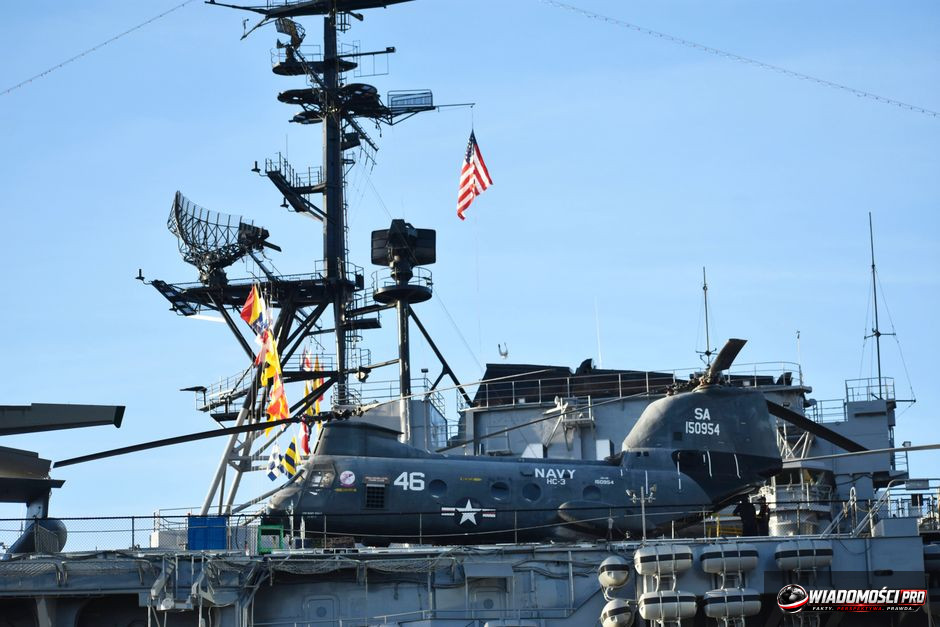
According to private information, a food crisis has occurred on the USS Abraham Lincoln, resulting in declining morale, cases of jumping overboard, and signs of mutiny among the crew. These reports – if they reflect reality – point to a deep breakdown in operational logistics on the Nimitz-class vessel, which has been on combat alert in the Middle East for months. The Pentagon's official silence on the matter makes it difficult to verify the scale of the problem, but signals from on board suggest that the situation has reached a critical point for military discipline.
Logistics on the edge: The mechanics of shortage
The aircraft carrier USS Abraham Lincoln (CVN-72) is a floating city with over 5,000 sailors and aviation personnel on board. Maintaining such a large group of people requires the daily delivery of thousands of high-calorie meals. The standard procedure for supplying a ship during a mission on the high seas is based on RAS (Replenishment at Sea) operations, during which Lewis and Clark-class supply ships transfer food, fuel, and ammunition. Problems with food rations on such a large unit suggest not so much a lack of goods in Navy warehouses, but errors in inventory management at the strike group level.
An anonymous non-commissioned officer from the Carrier Strike Group 3 logistics section reported that rations have been drastically reduced. Although the exact date of the start of this practice was not specified, it is worth noting the specific nature of work on an aircraft carrier. Sailors operating catapults, guidance systems, or nuclear reactors work in twelve-hour shifts. This requires a huge expenditure of energy. The calorie deficit mentioned by informants is not just an inconvenience. It is a real threat to the psychophysical fitness of the soldiers. When a sailor's body does not receive an adequate amount of nutrients, reaction time drops, and concentration and the ability to make quick decisions in stressful situations deteriorate. In operational conditions, where one mistake on the flight deck can cost the entire team their lives, crew malnutrition becomes a matter of national security.
The lack of official data regarding the duration of food restrictions makes it difficult to assess whether we are dealing with months of neglect or a sudden collapse of the supply chain. The US Navy has extensive inventory audit procedures. If stocks have been drastically depleted, it means that someone in command made a conscious decision to prioritize other supply elements at the expense of feeding the crew. It is this lack of transparency that raises the most controversy.
Mutiny or insubordination: The boundary of discipline
In military terminology, the concept of "mutiny" is strictly defined by law (in the US, it is Article 94 of the UCMJ – Uniform Code of Military Justice). It means the refusal to obey an order in an organized manner, intended to undermine the authority of the commander. Reports of sailors refusing to follow orders on the USS Abraham Lincoln fit this description. If soldiers argue their behavior is due to physical exhaustion, the command is trapped. On one hand, it must enforce regulations, but on the other, it is aware that the cause of the insubordination lies in basic logistical failures.
Open insubordination on board an aircraft carrier is an unprecedented situation in recent decades. Traditionally, the command structure on Nimitz-class units is extremely rigid. The hierarchy ensures that every sailor knows what to do every second of their service. When this structure begins to crack, the ship ceases to be an efficient tool for power projection and becomes a place of internal conflict. Informants indicate that the crew is increasingly questioning the point of the mission if it does not provide basic subsistence security. This is a signal that the crisis of trust between rank-and-file sailors and high command has reached a stage where standard disciplinary methods have ceased to work.
The lack of confirmation of the number of incidents by the Department of Defense does not mean they do not exist. In the military information machine, any events that violate the image of perfect discipline are often silenced. If there have indeed been cases of collective refusal to work, the command has a valid reason to hide this information from the public. Revealing a mutiny on such a powerful unit would be a signal of weakness that US adversaries in the region would immediately exploit.
Tragic incidents: Jumping overboard
Reports of sailors jumping overboard from the aircraft carrier are among the most difficult to verify. The US Navy rarely publishes data on suicides or suicide attempts at sea, treating them as internal matters. However, if the number of such events has increased, it indicates an extreme level of stress and a sense of being trapped among the crew. In high-seas conditions, jumping overboard is an ultimate act of desperation.
The ship's command has "Man Overboard" procedures, which mandate an immediate stop of the vessel and a rescue operation. If sailors decide to take this step, they know that the chances of survival in open waters, even with a quick response, are minimal. This means that such incidents must be recorded in the ship's logs. The lack of an official statement on the number of such events is therefore a conscious act of censorship. The Pentagon maintains a full information embargo, avoiding comments on the mental state of the USS Abraham Lincoln crew. Such an attitude does not protect the sailors' morale – on the contrary, it increases fear and uncertainty.
A lack of transparency leads to the creation of theories that can be much more harmful than the truth itself. If the crew does not receive information about how the command is reacting to problems, they begin to create their own narrative. In a closed environment like an aircraft carrier, rumors spread faster than official orders. Every jump overboard becomes, in the eyes of the crew, proof that the command does not care about the lives of its people. This is a vicious cycle that further destabilizes the situation on the ship.
Voice from the outside: Katz's controversial suggestion
The situation on the USS Abraham Lincoln went beyond the scope of an internal US Navy problem when Israeli Foreign Minister Israel Katz addressed it. His suggestion that, in the face of low morale, the soldiers should be withdrawn to the US caused consternation in Washington. This statement, although not supported by a date or source of information, was perceived as a political jab at the American administration.
For political observers, Katz's comment is a signal that the situation on the ship is known to foreign intelligence. If a minister of an allied government openly speaks about low morale on an American aircraft carrier, it means that reports of food shortages are no longer just an internal US Navy secret. This clash of rhetoric puts the Pentagon in a very difficult position. If they deny Katz's words, they must prove that morale is high, which would be difficult to defend given the current reports of mutiny. If they confirm it, they admit to a logistical failure in a region that is key to American security strategy.
It is unclear whether Katz's suggestion was a form of pressure or merely a cynical assessment of the situation intended to test the American administration's resilience to internal crises. Regardless of the intent, these words struck at the foundation of American determination. For the sailors serving on the USS Abraham Lincoln, however, these comments are more than just politics. It is a signal that their situation has ceased to be "invisible."
No official position: Silence as a signal
The US Department of Defense consistently avoids issuing statements regarding reports from the aircraft carrier. In a system that usually reacts to every image threat, the lack of a reaction is a signal that the scale of the problem has exceeded standard crisis communication procedures. All circulating news is based on unofficial sources, which forces us to treat current reports as unconfirmed. Readers must be aware that without official confirmation, any information about a "mutiny" or "jumping overboard" is only a piece of the puzzle.
This uncertainty leads to a degradation of trust within the command structure. Sailors, feeling left to themselves, lose the motivation to perform their tasks. For the public, the situation on the USS Abraham Lincoln remains in the shadows. We do not know if this is a conscious strategy of silencing or if the scale of the problem is so large that the Pentagon is unable to prepare a credible explanation. Every day of silence deepens the gap between the command and the rank-and-file sailors, making the situation on board increasingly unstable.
This crisis is a warning for American military logistics. If reports of malnutrition are confirmed, operational commanders will lose, and political opponents will gain, pointing out the weakness of the American war machine. For an outside observer, this means one thing: the world's largest fleet is only as strong as its weakest link, which in this case is the prosaic provisioning system. Regardless of whether the crisis concerns food rations or deeper systemic neglect, the consequences will be felt throughout the region.
Questions and answers
Are reports of jumping overboard officially confirmed?
At the moment, we are relying solely on private reports; there is no official confirmation from the Pentagon, which makes it impossible to verify the number of incidents.
What exactly did the Israeli Foreign Minister say?
Minister Israel Katz suggested that in the event of morale problems that threaten operational efficiency, soldiers should be withdrawn to the US, but no official date for this statement was provided.
Why would food rations be too small?
Private reports, including accounts from anonymous non-commissioned officers, point to serious errors in the unit's food supply logistics, but there is no data on when these shortages occurred.
How is mutiny defined in the context of the situation on the ship?
In a military context, it means a refusal to obey orders, a strike, or actions intended to undermine the command structure in the face of unmet subsistence needs.


Komentarze (0)
Ładowanie komentarzy...