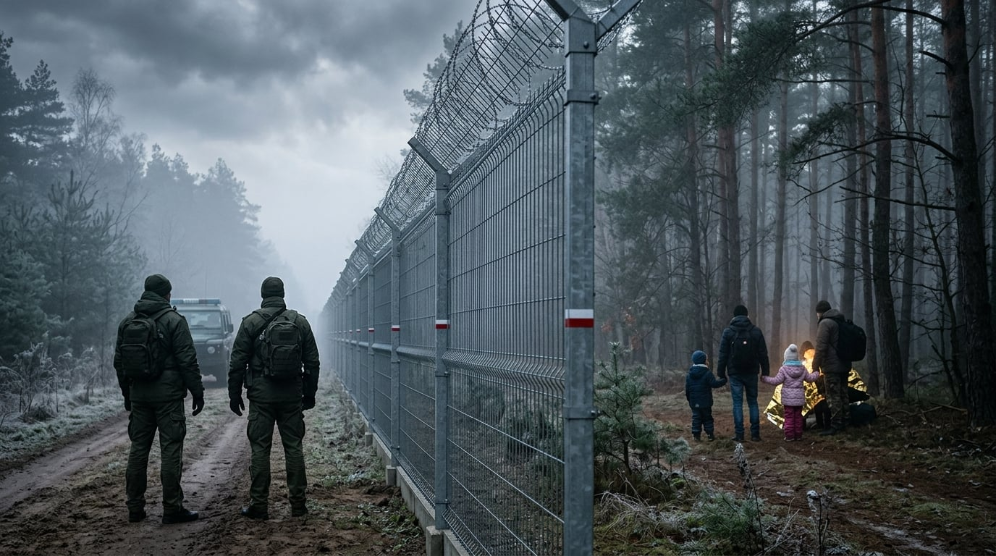
The scale of the phenomenon you cannot ignore
Since 2021, tens of thousands of attempts to cross the border illegally have been recorded at the Polish-Belarusian border. Border services, soldiers, and officers work in extreme conditions — in the forest, at night, in the freezing cold. They see things that the media does not always talk about loudly.
At the same time, humanitarian organizations are documenting cases of people — including children and pregnant women — who have died or suffered serious health damage in the border zone. Doctors Without Borders, the Polish Humanitarian Action, and dozens of volunteers have sounded the alarm: people are dying there.
Both of these things are true at the same time. And that is exactly what makes this topic so difficult — and so important.
Two camps. Two worlds. One country.
Those who say: the border must be sealed.
Their argument is simple and concrete: a state without control over its own border ceases to be a state. Poland borders Belarus — a regime that consciously organizes migratory pressure as a political and hybrid tool. This is not a random movement of people. It is a planned operation of destabilization.
They also speak about internal security: who is entering? Where are they from? What are their intentions? Without verification — it is unknown. And a lack of knowledge is a risk borne by all Poles.
On top of that, there are the costs. Reception, accommodation, healthcare, education, integration — these are real expenses from a budget that is already tight. Poles ask: why should we pay for someone who entered illegally?
Those who say: a person in need cannot be left alone.
Their argument is equally concrete: international law — the 1951 Geneva Convention — clearly states that every person has the right to seek asylum. Pushbacks, or turning people back without considering their application, are, according to many lawyers and international organizations, a violation of this right.
They also speak about morality: for decades, Poland sent its own emigrants to Germany, England, and France. Poles know what it means to seek a better life abroad. Can we really close the door now to someone doing the same?
Added to this is the practical argument: most people crossing the border are not terrorists or criminals. They are families, students, workers. People who — if given a chance — could boost the Polish economy, which desperately needs labor.
Where is the truth?
The truth — as usual — lies somewhere in the middle. But "in the middle" does not mean a safe compromise. It means difficult decisions that require courage.
Poland needs, simultaneously:
a sealed and controlled border that is not a tool for human rights violations,
an efficient asylum system that quickly and reliably verifies who truly needs protection,
a clear integration policy that defines who Poland is able to accept and under what conditions,
an honest conversation with citizens — without fear-mongering and without naivety.
This is exactly what is missing in the Polish public debate. Instead of facts — emotions. Instead of solutions — digging in on opposite sides of the barricade.
Why does this topic keep coming back like a boomerang?
Because it has not been solved. Because politicians — regardless of their affiliation — use it as a tool to mobilize voters, not for real action. Because the media often shows either only the humanitarian drama or only the security threat — rarely both at once.
And Poles — ordinary people — are left with a question to which no one gives them a full, honest answer.
What do you think about this?
This is not a topic that can be closed with one article. But you can start with one thing: a conversation based on facts, not on fear and propaganda.
Write in the comments: where do you draw the line? Security or humanity — do we really have to choose?
Follow upcoming materials on wiadomosci.pro — because we will have more of these topics that others remain silent about.
Editorial staff of wiadomosci.pro | Editorial material based on publicly available information and media reports.

Komentarze (0)
Ładowanie komentarzy...