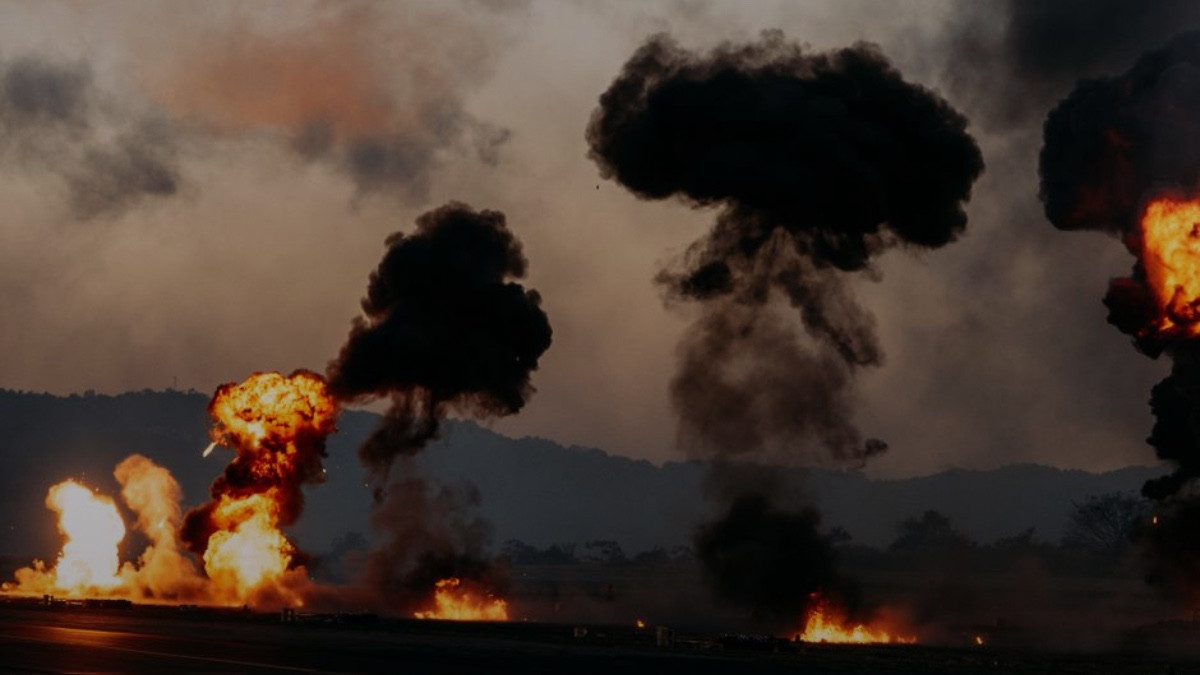
The main targets of Ukrainian attacks are refineries, such as the facility in Salavat, and energy infrastructure, which generates losses estimated at $100 million per day. This strategy forces the Russian general staff to constantly shift air defense systems from the front line deep into the country. Consequently, Moscow must choose between protecting its own industrial base and supporting units directly involved in combat on Ukrainian territory.
Refineries and the fuel sector as a priority target
Consistent strikes on Russian refineries, including the massive plant in Salavat, where a fire was reported on August 13, 2026, are not merely a display of technological capabilities. It is a method of limiting the Kremlin's financial liquidity. Every day of downtime at such facilities means not only a loss of revenue from the export of petroleum products but also the necessity of reorganizing fuel logistics for the Russian armed forces.
Commodity market analysts point out that the damage to the energy sector, estimated at the aforementioned $100 million per day, results from direct destruction of distillation units and the need to shut down entire technological chains. This phenomenon is not limited to one region. The Ukrainian strategy involves distracting Russian air defense, which, in the face of attacks on so many fronts, is beginning to show signs of overload.
It is worth noting that the process of repairing damaged refineries takes months, even if the infrastructure itself seems possible to patch up quickly. The lack of spare parts, resulting from sanctions and technological restrictions, means that every successful drone operation at a refinery has a long-term effect. Russia is losing not only current production but also the ability to quickly restore full processing capacity.
Operational scale: Raids on Moscow and panic
It is not just the frequency that has changed, but above all the strike mass. On July 20, 2026, an unprecedented raid on Moscow took place, in which over 400 unmanned aerial vehicles were used simultaneously. Such high saturation of airspace makes it impossible for Russian defense systems, such as the S-400 or Pantsir, to effectively eliminate all targets.
A month earlier, on June 18, 2026, attacks on Moscow triggered reactions in the Russian capital that were described in the media as panic and shock. For the city's residents, who had lived until then in the belief that the political center was inviolable, this was a signal that the geographical barrier had ceased to exist. The psychological dimension of these operations is just as important as the material one. Russian society, bombarded with information about the army's successes, collided with a reality in which distance from the front does not guarantee safety.
Russian authorities are employing a policy of information blackout, attempting to downplay the effects of the raids. However, the presence of drones over Moscow forces the command to maintain heightened vigilance within the country. This engages resources that, under normal conditions, could support offensive operations in Ukraine. Every drone heading toward the capital is a forced reaction, a diversion of radars, and a consumption of interceptor missiles, the price of which far exceeds the cost of building the drone itself.
Paralyzing the rear in Crimea
Crimea, treated by Moscow as a logistics hub and a staging base for operations in southern Ukraine, has become a target for precision strikes. On July 13, 2026, Ukrainian forces successfully disabled a strategic power point on the peninsula. The result was the paralysis of control hubs, which directly affected the coordination of Russian units in that sector.
Strikes on Crimea's energy infrastructure have a tactical dimension. Without stable power, radar systems, communications, and transshipment ports lose their effectiveness. Russia, forced to react quickly, had to introduce emergency power systems, which are highly unstable under wartime conditions.
These actions show that the Ukrainian command possesses precise intelligence data, allowing them to strike places where damage causes a domino effect. Instead of attacking thousands of soldiers in trenches, they choose a single transformer or relay station, the repair of which requires specialized knowledge and equipment that Russia is currently unable to quickly deliver to the front.
Balance of actions: An exchange of blows
Russia is not remaining passive in this exchange of blows. Data from August 2, 2026, indicate a massive scale of retaliatory actions: 1,600 bombs, 1,900 drones, and elusive ballistic missiles used against civilian targets. This is a statistic that illustrates how brutal the conflict has become in recent months.
On July 2, 2026, a massive attack on Kyiv took place, which forced President Zelenskyy to return urgently to the country. In turn, on July 24, 2026, an attack on the Ukrainian capital resulted in fatalities, including an employee of a Polish company. These events show that both sides have entered a phase of infrastructural attrition, in which every loss on one side is immediately "made up for" by increasing the intensity of shelling on the other.
The Russian retaliatory strategy is based on a simple assumption: by destroying Ukrainian cities and civilian infrastructure, Moscow wants to force Kyiv to abandon strikes deep into Russia. So far, however, this tactic has not brought the expected result. Ukraine continues its attacks on refineries and energy facilities, believing that the economic paralysis of the aggressor is the only effective way to limit its offensive capabilities.
The cost of this escalation is enormous. On the Ukrainian side, there are destroyed residential areas and energy infrastructure; on the Russian side, billions of dollars in losses in the oil sector and internal destabilization. Both sides are stuck in a stalemate, where the winner is the one who can keep their critical systems operational under constant shelling for longer.
What this means for you
The intensification of attacks on the Russian energy rear is changing the rules of the economic game. Russia is losing billions of dollars due to refinery downtime and damage to transmission networks, which forces the Kremlin to allocate funds from the state budget for costly repairs and modernization of air defense systems instead of financing further expansion. In turn, civilians on both sides of the front pay the highest price for this escalation, living in permanent danger. For an outside observer, this means that the war has ceased to be fought solely on the battlefield and has become a race of economic attrition, in which resilience to financial losses and the ability to react quickly to infrastructure crises play a key role.
Questions and answers
Why does Ukraine mainly attack refineries?
Strikes on refineries, such as the facility in Salavat, are aimed at directly hitting the Russian economy, generating losses of $100 million per day and hindering the army's fuel logistics.
How large are the raids on Moscow?
The scale of the operations is significant, which is confirmed by the raid on July 20, 2026, in which over 400 drones were used simultaneously, exceeding the capabilities of Russian air defense.
Are attacks on energy infrastructure effective?
Yes, the successful strike on a strategic power point in Crimea on July 13, 2026, led to the paralysis of control hubs, which forced Russia to undertake repair actions under wartime conditions.
How is Russia responding to Ukrainian attacks?
Moscow is using massive strikes on Ukrainian cities, using thousands of bombs and drones, as seen, among other things, in the intense attacks on Kyiv in July 2026.
What do the data on Russian attacks from August 2026 show?
Data from August 2 indicate the use of 1,600 bombs and 1,900 drones, which proves that Russia has opted for brutal retaliation against Ukraine's civilian infrastructure in response to losses in the oil sector.
What are the consequences of the attacks for the residents of Moscow?
The attacks, especially those from June 2026, triggered a wave of panic and shock, making Russian society realize that geographical distance no longer protects against the direct consequences of war.
Is it known what will happen in the next 48 hours?
Alerts announced by the authorities, such as those from July 24, 2026, indicate the high dynamics of military operations, where each side tries to carry out as many retaliatory strikes as possible in a short time.
Is Russia able to quickly repair the destroyed refineries?
Repairs are hindered by international sanctions that limit access to modern technological components, which means that the effects of Ukrainian attacks are long-term.
What is the main difference between the current phase of the war and the previous one?
Currently, the war is focused on the systematic destruction of the economic bloodstream of both countries, with Ukraine focusing on refineries and Russia on Ukraine's broadly understood civilian infrastructure.
Are both sides seeking a ceasefire?
Currently, both sides are stuck in a stalemate, exchanging blows of increasing intensity, which does not provide grounds for a quick end to hostilities.
Sources
- Drone attack on Salavat. One of the largest refineries in Russia is burning - Onet News
- Moscow's bloody retaliation, massive attack on Kyiv. Zelenskyy returns to the country urgently - Interia Wydarzenia
- Ukrainians hit a strategic power point in Crimea. Russia is preparing a response - Rzeczpospolita
- 1,600 bombs, 1,900 drones, elusive ballistic missiles. This is how Russia attacks civilians - Polskie Radio 24
- "Panic", "shock", "nightmare". This is how Russians reacted to the drone attack on Moscow - TVN24
- Great raid on Moscow. Over 400 drones - WP Wiadomości
- Employee of a Polish company a victim of Russia's attack on Kyiv. Zelenskyy warns: Within 48 hours - Gazeta
- Striking Russia's deep rear. The target is energy facilities. Losses $100 million per day - Money.pl


Komentarze (0)
Ładowanie komentarzy...