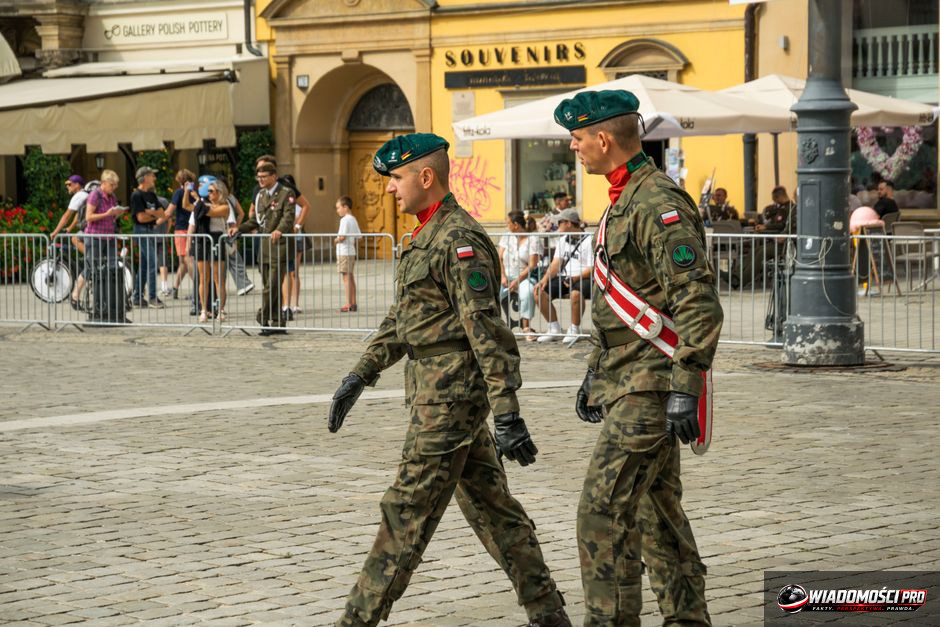
The Polish army is currently in a phase of hybrid transformation, rather than full operational readiness. Poland currently possesses two armored pillars – K2 Black Panther and M1A2 SEPv3 Abrams tanks – supported by Wisła anti-aircraft systems, which together account for a record 4.7% of GDP for defense in 2026. This structural change process is the result of an attempt to quickly replace the post-Soviet machine park with modern Western and Asian solutions, which necessitates a complete remodeling of military logistics.
A new era of the armored fist: K2 and Abrams in Warsaw
The Warsaw parade on August 15, 2026, revealed structural diversity that poses an unprecedented challenge for logisticians. Within the 18th Mechanized Division, responsible for operations on the so-called eastern flank, M1A2 SEPv3 Abrams heavy tanks have been deployed. In turn, the 16th Mechanized Division is successively receiving Korean K2 Black Panthers. Separating these platforms between key tactical units allows for faster saturation of units with modern equipment, but at the same time creates a barrier in the exchange of spare parts.
The K2 Black Panther features an automatic loading system, which reduces the crew to three soldiers and allows for firing at a rate impossible to achieve for manually loaded designs. Its hydropneumatic suspension allows for ground clearance modification, which in specific terrain conditions provides an advantage in firing from positions hidden behind hills. The Abrams, on the other hand, is a machine with a completely different philosophy. The M1A2 SEPv3 focuses on maximizing crew survival through multi-layer composite armor and active protection systems that integrate the sensor with the effector in real time.
The problem lies in managing the supply chain for two such different technologies. The military must maintain separate service lines, train separate cadres of mechanics, and manage different types of 120 mm ammunition. The Ministry of Defense has not yet publicly presented a full plan for the unification of technical maintenance for these units. It has not been confirmed whether, in conditions of a long-term, high-intensity conflict, Polish repair infrastructure will be able to maintain the combat readiness of both types of tanks simultaneously. Currently, these units operate based on separate logistics packages, and the lack of full information about the delivery rate of consumable components raises questions about the real availability of these machines in case of sudden need.
Multi-layered shield: Wisła and Narew in service
The construction of a multi-layered air defense is no longer based on individual batteries, but on an attempt to connect different systems into one organism using the IBCS battle management system. The Wisła system, using PAC-3 MSE missiles, constitutes the upper tier of this structure. Its high-resolution radars allow for tracking ballistic targets at distances exceeding 100 kilometers. It cooperates with the Narew system, based on CAMM-ER missiles with a range of up to 45 kilometers, which are tasked with eliminating lower-level threats, including helicopters and precision cruise missiles.
The physical presence of the units at the parade confirms that the implementation process has entered an operational phase, however, the effectiveness of this shield depends on full network-centric integration. The Ministry of National Defense has not published data confirming the extent to which IBCS radars exchange data with older, Polish-produced sensors. Without this full digital coherence, the Wisła and Narew systems may act as isolated islands, which significantly lowers their effectiveness in the face of a massive attack.
Paying a record 4.7% of GDP, the taxpayer has the right to expect transparency regarding the pace of implementing integration software. Currently, it is unknown whether all air defense units already possess certified data links that allow for the exchange of target information in milliseconds. Possessing missiles is just the beginning of the road to creating real sky protection. Without full interoperability between American control systems and Polish sensors, the army only possesses advanced tools that do not yet form a unified defense network.
Artillery: Krab, K9, and Himars as the foundation of strike capability
Artillery has become the backbone of modern firepower, combining Polish technical thought with Korean efficiency and American long-range precision. The 155 mm AHS Krab has proven its utility in combat operations, becoming the primary support tool for armored units. Its design, based on a proven chassis, allows for rapid positioning and counter-battery fire. Alongside the Krabs, Korean K9 Thunder howitzers operate within the 16th Mechanized Division, offering a high rate of fire, thereby supporting the ability to conduct intense fire in a short time.
Complementing these systems is the M142 HIMARS. The ability to strike targets at distances of up to 300 kilometers using ATACMS missiles shifts strike capabilities beyond the immediate front line, which is crucial for disrupting enemy logistics. However, possessing such advanced systems is a challenge for the battle management system. The Ministry of Defense has not specified the delivery schedule for full logistics packages for the HIMARS, which in the future may affect the maintenance of the technical efficiency of these launchers.
The issue of ammunition compatibility between Krabs and K9s has been resolved through NATO standardization, which is a significant logistical facilitation. Nevertheless, maintaining the operational readiness of these three different systems requires enormous financial outlays for maintenance and personnel training. It has not been confirmed so far how the army intends to optimize the operating costs of these three platforms over the next five years. Whether these systems will be able to operate together under one digital command, or whether their operation will require tedious coordination at the staff level – this is a question to which we will only know the answer during large-scale field exercises.
Logistical challenges: the price of modernity
Introducing such diverse equipment generates risks that cannot be eliminated by money alone. The variety of armored and artillery platforms means that the logistics command must manage many separate supply chains for spare parts. Each of these units requires dedicated technical facilities, and the lack of unification increases operating costs exponentially. The Ministry of Defense has not disclosed forecasts regarding future expenditures on servicing these systems, which makes it difficult to assess the long-term budgetary stability of the entire process.
A key problem remains the human factor. Modern BMS-class systems, i.e., battle management systems, require soldiers to have not only technical skills but also advanced knowledge in the field of digital data transmission. Training specialists capable of operating such complex equipment takes months, and often years. The Ministry has not published a schedule for full crew certification for both types of tanks, which raises reasonable doubts as to whether the equipment will sit in hangars due to a lack of qualified operators.
Investing in modernity is a process that goes beyond just purchasing subsequent units of equipment. It is also the necessity of rebuilding the entire organizational culture of the army. The transition from post-Soviet platforms to Western standards requires commanders to change their way of thinking about fire support and logistics. If the army does not integrate these systems into a coherent whole, a situation may arise in which we possess impressive firepower but are unable to fully utilize it in conditions of a dynamic conflict.
What this means for you
The modernization of the Polish Armed Forces is a process of transitioning from post-Soviet technology to Western and Asian standards. Soldiers benefit from this by receiving equipment with a higher class of protection and strike effectiveness, but the cost is a huge budgetary burden and the necessity of unifying command systems. The main challenge remains logistics, which, with such a large variety of equipment, could become a bottleneck in a crisis situation. For the citizen, this means a high cost of maintaining the army, the effectiveness of which will only be possible to assess after the full integration of BMS systems and the achievement of full proficiency by crews in operating these advanced machines.
Questions and answers
Is the Polish army already fully modern?
The modernization process is ongoing. The parade showed key components of the new armed forces, but full integration of all systems with the BMS battle management network will take several more years of intensive exercises and certification.
Why is Poland buying tanks from two different sources (USA and Korea)?
This results from the production limitations of individual manufacturers and the necessity of quickly filling equipment gaps after transferring older weaponry to allies. Purchasing from two sources accelerates the process of saturating the army with modern equipment.
What is the biggest challenge after the parade?
The biggest challenge remains creating a coherent and efficient logistics system for such a technically diverse machine park and fully training the personnel who will be able to utilize the digital potential of the purchased systems in combat conditions.



Komentarze (0)
Ładowanie komentarzy...