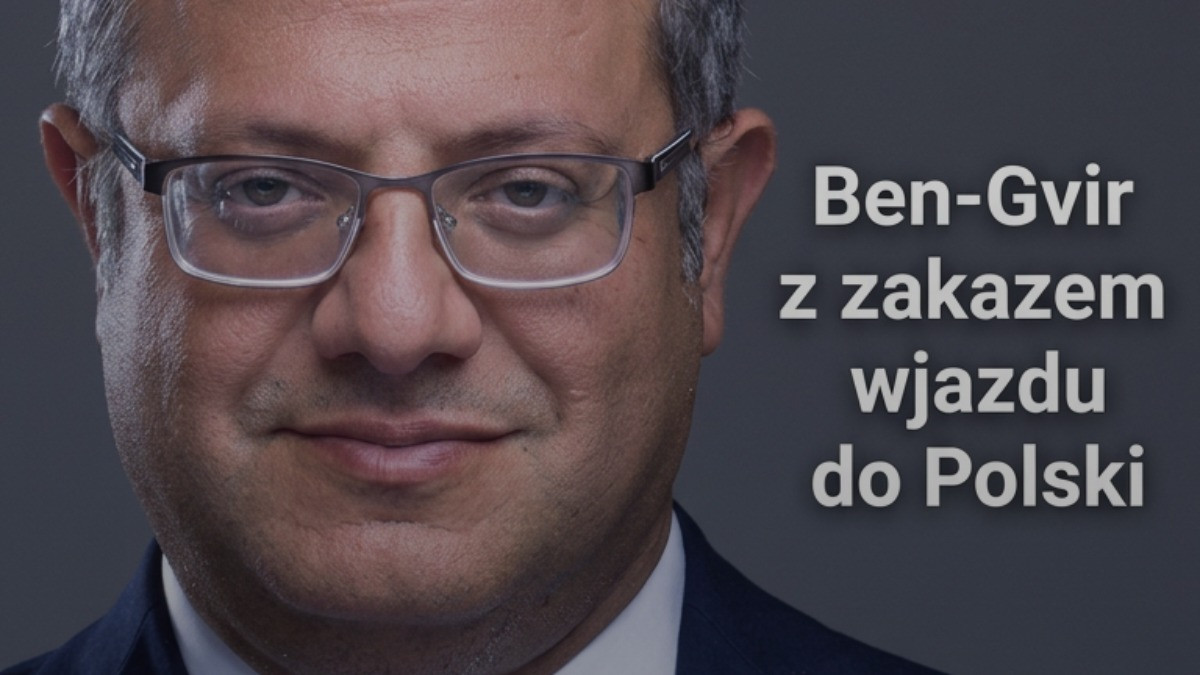
No, Itamar Ben-Gvir is not banned from entering Poland. In May 2026, media reported the imposition of a 5-year entry ban on the Israeli minister; however, the Israeli side now officially denies the existence of such a restriction. The discrepancy between the press dispatches from that time and the legal reality reveals a gap between the political signal sent by the Ministry of Foreign Affairs and the formal administrative procedure, which in this case was never fully implemented.
The mechanism of the May diplomatic crisis
On Thursday, May 21, 2026, the Polish information space was dominated by the topic of sanctions aimed at Israel. The direct cause was the detention of Polish citizens by Israeli services, which Radosław Sikorski deemed an unacceptable situation. Within just a few hours of the incident, media outlets such as Onet, RMF24, and WP Wiadomości began reporting on the decisive reaction of the head of Polish diplomacy.
All major national newsrooms, citing government sources, reported on the preparation of a request to ban the Israeli Minister of National Security, Itamar Ben-Gvir, from entering the country. The dynamics of events were extremely high. By the morning of the same day, services such as Polsat News and Interia Wydarzenia were publishing headlines suggesting that the restrictions had already come into effect. Specific numbers appeared – there was talk of a five-year ban, which was supposed to be a response to the "humiliation of Polish citizens."
It is worth looking at how information circulates during such heated moments. The media, based on the positions of politicians, created a narrative of a "fait accompli." Euronews, citing the situation in Poland, gave the matter an international dimension, specifying that the restriction was to remain in force for half a decade. At the same time, comparisons to France's actions appeared in the press. "Rzeczpospolita" reported on May 23, 2026, on analogous steps taken by Paris, which were supposed to be a response to the detention of activists from a flotilla heading to the Gaza Strip. In this way, an image of a coordinated action by European states against Ben-Gvir was formed in the eyes of public opinion.
Legal reality vs. media coverage
In the Polish legal system, imposing an entry ban on a foreigner, even if they are a representative of a foreign government, requires going through specific procedures. It is usually a multi-stage process involving the Ministry of Foreign Affairs, which directs a request to the appropriate services and then enters the foreigner into the Schengen Information System (SIS) or the national list of undesirable persons.
August 2026 brought a verification of these assumptions. The Israeli side, referring to the information about the ban repeated by the media, officially denied that any formal entry sanctions had been applied against Itamar Ben-Gvir. From a procedural perspective, if such a request was not effectively entered into border systems, it remains merely a political postulate. This means that, in the eyes of the law, Minister Ben-Gvir does not appear in Polish registers as a person banned from crossing the border.
The lack of traces in databases suggests that either the request never went beyond the phase of diplomatic declarations or it was extinguished before full implementation. Politicians often use the rhetoric of tough actions to calm public sentiment or exert pressure on a partner in negotiations. In this case, the declaration of an entry ban may have served as a "scare tactic" intended to force Israel to change its approach regarding the treatment of Polish citizens. Once the goal of releasing the Poles was achieved, the need to maintain sanctions – if they were ever of a legal nature – ceased to exist.
The diplomatic dance between Warsaw and Jerusalem
Polish-Israeli relations are burdened with many historical and current tensions. Every attempt to strike at a representative of the Netanyahu government, especially one as controversial as Ben-Gvir, is noted by both sides with great attention. On May 21, 2026, the Polish Ministry of Foreign Affairs decided on a move intended to show firmness. The media, reporting on these events, often outpaced reality, treating ministerial announcements as legally binding administrative decisions.
The French example, cited in the media as confirmation of a trend, also requires clarification. France's actions against Ben-Gvir after the flotilla incident had a different legal and political basis than the Polish postulate. Therefore, one cannot automatically assume that because one European country took specific steps, Poland automatically did the same to the same extent. The lack of confirmation from Israeli security agencies regarding any entry bans for Ben-Gvir to Poland puts an end to these speculations.
Why, then, does public opinion still live with the conviction that a ban exists? The answer lies in the power of media messaging. Press headlines from May 2026 were so unambiguous that subsequent denials or the silence of the Ministry of Foreign Affairs on the matter did not break into the mainstream with the same force. In political communication, an image of "punishing" a politician once planted is extremely difficult to remove, even if the facts point to something completely different. For the reader, this means that information from the first phase of the crisis became a "media truth" that has no reflection in the practice of border services.
Lack of evidence is also evidence
Analyzing the available source material, it is worth noting the lack of official statements from the Ministry of Foreign Affairs that would directly confirm the effectiveness of the ban in August 2026. The Ministry of Foreign Affairs usually provides very precise information about imposed sanctions if they are permanent. The silence from the Polish administration, contrasted with the open denial from the Israeli side, is the most telling commentary on this matter.
Unofficially, it is said that the entire procedure could have been halted at the stage of behind-the-scenes talks. In diplomacy, such solutions are standard – a tough stance is announced publicly, and a compromise is worked out behind closed doors that allows both sides to save face. Ben-Gvir, as a politician with radical views, is a figure whose presence in Poland could cause additional tensions, but that does not mean he received a formal "persona non grata" status.
For a citizen following media reports, it is crucial to distinguish between a political declaration and an administrative decision. In Polish law, an entry ban is a specific procedure, an entry into the system, and a decision that must be legally justified. If there is no entry in the SIS system, there is no ban. And all signs in heaven and on earth – including the position of the Israeli side – indicate that in the case of Minister Ben-Gvir, such a procedure was not finalized.
What does this mean for the news consumer?
Confronting the media image with reality is a lesson in critical news reading. In May 2026, we witnessed a phenomenon where diplomatic emotions took precedence over informational precision. Readers received a message about a "five-year ban," which became a symbol of Polish determination. However, when the dust settled, it turned out that the "tough consequences" were merely an element of a political game.
The conclusions are clear. Not every press report that circulates through all portals in one day must have a basis in legal reality. In international relations, where the stakes are high, the words of politicians often outpace the facts, and sometimes even replace them. The lack of confirmation of an entry ban for Itamar Ben-Gvir is not proof of the weakness of Polish diplomacy, but rather a testament to how complicated and opaque the processes that take place behind the closed doors of foreign ministries are.
Today, having a fuller picture of the situation, we can state that the May storm in a teacup was effective only in the context of an immediate goal – solving the problem of the detained Poles. After achieving this goal, the issue of an entry ban for the Israeli minister ceased to be important from the point of view of Polish national interest, which led to the silencing of the matter. Itamar Ben-Gvir can still theoretically apply for entry to Poland, and the lack of formal legal obstacles makes him a politician who, although persona non grata in rhetoric, is not one in light of Polish migration regulations.
Questions and answers
Did Itamar Ben-Gvir receive an official entry ban?
In May 2026, media reported the imposition of a 5-year entry ban, but currently, the Israeli side officially denies the existence of such a restriction, and there is no evidence in Polish systems of the politician being formally placed on a list of undesirable persons.
Who requested the entry ban for the minister?
The request to impose an entry ban on the Israeli Minister of National Security was initiated in May 2026 by the Polish Minister of Foreign Affairs, Radosław Sikorski.
Why did Poland want to impose the ban?
The ban was intended to be a direct response to the detention of Polish citizens by Israeli services and to express opposition to the treatment of Poles by the Israeli side.
Did France also impose a ban on Ben-Gvir?
Media reported on similar steps taken by France in connection with the incident involving the flotilla heading to the Gaza Strip, which was supposed to create a broader European front against the Israeli minister.
What is the current status of this matter?
The matter remains in limbo between the tough political rhetoric of May 2026 and the lack of real legal grounds in border systems, which suggests that the entry ban did not formally come into effect.
Sources
- The ban has come into effect. Israeli minister without the right to enter Poland - PolsatNews.pl
- Severe consequences for the Israeli minister. "There is no consent for the humiliation of Polish citizens" - Interia Wydarzenia
- Radosław Sikorski wants an entry ban to Poland for the Israeli minister. A request has been made - Wiadomości Onet
- Poland strikes at Netanyahu's government minister. Poles released after detention by Israel - Gazeta Prawna
- Poles to leave Israel. Sikorski wants an entry ban for the Israeli minister - RMF24
- Sikorski has made a decision. Israeli minister banned from entering Poland - WP Wiadomości
- Israeli Minister Itamar Ben-Gvir with a 5-year ban on entering Poland - Euronews.com
- France banned Ben-Gvir from entering after the detention of activists from a flotilla to Gaza - Rzeczpospolita



Komentarze (0)
Ładowanie komentarzy...