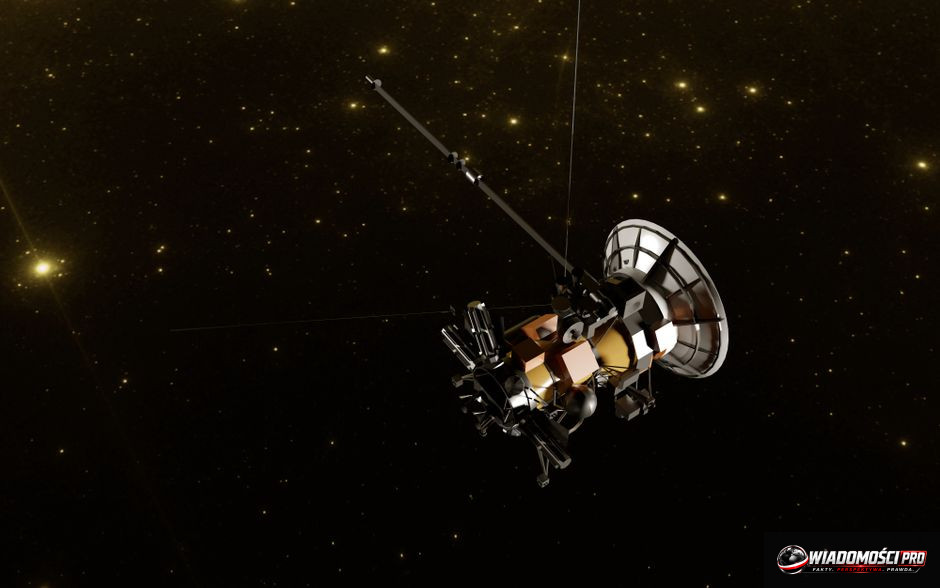
The Europa Clipper probe, launched in October 2024, is NASA's largest planetary probe, investigating conditions beneath Europa's icy shell. In December 2025, the device confirmed its operational readiness by capturing an image of comet 3I/Atlas during its journey toward the Jovian system. The mission does not conduct direct searches for living organisms, but focuses on analyzing environmental parameters that could enable their existence in the moon's deep, subsurface ocean.
The largest planetary probe in NASA history
The construction of Europa Clipper represents a pinnacle achievement in NASA's space engineering. Measuring over 30 meters in span with its solar panels deployed, this machine is the largest spacecraft designed by Americans for interplanetary research. This size is not due to a desire to break records, but rather the necessity of providing the equipment with a massive amount of energy. Europa is located in an area with significantly less sunlight than Earth, and the measurement systems require stable power for years of operation.
The heart of the probe is a suite of instruments designed to scan the icy shell and analyze the surface's chemical composition. A key tool is REASON, or Radar for Europa Assessment and Sounding: Ocean to Near-surface. This device uses very low-frequency radio waves to penetrate kilometers of ice and map its internal structure. Engineers hope to use it to detect pockets of water within the shell that could indicate geological activity. Meanwhile, MISE, or Mapping Imaging Spectrometer for Europa, handles the analysis of the surface's chemical composition. This spectrometer examines the distribution of ice, salts, organic compounds, and chemical substances that may be crucial for biological processes.
Managing such an advanced laboratory in space involves the necessity of protecting electronics from Jupiter's deadly radiation. The giant planet generates a powerful magnetic field that accelerates charged particles to relativistic speeds. To survive in this environment, the probe's heart is housed in a special, thick-walled vault made of titanium and aluminum. This protection aims to minimize the risk of degradation to the integrated circuits and onboard computer memory, which is a critical requirement for the success of a mission planned for a decade.
Why is Europa the key to discovering life?
Europa has been at the center of astrobiologists' attention for years due to the massive ocean of liquid water that, according to geophysical models, hides beneath a thick layer of icy crust. The amount of water in this reservoir exceeds the total resources of Earth's oceans. The existence of liquid water at such a great distance from the Sun is possible thanks to tidal processes caused by Jupiter's gravity. The moon's core is constantly being kneaded, which generates internal heat, preventing the entire reservoir from freezing.
However, scientists are not looking for the organisms themselves. Europa Clipper is to verify whether the environment of this ocean possesses the necessary building blocks of life, such as carbon, nitrogen, phosphorus, or sulfur, and whether there are sources of chemical energy there. The lack of a direct life detector stems from the fact that current technology does not allow for the unambiguous identification of biological processes from orbit. Instead, the probe studies surface chemistry, which may be the result of matter exchange between the ocean and the crust. If the mission confirms the presence of appropriate chemical gradients, Europa will become a priority target for future landers.
It is worth noting the skepticism of part of the scientific community. Even if Europa Clipper provides evidence of a chemical "soup" rich in organic compounds, it will not be equivalent to detecting life. Astrobiologists warn against so-called false positives, i.e., situations where inorganic processes mimic biological signatures. The probe is therefore a tool for studying habitability, or the potential of an environment to be inhabited, rather than for studying biology itself. This is a subtle but fundamental difference that shifts the focus from searching for "little green men" to understanding the limits of life's possibilities in harsh cosmic conditions.
First tests in deep space: Comet 3I/Atlas
December 2025 brought the first measurable operational success of the mission. Recording the image of comet 3I/Atlas was more for the mission team than just a check of camera sensitivity. It was a test of the integration of all imaging systems under conditions in which the probe will have to work during actual flybys over Europa. The image of the comet provided data on how the instruments handle contrast and tracking fast-moving objects against the black void.
This success allowed the team at the Jet Propulsion Laboratory to calibrate the image processing software. In the future, when the probe begins performing maneuvers near Jupiter, the time available to take high-quality photos will be counted in seconds. Each flyby of Europa will take place at tremendous speed, which forces precise operation of stabilization and spatial orientation systems. The test with comet 3I/Atlas proved that these mechanisms were not damaged during launch and the ongoing journey.
For operations engineers, this is also an important signal regarding communication. A signal sent from millions of kilometers away requires extreme precision in positioning the high-gain antenna. The registration of the comet confirmed that the communication systems are fully functional, and data transmission delays fall within the assumed technical parameters. This is a key stage, because during the actual research phase over Europa, the probe will have to send huge packets of spectrometric data, which will strain the bandwidth of the Deep Space Network.
Schedule and future of the Europa Clipper mission
The mission plan assumes a multi-year journey, during which the probe uses planetary gravity assists to gain speed and reach the Jovian system. The launch in October 2024 was just the beginning of a series of complex orbital maneuvers. After reaching the Jupiter system, the probe will enter a high orbit around the gas giant, from which it will perform multiple flybys near Europa. This method of research is safer than a permanent orbit around the moon because it limits the exposure time to the strongest radiation belts surrounding Jupiter.
During each of the scheduled research sessions, the instruments will work in an intensive mode. The REASON radar will map the thickness of the ice, and MISE will look for traces of organic compounds in places where the ice is youngest and most geologically active. This data will then be sent to Earth, where scientists will create three-dimensional maps of the moon's subsurface structure. This work will last for years, and each subsequent orbit will provide new information about the dynamics of this icy world.
The situation after 2025 is stable, but technological challenges remain real. Radiation near Jupiter is a factor that cannot be fully simulated on Earth. Every day of the instruments' operation in this harsh environment brings us closer to answering the question about the limits of biology. If the probe survives its expected service life, its data archive will become the foundation for astrobiology for decades to come. It is an investment in knowledge, the fruits of which will be harvested by future generations of researchers.
What this means for you
Confirming the existence of an ocean on Europa would be a paradigm shift in thinking about life. Until now, our knowledge of biology is based on one example — Earth. Finding an alternative, independent environment where conditions favor the chemistry of life would mean that the universe could be much more "alive" than we assumed. From the reader's point of view, this mission pushes the boundaries of our curiosity beyond the Earth-Mars system.
The catch, however, remains the cost and time. Billions of dollars spent on the project will not bring immediate answers. The probe will not send us a photo of an alien civilization, but rather charts of the chemical composition of ice that are boring to a layman. However, if it turns out that conditions exist in Europa's ocean in which life could arise, our entire philosophy regarding humanity's place in the cosmos will change. We will cease to be perceived as a unique case and will become part of a much broader, potentially common phenomenon, which is life in planetary systems. Skepticism, however, remains necessary — nature has shown many times that creating conditions for life is not the same as the birth of life itself.
Questions and answers
When will Europa Clipper reach its destination?
The probe launched in October 2024. The journey to the Jupiter system is spread over several years, during which the probe performs gravity assist maneuvers.
Is the probe searching for life directly?
No. The mission focuses on studying environmental parameters, such as the chemical composition of the surface and the structure of the icy crust, to assess whether the ocean beneath Europa's surface has the conditions to support life.
What makes this probe unique?
It is the largest planetary probe built by NASA. It has been equipped with specialized instruments, such as the REASON radar and MISE spectrometer, which are intended to allow for the study of the moon's deep structure in extremely difficult radiation conditions.
What was the purpose of registering comet 3I/Atlas in 2025?
It was a key operational test that allowed engineers to calibrate the probe's optical and communication systems in deep space conditions before reaching Jupiter.
Sources
- Start of the Europa Clipper mission to Europa - AstroNET – Polish Astronomical Portal
- Europa Clipper sails toward Jupiter's oceanic moon - Przystanek nauka
- Europa Clipper probe will search for life on Jupiter's moon, Europa - wszystkoconajwazniejsze.pl
- NASA launched its largest planetary probe. It will investigate whether there is life under the icy cover of Jupiter's moon - national-geographic.pl
- Comet 3I/Atlas captured by the probe searching for life. "Extremely valuable image" - Spider's Web
- This space watch pays tribute to a unique NASA mission. It looks like it was "grown" in a laboratory - Well.pl
- Does Europa hide life? NASA will send a probe to Jupiter's moon - Rzeczpospolita
- Europa Clipper - this is the name given to the mission to Jupiter's moon - Urania - Polish Astronomical Portal



Komentarze (0)
Ładowanie komentarzy...