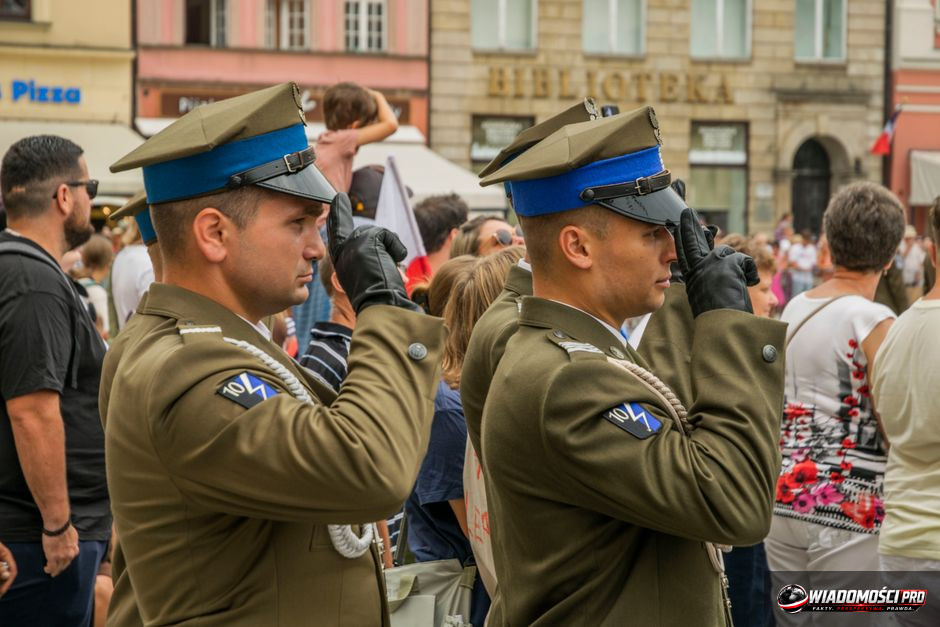
On the 87th anniversary of the aggression, analysts point out that while alliances are crucial, history teaches that a state's security must be based primarily on its own defensive readiness. This year's commemorations at Westerplatte serve as a brutal reminder of this truth. A similar message comes from the ceremonies organized in Wieluń, where some of the first bombs fell on September 1, 1939.
Westerplatte and Wieluń: Symbols of Polish resistance
On September 1, 2026, the nation's attention is focused on the places that became the scene of the first acts of aggression in 1939. Westerplatte, according to information provided by TVN24, is the central point of remembrance for the defenders of the post. Simultaneously, Wieluń, a city almost completely destroyed in the first hours of the war by the Luftwaffe, reminds us of the scale of terror that Poland had to face. The Museum of the Second World War in Gdańsk, as the main organizer of the state ceremonies, emphasizes these two points, making them the foundation of this year's narrative on national security.
The ritual of laying wreaths in 2026, however, has gained a new context. Political speeches have ceased to be merely historical retrospection. Today, Westerplatte serves as a brutal reminder of the lessons of 1939. Back then, Poland also had allies with whom it had security guarantees. Great Britain and France pledged their help, but at the moment of the attack, their reaction was limited to declaring war without taking real military action on the Western Front. This historical fact becomes a starting point for evaluating the current security architecture.
Wieluń, in turn, is a symbol of defenselessness against massed aerial aggression. In 2026, this comparison becomes disturbingly relevant. At that time, the lack of a sufficiently strong anti-aircraft defense led to the destruction of a civilian city. Today's discussion about defense spending and military modernization is not just a matter of foreign policy. It is a direct reference to the conclusions that were not sufficiently drawn in 1939. Trust in allies cannot be treated as an insurance policy that exempts the state from the obligation of having its own combat-capable army.
The role of institutions in preserving historical memory
The 87th-anniversary commemorations are not just political declarations. They are also the painstaking work of educational and archival institutions. Public administration and cultural institutions focus on the transmission of knowledge, treating historical awareness as an element of social resilience. But do digital archives and solemn academic ceremonies constitute a real barrier for an aggressor?
Institutions operate in specific areas:
- The Institute of National Remembrance, according to information from September 1, 2026, has intensified educational projects aimed at consolidating the image of September 1939. They focus on documenting the fates of civilian victims, which is intended to counteract the relativization of history.
- The Museum of the Second World War in Gdańsk has prepared an anniversary offer addressed to the young generation. The program is based on interactive exhibitions intended to show the mechanism of the collapse of statehood in 1939.
- The Public Information Bulletin of the Commissioner for Human Rights has published analyses regarding the legal and historical aspects of the aggression. These documents remind us of the lack of consequences for the aggressor after the outbreak of the war, which is cited as a warning against the weakness of international arbitration mechanisms.
This educational effort is necessary, but it can be a trap. The narrative of heroism often obscures the hard facts about the state of the country at that time. The memory of Wieluń or Westerplatte is a foundation of identity, but it cannot be a substitute for defensive readiness. The lesson from 1939 is unambiguous: allies can fail, and security depends on one's own potential. Museum exhibitions or official communiqués build morale, but they will not stop armored divisions. The state must rely on the strength it develops itself.
Wieliński: Have we learned the lessons of 1939?
Today's commemorations at Westerplatte and in Wieluń are a lesson in political pragmatism. Bartosz Wieliński, in his analysis published by Wyborcza.pl, asks about the durability of security guarantees in the face of contemporary geopolitical threats of 2026. The author points out that comparing the treaties of that time with current allied commitments is essential. In 1939, Poland had formal guarantees that proved useless at the moment of trial. Is the situation today, in 2026, diametrically different?
Analysts looking at the anniversary speeches point to a significant shift in emphasis. Although alliances remain the foundation of the security architecture, historical experience is ruthless. It teaches that external assurances, regardless of their formal status, will never replace one's own military potential. Wieluń and Westerplatte remind us that the price for an error in geopolitical judgment can be final.
Today, looking at the map of Europe, this warning is more relevant than ever. Politicians are eager to talk about collective defense, but it is one's own defensive readiness that constitutes the ultimate safety fuse. The history of 1939 teaches that trust in partners should go hand in hand with a cold calculation of one's own capabilities. This is the most important conclusion from the anniversary commemorations. Is the Polish state in 2026 ready for a scenario in which allies limit themselves only to words of condemnation, as was the case in 1939? This question dominates the sidelines of today's ceremonies.
The Polish Army and the anniversary: A modern approach to history
Wojsko-Polskie.pl, in its official statement for the 87th anniversary of the aggression, emphasizes that the army does not build its identity solely based on martyrology. This is a significant change in perspective. The commemorations are not just a tribute to those who fell in 1939, but a manifestation of strength intended to deter. The ministry combines the memory of the Westerplatte defenders with investments in equipment and training. This is a clear signal to a potential aggressor. The Polish army of 2026 wants to be perceived through the prism of modern capabilities, and not just through the prism of September 1939.
The local dimension of the anniversary is visible in Bardo, where the residents of the "City of Miracles" also paid tribute to the victims of the war. Such initiatives remind us that state security begins with civic awareness, and not solely with treaties signed in distant capitals. This, however, raises a dilemma. We have a modern army and a strong need for memory, but is faith in allied assurances alone sufficient?
On the 87th anniversary of the aggression, analysts point out that while alliances are crucial, history teaches that a state's security must be based primarily on its own defensive readiness. Relying solely on external guarantees would be a risky repetition of the mistakes that led to a national catastrophe eighty-seven years ago. The lesson from 1939 remains brutally relevant: we must be self-sufficient. Modernization of the army cannot be a process dependent on the political moods of our allies. It must be a permanent survival strategy, independent of election cycles.
History teaches us that in 1939, the hope for help from the West was the main factor that lulled the vigilance of the Polish elites. Today, although we live in a completely different alliance system than in the interwar period, the psychological mechanism remains similar. We believe that Article 5 of the North Atlantic Treaty is an absolute guarantee. However, in the history of international relations, there are no absolute guarantees. There are only interests, which in the face of a crisis can be re-evaluated.
That is precisely why it is so important that today's commemorations at Westerplatte do not become merely an empty ritual. They must be an opportunity for self-reflection on whether Polish defensive capabilities are proportional to the threats. In 1939, Poland had an army that was able to fight, but was not able to win a war on two fronts while lacking support from allies. Today the situation is different, but the challenge remains the same: possessing the strength that will make the cost of aggression against Poland unacceptable for any opponent.
The memory of September 1, 1939, is not just mourning. It is also a reckoning of conscience regarding what we have done to ensure that another aggression never becomes a fact. If our security is to be real, it must be based on hard data regarding the number of divisions, the efficiency of air defense systems, and the ability to mobilize independently. Allies are needed, but it is one's own army that is the only guarantor that cannot withdraw its commitments at the last minute.
What this means for you
This anniversary ceases to be just a memory of the past. It becomes an element of the debate on national security in 2026. Historians and educators have a field day, but the catch is the growing uncertainty regarding the durability of international alliances. For the citizen, this means the necessity of understanding that defense is not just budget expenditures, but above all the awareness that in extreme situations, no one will come to our aid as quickly as we would expect.
Questions and answers
Where are the most important 87th-anniversary commemorations taking place?
The main ceremonies are taking place at Westerplatte, in Wieluń, and in Gdańsk, where the organizer is the Museum of the Second World War.
Why is September 1, 1939, so important for Poland?
It is the date of the German Nazi aggression against the Republic of Poland, which started the Second World War and brought Poland enormous human and material losses.
Do alliances guarantee our security in 2026?
Publicists, such as Bartosz Wieliński, point out that in the face of the 87th anniversary, one should critically evaluate the durability of alliances and rely on one's own defensive readiness as the main pillar of security.
Sources
- 87th anniversary of the outbreak of WWII. Ceremonies at Westerplatte - TVN24
- Can we be sure of our allies? Wieliński on the anniversary of September 1 - Wyborcza.pl
- 87th anniversary of the outbreak of WWII – we invite you to the commemorations in Gdańsk - Museum of the Second World War in Gdańsk
- 87th anniversary of the outbreak of WWII - Institute of National Remembrance
- 87th anniversary of the outbreak of WWII - commemorations at Westerplatte and in Wieluń - dzieje.pl
- 87th anniversary of the outbreak of WWII - Public Information Bulletin of the Commissioner for Human Rights
- 87th anniversary of the outbreak of WWII - Wojsko-Polskie.pl
- September 1 – anniversary of the outbreak of WWII - Bardo - City of Miracles


Komentarze (0)
Ładowanie komentarzy...